Sourcing gas turbines and turbine parts from China
First decide whether you are buying a complete industrial gas turbine, a replacement part for an existing machine, or an aircraft-engine part. For replacements, make the engine configuration, drawing revision and engineering acceptance part of the order. The two industrial tariff lines below carry 0% duty and 20% import VAT; clearance does not prove a part is fit to install.
Buying from China for a business? How our UK China sourcing agent service works · China sourcing agent for small orders and first imports
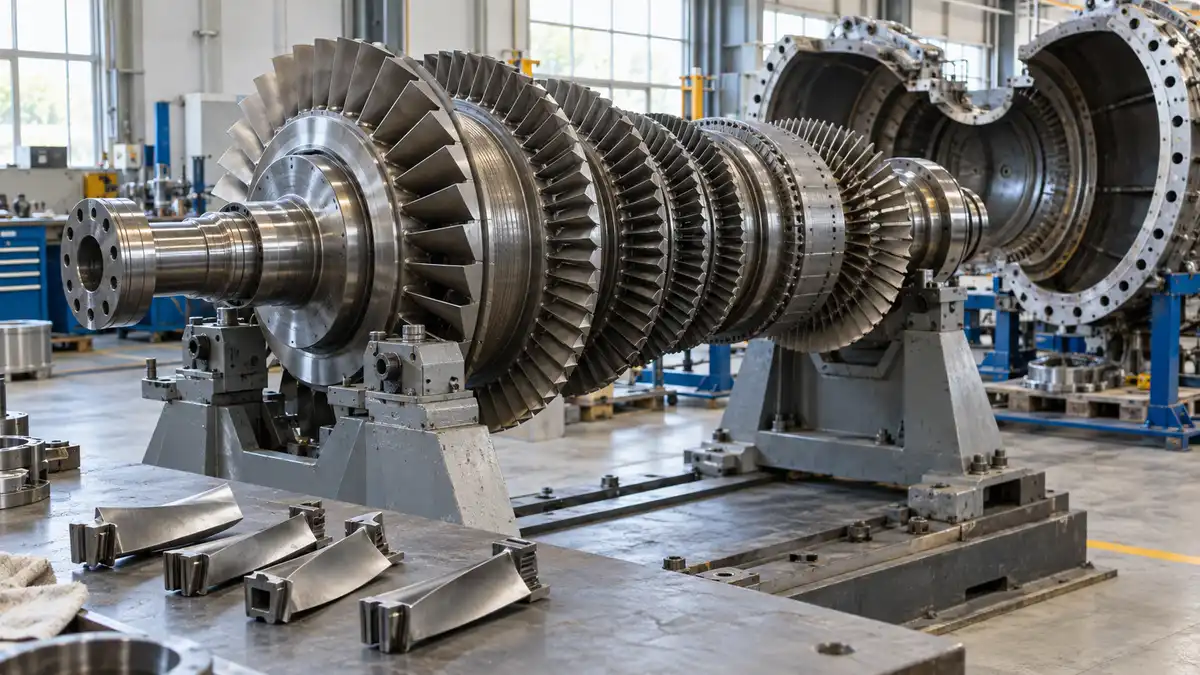
Start with the engine configuration, not a matching photograph
For a replacement blade, nozzle or ring segment, send the engine model, part number, drawing revision and intended position in the machine. State whether you require a new component or an approved repair. Ask your engineering authority to approve any proposed substitute before placing the order. For nozzle ring procurement, see our gas turbine nozzle ring sourcing guide. For vane procurement, see our gas turbine stator vane sourcing guide.
Make alloy, manufacturing route, heat treatment, coating, critical dimensions and inspection acceptance criteria explicit contractual requirements. Require traceability between each delivered part and its manufacturing and inspection records. A supplier's statement that a blade is 'equivalent' should trigger an engineering review, not automatic acceptance. Use the engineered-parts quality planning guide to organise approval responsibilities. For combustion chamber procurement, see our gas turbine combustion chamber sourcing guide.
Chinese manufacturing locations worth investigating
Wuxi's Huishan district is a documented starting point for turbine supply-chain research. Wuxi's state-owned assets authority reported that an AECC light gas-turbine industrialisation project was locating in Huishan, covering small and medium gas turbines, packaged units and lifecycle services.
Yixing is another documented blade-manufacturing location. Its government reported the opening of Siemens Gas Turbine Parts (Jiangsu) Co., Ltd. (西门子燃气轮机部件〔江苏〕有限公司), describing it as an important turbine-blade production base.
These are manufacturing leads, not evidence that the named companies accept independent replacement-part orders or approve a substitute for your engine. Ask which plant performs casting, machining, coating and final release, and identify every subcontracted operation in your factory audit brief.
Inspect the features that decide whether a blade can be accepted
GE Vernova's heavy-duty turbine maintenance guidance identifies cracking, corrosion pitting, rubbing and object damage among compressor-blade inspection concerns. It also calls for close examination of turbine wheel dovetail features for wear, galling, cracking and fretting. Use these OEM-specific examples to frame questions; obtain the acceptance limits for your own engine.
For blades and attachment features, request a dimensional report covering the drawing's critical interfaces and a nondestructive inspection report identifying the method, inspected areas and acceptance criteria. For used or repaired parts, request the service history, repair scope and approval records before discussing shipment.
For internally cooled blades, include cooling-channel geometry in the inspection plan. Published turbine-blade research identifies internal cooling channels as relevant to thermal performance and service life. Ask your engineer whether X-ray or CT evidence is required for the proposed design; do not assume a surface inspection covers internal geometry.
Put the required reports and rejection criteria in the product specification. Agree who can accept a deviation and prohibit shipment of a deviating part without that written decision.
Complete turbines: define what the acceptance test proves
Agree the fuel information and environmental information required from the packager. Your RFQ should state site conditions, fuel specification, required output, package boundaries and the guarantees to be tested. For steam-powered turbine packages, see our steam turbine sourcing guide. For the reverse route, see exporting steam and gas turbines to China. For micro turbine procurement, see our micro gas turbine engine sourcing guide. For turboshaft purchases, see our turboshaft engine sourcing guide.
Specify emission, noise and vibration checks, individual-component performance checks and protective-system checks separately where your project requires them; a performance-test report should not be treated as evidence for every aspect of the package.
Name the agreed standard editions, test conditions, correction method, instruments, witnessing arrangements and acceptance decision in the contract. Ask for the proposed test procedure before approving the order.
UK installation route: industrial machinery or aviation
For machinery supplied into Great Britain, the Supply of Machinery (Safety) Regulations 2008 remain the relevant machinery framework. OPSS guidance requires applicable safety requirements, conformity assessment, a declaration of conformity and the relevant marking; partly completed machinery instead needs assembly instructions and a declaration of incorporation. Agree whether your purchase is a complete machine or partly completed machinery, and who is responsible for the finished assembly. Northern Ireland has a separate application of the rules.
Aircraft-engine parts require a separate airworthiness decision. UK Part 21, point 21.A.307, sets the general installation conditions for parts in type-certified products: safe condition, required marking and an authorised release certificate, CAA Form 1, certifying conformity with approved design data. Defined exceptions exist. Have the UK maintenance or airworthiness organisation confirm the acceptable release route for the exact part before ordering. For the reverse trade route, see our guide to exporting aircraft engines to China from the UK. For complete turboprop purchases, see our turboprop engine sourcing guide.
A material report does not replace an aviation release document, and an aviation document does not replace industrial package acceptance. Review the applicable route using the UK certification guide.
Working out your own order? Send us the product on WhatsApp and we reply the same working day: WhatsApp us
UK duty: classify the actual item being shipped
The following selected industrial lines were read from the UK Trade Tariff on 3 October 2026. Both show an all-country third-country duty of 0.00% and standard VAT of 20.00%. Check the current measures applicable to Chinese origin before shipment. These are selected lines, not a classification of every turbine package or component.
Use 8411990099 only after ruling out more specific parts lines. In particular, 8411990045 has a detailed description for certain stationary-turbine ring segments and blades, including material, temperature and dimensional conditions. Do not classify a blade solely by the word 'blade', or automatically apply gas-turbine parts codes to turbocharger components. For water-powered turbines, see our hydro turbines and water wheels guide.
| Goods | Commodity code | Duty | Anti-dumping duty on China |
|---|---|---|---|
| Other gas turbines, power not exceeding 5,000 kW, 'Other' subheading | 8411810090 | 0% | Check current measures |
| Other parts of other gas turbines, residual 'Other' subheading | 8411990099 | 0% | Check current measures |
Worked landed-tax example and the purchasing brief
Hypothetical example, not a supplier quotation: industrial gas-turbine parts correctly classified under 8411990099 cost £40,000, with £1,500 freight and insurance to the UK border. Assume no other customs-value additions: customs value is £41,500 and duty is £41,500 × 0% = £0.
Assume a further £500 of handling and delivery expenses to the documented first UK destination, with no additional known-destination costs or other taxable additions. Import VAT value is £41,500 + £0 + £500 = £42,000. At 20%, import VAT is £8,400. The example's goods, transport, handling and import taxes total £50,400 before any VAT recovery. HMRC requires relevant destination expenses to be included even when customs duty is zero. See UK import duty and VAT calculations.
Before requesting a sourcing quotation, assemble the configuration and drawing pack, acceptance authority, required manufacturing records, inspection plan, installation route and delivery scope. For Cambridge China Bridge's machinery sourcing service, use that pack as the brief and ask for the proposed supplier and inspection scope to be set out in the quotation. For casing procurement, see our gas turbine casing sourcing guide.
Related help: our services.
Frequently asked questions
Does a factory in a turbine manufacturing cluster guarantee compatibility?
No. Treat the location as a research lead. Require approval of the exact configuration, drawing revision, manufacturing route and acceptance evidence for your machine.
How should noise, vibration and emissions be included in acceptance?
Specify separate procedures and acceptance limits where the project requires them, and confirm which checks the agreed performance-test procedure covers.
Is zero duty the same as a tax-free import?
No. The selected tariff lines show 20% standard import VAT. The hypothetical example produces £0 duty and £8,400 import VAT.
Sources
- Wuxi SASAC: AECC gas-turbine project in Huishan
- Yixing government: Siemens gas-turbine parts production base
- GE Vernova: heavy-duty gas-turbine maintenance guidance
- Research: turbine-blade geometry and internal cooling-channel inspection
- OPSS machinery guidance for Great Britain
- UK aviation Regulation 748/2012: revised legislation
- CAA: Part 21.A.307 installation eligibility
- UK Trade Tariff: 8411810090
- UK Trade Tariff: 8411990099
- UK Trade Tariff: specific blade and ring-segment line 8411990045
- HMRC: import VAT valuation