Sourcing rubber stable mats from China
Rubber stable mats within heading 4008 carry 2% UK duty from China across the listed lines, with no recorded trade remedies. Consumer products must be safe; confirm any applicable UK REACH checks for skin-contact rubber with HSE. Specify compound, thickness, drainage and wet grip. Cambridge China Bridge sources rubber stable mats.
Buying from China for a business? How our UK China sourcing agent service works · China sourcing agent for UK manufacturers and engineering firms
UK duty on rubber stable mats
Read from the UK Trade Tariff on 6 November 2026, heading 4008 covers plates, sheets, strip, rods and profile shapes of vulcanised rubber other than hard rubber. Its non-cellular floor coverings and mats line is the starting point for solid rubber stable mats. The table also shows sheet and profile materials that may accompany a flooring order; they are not interchangeable classifications for finished mats.
All listed lines carry 2% duty for goods from China. The supplied tariff record lists no anti-dumping or countervailing measures, suspensions or attached import controls. Import VAT is normally 20%; see UK import duty and VAT.
Confirm the material, cellular structure and finished form against the commodity code guide before ordering. For other rubber sheet, strip and profiles, see rubber sheet and matting.
| Goods | Commodity code | Duty | Anti-dumping or countervailing duty on China |
|---|---|---|---|
| Non-cellular rubber floor coverings and stable mats | 4008 21 10 00 | 2% | None |
| Cellular rubber sheet for cushioning layers | 4008 11 00 00 | 2% | None |
| Other non-cellular rubber sheet and strip | 4008 21 90 00 | 2% | None |
| Other non-cellular rubber profiles for edging | 4008 29 00 90 | 2% | None |
Compound, hoof grip and drainage
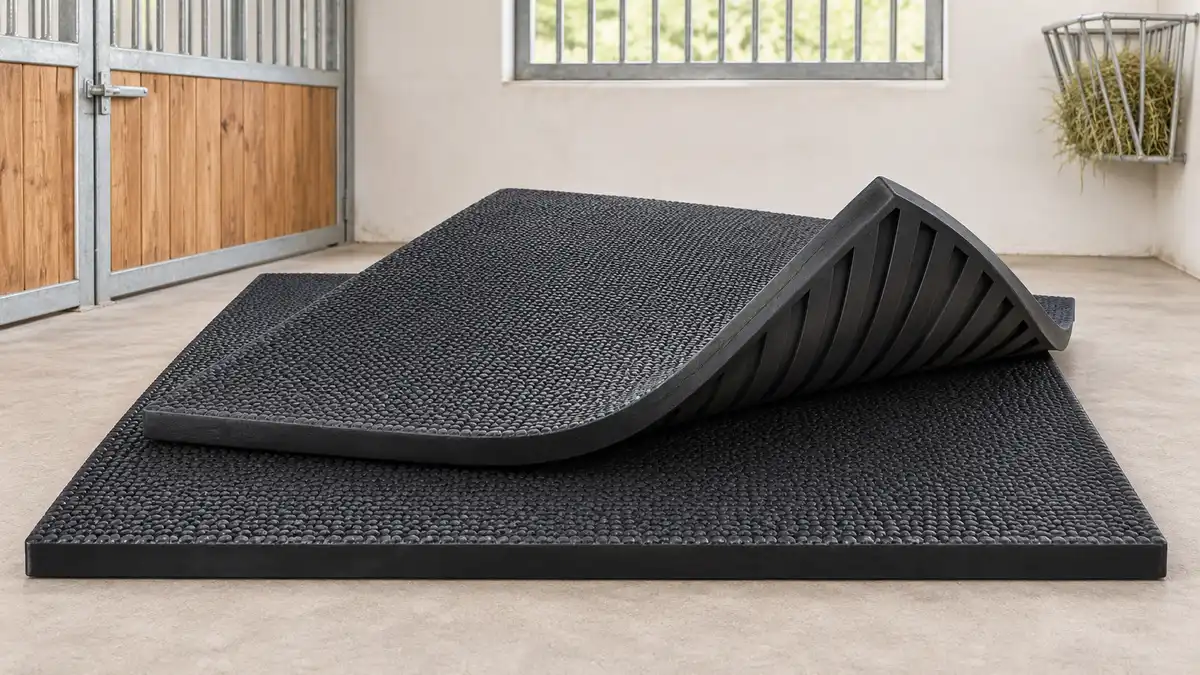
Specify whether the mat is solid vulcanised rubber or cellular rubber, the compound and recycled content, thickness and dimensional tolerances, weight, hardness, surface pattern and underside drainage channels. Agree whether edges are straight or interlocking and how mats meet doorways. Keep an approved sample and a drawing showing the installation layout.
Compare samples on the intended floor with bedding and the cleaning products used by the stable. Assess wet grip, rocking, edge lift and whether channels drain or trap liquid. Agree tests for hardness, tear strength and compression recovery rather than accepting a claim that the mat is suitable for horses.
If sold as a consumer product, the mat must meet consumer product safety requirements. For rubber parts intended for prolonged or repeated human skin contact, ask HSE to confirm whether the UK REACH PAH restrictions discussed in the wider rubber guide apply. Agree the relevant chemical testing with testing and certification support.
Worked duty example
Illustrative example, not a quote: Illustrative order: 20 tonnes of solid rubber stable mats under 4008 21 10 00, invoiced at £40,000 free on board, with £3,000 of freight and insurance to the UK. The customs value is £43,000. Duty at 2% is £860. Import VAT at 20% is charged on the customs value plus duty, £43,860, so it is £8,772. Import taxes total £9,632; a VAT-registered importer can usually reclaim the VAT, so the lasting cost is the £860 of duty. The import duty and VAT guide explains each step.
Inspection checklist
Dimensions and fit: measure thickness across sampled mats, check squareness and lay adjoining mats together to identify gaps, rocking or raised edges.
Compound and recovery: compare hardness, density and tear behaviour with the approved sample and test reports; check whether loaded areas recover after unloading.
Surface and drainage: inspect tread definition, underside channels, cracks, loose particles, oily bloom and odour; assess wet grip and drainage on a representative floor.
Packing and arrival: check batch identification, pallet stability and protection of edges; unpack arrival samples to look for curling, distortion or damage. Agree the sampling scope through quality inspection.
Working out your own order? Send us the product on WhatsApp and we reply the same working day: WhatsApp us
What goes wrong
A mat can match the drawing yet differ from the approved compound. Excess filler, inconsistent recycled material or poor curing can leave it brittle, strongly smelling or slow to recover. Thin areas and distorted edges can produce an uneven floor, while shallow underside channels can retain dirty water.
A textured surface alone does not demonstrate wet grip. Test production samples in the intended conditions and compare them with the approved sample before shipment. Keep batch records and photograph any arrival defects before installation so the supplier can investigate the affected production.
Cambridge China Bridge sources these products for UK businesses, checking the factory and the documents before shipment. See factory verification. For repeat volumes, see container programmes.
Frequently asked questions
What is the UK import duty on rubber stable mats from China?
The supplied tariff record shows 2% for every listed heading 4008 line, including non-cellular rubber floor coverings and mats, with no recorded anti-dumping or countervailing duty.
Which commodity code covers solid rubber stable mats?
4008 21 10 00 covers non-cellular rubber floor coverings and mats. Confirm that the actual material and finished construction fit this description before declaring the goods.
How do I check whether stable mats are slippery?
Assess production samples wet and dry on the intended floor, including the bedding and cleaning conditions. Compare results with the agreed acceptance criteria; tread appearance alone is insufficient.
What should I specify for recycled rubber stable mats?
Agree recycled content, compound, thickness tolerances, hardness, tear strength, recovery, odour acceptance, surface pattern and drainage. Match the test reports and production samples to the approved specification.