Sourcing extruded rubber profiles from China
Extruded vulcanised rubber profiles from China under heading 4008 carry a uniform 2% UK duty, with no trade remedies listed in the supplied tariff extract. For skin-contact applications, ask HSE to confirm whether UK REACH PAH limits apply. Specify the compound, section drawing and compression behaviour. Cambridge China Bridge sources extruded vulcanised rubber profiles.
Buying from China for a business? How our UK China sourcing agent service works · China sourcing agent for UK manufacturers and engineering firms
UK duty on extruded rubber profiles
Heading 4008 covers plates, sheets, strip, rods and profile shapes of vulcanised rubber other than hard rubber. For this guide, distinguish cellular profiles, solid profiles and flat extruded strips. The table includes strip lines because a flat section may be classified as strip rather than as a profile shape.
Read from the UK Trade Tariff on 1 October 2026, all the listed lines carried 2% duty for goods from China. The supplied extract lists no anti-dumping or countervailing duty, suspensions or attached import controls. This describes the tariff extract; chemical restrictions still need consideration for the intended application.
Give your broker the section drawing, compound details, cellular or solid construction and supplied form to confirm the commodity code. Finished gaskets and seals may fall under heading 4016, as explained in the reference guide. For related cellular strip products, see EPDM sponge rubber strips.
| Goods | Commodity code | Duty | Anti-dumping or countervailing duty on China |
|---|---|---|---|
| Cellular vulcanised rubber profiles | 4008 19 00 00 | 2% | None |
| Non-cellular vulcanised rubber profiles and rods | 4008 29 00 90 | 2% | None |
| Cellular vulcanised rubber flat strip | 4008 11 00 00 | 2% | None |
| Non-cellular vulcanised rubber flat strip, excluding flooring | 4008 21 90 00 | 2% | None |
Specify the section, compound and compression
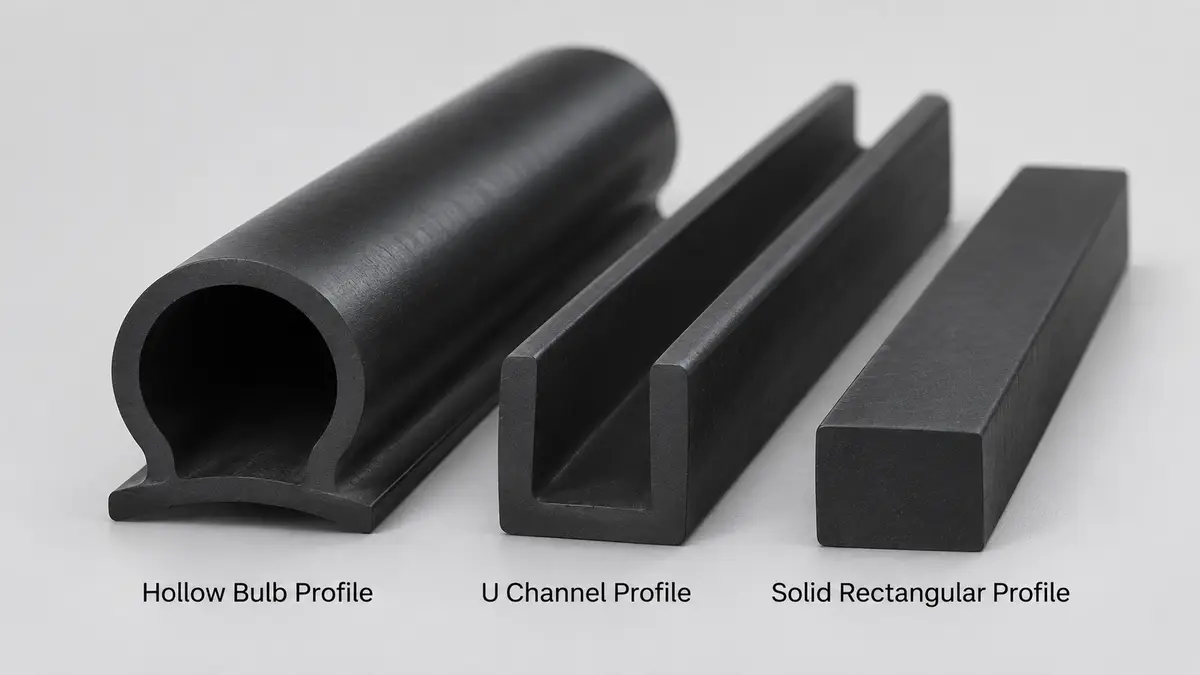
Supply a dimensioned cross-section drawing showing the base, lips, hollow chambers, wall thickness and mating groove. Agree dimensional tolerances, supplied lengths, permitted joints, colour and surface finish. Use an approved sample fitted into the actual channel to establish acceptable insertion force, retention and compression.
Specify EPDM for weather and ozone exposure or nitrile for oil exposure, as appropriate to the application. Agree hardness, tensile properties and compression set against the compound data sheet. For cellular profiles, also agree density and recovery after compression. State the service environment and the tests used to accept production.
UK REACH restrictions can limit, ban or set conditions on substances being placed on the market or used. For rubber parts with long or repeated skin contact, ask HSE to confirm whether the PAH restrictions in entry 50 apply. Request compound-specific evidence where relevant, using testing and certification support.
Worked duty example
Illustrative example, not a quote: Illustrative order: 2,000 metres of solid extruded rubber profile under 4008 29 00 90, invoiced at £5,000 free on board, with £860 of freight and insurance to the UK. The customs value is £5,860. Duty at 2% is £117.20. Import VAT at 20% is charged on the customs value plus duty, £5,977.20, so it is £1,195.44. Import taxes total £1,312.64; a VAT-registered importer can usually reclaim the VAT, so the lasting cost is the £117.20 of duty. The import duty and VAT guide explains each step.
Inspection checklist
Section: measure the base, lips, cavities and wall thickness against the drawing along sampled lengths, checking for twist and collapsed hollow sections.
Fit: install samples in the intended channel and check insertion, retention, corner behaviour and contact along the sealing face.
Compound: compare hardness, density and agreed resistance and compression tests with the approved data sheet and batch records.
Arrival: check supplied lengths, joints, cracks, surface bloom, flattening from packing and batch identification before releasing stock.
Working out your own order? Send us the product on WhatsApp and we reply the same working day: WhatsApp us
What goes wrong
A profile can match the outside dimensions yet fail because its lip is too stiff, its wall is too thin or its hollow chamber collapses. Stretching during installation can leave gaps after the rubber relaxes. Check fit without stretching the profile and compare compressed sections with the approved sample.
Compound substitution can cause cracking outdoors, swelling in oil or poor recovery after compression. Tight packing can leave distorted lips and flattened bulbs. Agree packing that protects the section, and investigate discrepancies through batch tests and retained samples before accepting the shipment.
Cambridge China Bridge sources these products for UK businesses, checking the factory and the documents before shipment. See factory verification. For repeat volumes, see container programmes.
Frequently asked questions
What is the UK import duty on extruded rubber profiles from China?
The supplied tariff extract shows 2% for the relevant heading 4008 lines, with no anti-dumping or countervailing duty, suspensions or attached import controls.
Which code covers solid extruded rubber profiles?
4008 29 00 90 is the supplied line for other non-cellular rubber shapes. Flat strip has a separate line. Confirm classification using the drawing, compound and supplied form.
How do I specify an extruded rubber profile?
Provide a section drawing, compound, hardness, tolerances, supplied lengths and service conditions. Agree a fitted sample and acceptance tests for compression, retention and recovery.
Do rubber profiles need PAH testing?
For rubber parts with long or repeated skin contact, ask HSE to confirm whether UK REACH entry 50 PAH limits apply. Match the evidence to the actual compound and intended use.