Sourcing dried konjac corms from China
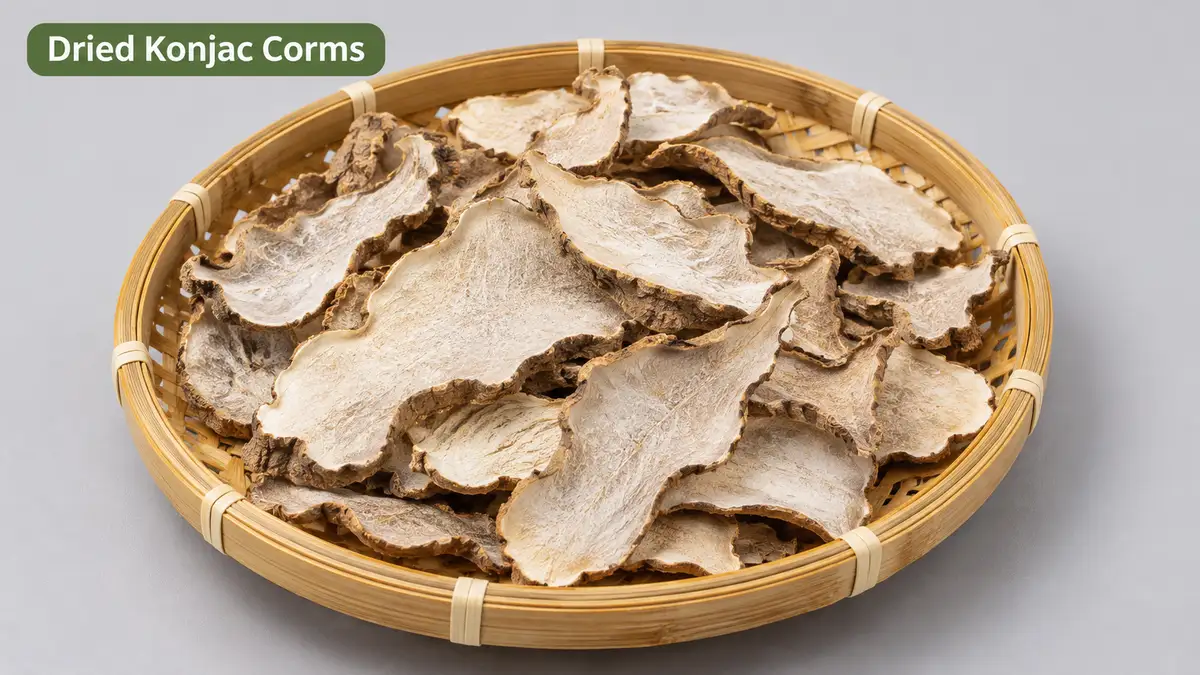
Dried konjac corms provisionally classified under 0714 90 90 00 carry 2% UK duty from China, with no recorded trade remedy or suspension. Food must meet general food safety requirements, and organic importers need UK certification. Cambridge China Bridge sources dried konjac corms.
Buying from China for a business? How our UK China sourcing agent service works · China sourcing agent for small orders and first imports
Duty and organic import control
Heading 0714 covers specified roots and tubers, including dried goods and slices. For dried konjac corms, use the supplied “other” line as a provisional classification for broker review. The table shows buying formats under the same candidate code, rather than separate tariff subdivisions. For the wider product family, see konjac glucomannan.
Read from the UK Trade Tariff on 4 October 2026, 0714 90 90 00 carries 2% duty for goods from China. The supplied record lists no anti-dumping or countervailing duty and no suspension for this line. It attaches import control of organic products.
Your business must be based and certified in the UK to import organic products. The certificate of inspection is issued by the exporter’s control body in the country of export. Confirm the attached organic control and consignment paperwork with your customs broker before shipment. Send the broker the botanical identity, drying process, product photographs and intended use to confirm the commodity code.
| Goods | Commodity code | Duty | Anti-dumping or countervailing duty on China |
|---|---|---|---|
| Whole dried konjac corms, provisional classification | 0714 90 90 00 | 2% | None |
Specify the corm, cut and drying process
State the botanical species, whole or sliced format, peeling condition, intended processing use and drying method. Agree moisture acceptance criteria and the measurement method, slice thickness, permitted broken pieces, colour and foreign matter limits. Ask the supplier to disclose any treatment or added substance. Keep an approved sample for comparison.
Food intended for human consumption must meet general food safety legal requirements. Request batch records and agree a laboratory testing plan for pesticide residues, contaminants and microbiological quality with your food safety adviser. Trial the material in your own milling or extraction process before approving bulk supply.
Do not assume drying alone resolves plant health questions. Official guidance includes simply prepared plant products within its scope. Ask your broker to confirm the position for the exact species and processing condition before dispatch.
Worked duty example
Illustrative example, not a quote: Illustrative order: 200 kg of dried konjac corm slices under 0714 90 90 00, invoiced at £1,580 free on board, with £1,350 of freight and insurance to the UK. The customs value is £2,930. Duty at 2% is £58.60. Import VAT at 20% is charged on the customs value plus duty, £2,988.60, so it is £597.72. Import taxes total £656.32; a VAT-registered importer can usually reclaim the VAT, so the lasting cost is the £58.60 of duty. The import duty and VAT guide explains each step. This assumes the goods are standard-rated for VAT. Most food for human consumption is zero-rated, and animal feed can be too, in which case no import VAT is due, so check the rate for your product in HMRC's VAT Notice 701/14.
Inspection checklist
Identity and cut: compare sampled corms or slices with the approved sample, botanical declaration, peeling condition and agreed dimensions.
Dryness and condition: measure moisture using the agreed method; check internal pieces for dampness, mould, insect damage and unusual odours.
Foreign matter and weight: inspect for soil, stones, fibres and packaging fragments; check net weights and the proportion of fines.
Packing and records: check liner seals and signs of water ingress; match package lot codes to production records and test reports. Use quality inspection to document acceptance.
Working out your own order? Send us the product on WhatsApp and we reply the same working day: WhatsApp us
What goes wrong
Uneven drying can leave damp centres that are missed when only the surface is checked. Thin slices can break into fines during handling, while poorly sealed liners allow moisture back into the material. Inspect samples from different packages and compare arrival condition with the dispatch records.
A description such as “konjac” leaves room for confusion between dried corms, milled material and extracted glucomannan. Put the supplied form and processing history on the purchase specification, invoice and packing list. Hold questionable batches for assessment rather than mixing them into accepted stock.
Cambridge China Bridge sources these products for UK businesses, checking the factory and the documents before shipment. See factory verification. For repeat volumes, see container programmes.
Frequently asked questions
What is the UK import duty on dried konjac corms from China?
The supplied tariff record gives 2% for 0714 90 90 00, with no trade remedy or suspension. Confirm that this provisional code fits your dried corms.
Can I import organic dried konjac corms?
Your business must be based and certified in the UK to import organic products. Confirm the tariff’s organic control and consignment inspection paperwork with your broker before shipment.
Do dried konjac corms need a phytosanitary certificate?
Confirm this for the botanical species and processing condition with your broker before shipment. Drying alone should not be treated as proof of exemption.
What should I check when dried konjac corms arrive?
Check identity, moisture, mould, insect damage, foreign matter, cut consistency, fines, net weight and liner seals. Match the lot codes to the production records and test reports.