Sourcing dried forage maize from China
Dried forage maize provisionally classified as other forage carries 0% duty from China; the wider heading ranges from 0% to 4%. Feed importers need registration or approval, and organic imports require a certified business. Confirm the product and import route before ordering. Cambridge China Bridge sources dried forage maize.
Buying from China for a business? How our UK China sourcing agent service works · China sourcing agent for small orders and first imports
Zero duty on the other-forage line
Read from the UK Trade Tariff on 29 September 2026, heading 1214 covers forage products, including pellets. The other-forage line, 1214 90 90 90, carries 0% duty from China, with no recorded anti-dumping or countervailing duty and no suspension. The table shows possible maize supply forms using that same provisional line, rather than separate tariff subdivisions.
The tariff attaches an organic-products import control to this line. An approved UK control body must certify a business importing organic products. Ask that body and your customs broker to confirm the inspection certificate and clearance documents for Chinese organic forage. The separate hay line carries an import prohibition: ask your broker to confirm whether that control affects the proposed goods.
Give your broker the plant parts, composition, drying process, physical form and intended feed use to confirm the commodity code. Do not classify by the supplier's product name alone. See the wider forage guide for the rest of the heading.
| Goods | Commodity code | Duty | Anti-dumping or countervailing duty on China |
|---|---|---|---|
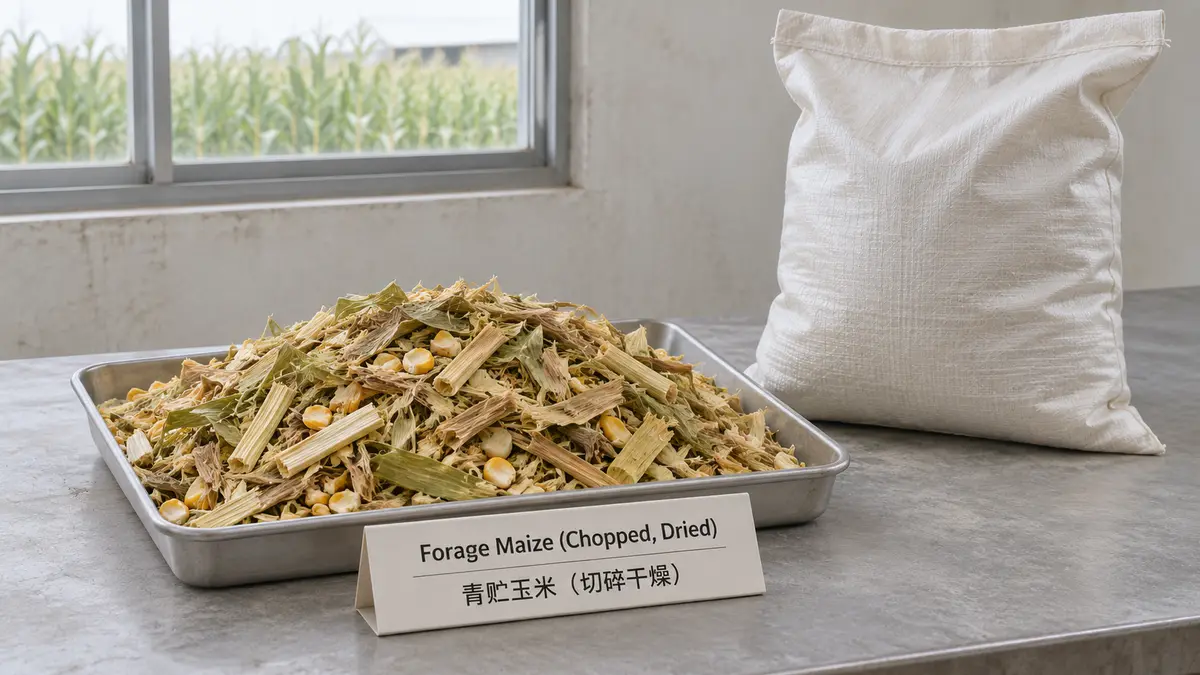
| Dried forage maize, chopped, subject to classification confirmation | 1214 90 90 90 | 0% | None |
Specify the maize plant material and drying
State whether the material is whole-crop maize or selected stalks and leaves, and describe any grain content. Agree chopped, baled, ground or pellet form, particle size, moisture, dry matter, starch, fibre, ash and acceptable foreign matter. Ask the supplier to declare additives and provide a representative sample with the test methods.
Feed-hygiene rules require most feed businesses, including importers, to be approved or registered with their competent authority. Settle your business's status before trading. For the purchase specification, agree batch identification, sampling, retained samples and which laboratory results will determine acceptance.
Worked duty example
Illustrative example, not a quote: Illustrative order only: 20 tonnes of chopped dried forage maize, subject to classification confirmation under 1214 90 90 90, invoiced at £2,500 free on board, with £2,500 of freight and insurance to the UK. The customs value is £5,000. Duty at 0% is £0. Import VAT at 20% is charged on the customs value plus duty, £5,000, so it is £1,000. With no duty, the only import tax is the VAT, which a VAT-registered importer can usually reclaim. The import duty and VAT guide explains each step. This assumes the goods are standard-rated for VAT. Most food for human consumption is zero-rated, and animal feed can be too, in which case no import VAT is due, so check the rate for your product in HMRC's VAT Notice 701/14.
Inspection checklist
Identity: compare stalk, leaf and grain content with the agreed sample; check for substituted straw, other forage or undeclared ingredients.
Condition: sample moisture through the load; inspect for mould, musty smells, insects, damp pockets and signs of heating.
Feed value: compare dry matter, starch, fibre and ash results with the contract; arrange mycotoxin testing appropriate to the maize material.
Packing and records: check bale ties or bag seals, water damage, batch marks and matching laboratory reports. Use the inspection guide to agree sampling before dispatch.
Working out your own order? Send us the product on WhatsApp and we reply the same working day: WhatsApp us
What goes wrong
A sample rich in grain can conceal a shipment dominated by stalks, changing its feed value. Excessive fines affect handling, while soil contamination raises ash. Uneven drying leaves damp material inside apparently dry bales or bags, creating a risk of mould and heating.
Another failure is treating a supplier's description or a zero duty rate as confirmation that the shipment can enter Great Britain. Resolve the forage-versus-hay classification and organic paperwork before loading. On arrival, keep suspect batches separate while you compare samples and reports with the agreed acceptance criteria.
Cambridge China Bridge sources these products for UK businesses, checking the factory and the documents before shipment. See factory verification. For repeat volumes, see container programmes.
Frequently asked questions
What is the UK import duty on dried forage maize from China?
The supplied tariff snapshot shows 0% on 1214 90 90 90, the provisional other-forage line, with no recorded trade remedy. Confirm that classification for the actual goods.
Can dried forage maize from China enter Great Britain?
Confirm the exact product and route with your customs broker before ordering. The supplied snapshot attaches an organic control to other forage and an import prohibition to the separate hay line.
Do I need to register to import forage maize as feed?
Confirm the status required for your activities.
What should I test in dried forage maize?
Agree moisture, dry matter, starch, fibre, ash and foreign matter checks. Arrange appropriate mycotoxin testing and link representative samples and laboratory reports to the delivered batch.