Sourcing car boot organisers from China
Car boot organisers from China have candidate UK duty rates of 2% to 8% under heading 4202, depending on the outer surface and classification. Consumer products sold in Great Britain must be safe. Specify the base, dividers and carrying load before approving samples. Cambridge China Bridge sources car boot organisers.
Buying from China for a business? How our UK China sourcing agent service works · China sourcing agent for small orders and first imports
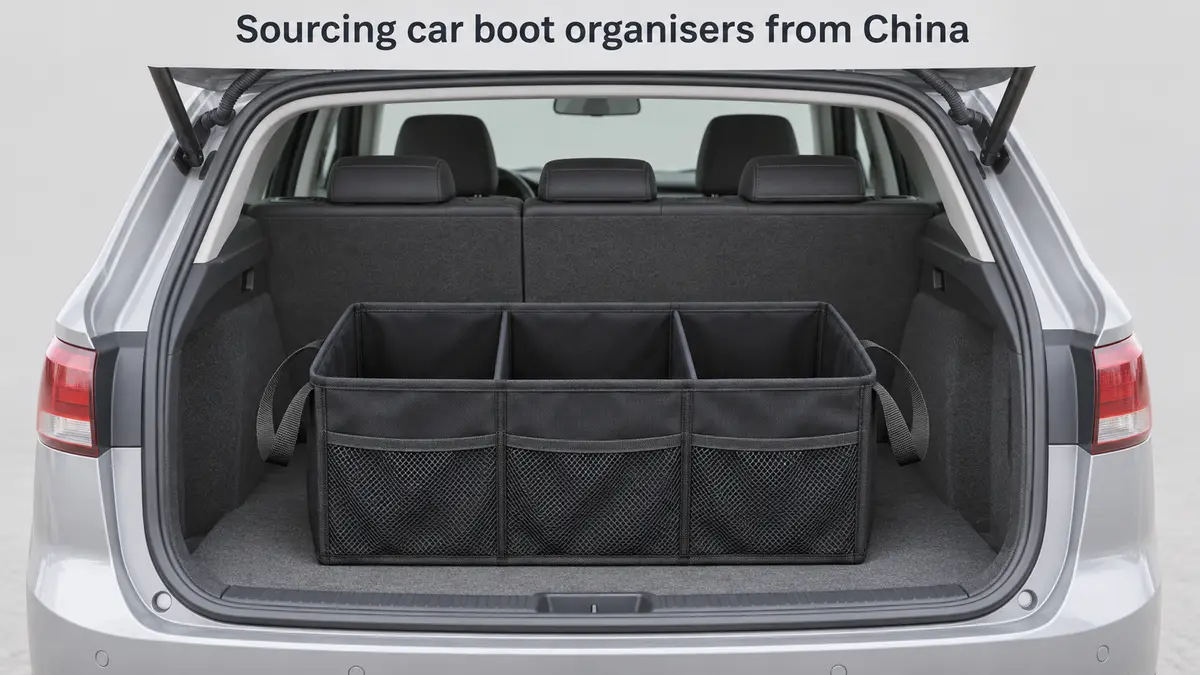
Outer surface and construction determine the candidate code
Heading 4202 covers bags and similar containers. The table selects candidate lines for bag-like car boot organisers, subject to confirmation from the finished design. Read from the UK Trade Tariff on 28 October 2026, these lines show 2% duty for textile, leather or composition leather outer surfaces and 8% for plastic sheeting on goods from China. They show no anti-dumping or countervailing duty and no suspensions. Import VAT is 20%.
The tariff attaches CITES import and export controls to the textile and leather lines, plus cat and dog fur and seal product controls to the leather line. CITES-listed skins need valid permission. Cat and dog fur products are banned from import. Seal products face a ban with limited exceptions. For an organiser from China containing animal materials, identify the species and have your customs broker confirm admissibility and the required documents before ordering.
Send photographs, an assembled sample and the outer material specification, including coatings, to your broker to confirm the commodity code. Do not select a code from the lining or the supplier's product name. These candidates concern bag-like containers; a different construction needs a fresh classification check. For the wider heading, see cosmetic bags, tool bags and pouches.
| Goods | Commodity code | Duty | Anti-dumping or countervailing duty on China |
|---|---|---|---|
| Other containers, textile outer surface, other than hand-made | 4202 92 98 90 | 2% | None |
| Other containers, textile outer surface, hand-made | 4202 92 98 10 | 2% | None |
| Other containers, plastic sheeting outer surface | 4202 92 19 00 | 8% | None |
| Other containers, leather or composition leather outer surface, not hand-made | 4202 91 80 90 | 2% | None |
Specify the folding base, dividers and boot fit
Give the factory the intended boot space and usable internal dimensions with the base and dividers installed. Specify outer fabric, coating, lining, base insert material, divider attachment, handle reinforcement and the folded form. Say whether the organiser is carried while loaded or stays in the boot. Agree the carrying load and test method using the intended contents.
Consumer organisers sold in Great Britain must be safe under the General Product Safety Regulations 2005. Keep the approved sample and test records. Assess sharp insert edges, exposed fittings and handle failure when loaded. Agree cleaning instructions and check whether the base insert can be removed before washing. Treat anti-slip backing as a feature to test on the intended boot lining.
Worked duty example
Illustrative example, not a quote: 300 textile car boot organisers; illustrative order, not a quotation under 4202 92 98 90, invoiced at £3,450 free on board, with £420 of freight and insurance to the UK. The customs value is £3,870. Duty at 2% is £77.40. Import VAT at 20% is charged on the customs value plus duty, £3,947.40, so it is £789.48. Import taxes total £866.88; a VAT-registered importer can usually reclaim the VAT, so the lasting cost is the £77.40 of duty. The import duty and VAT guide explains each step.
Inspection checklist
Materials: compare the outer surface, coating, lining and base insert with the approved sample; check for substitution, peeling, persistent odour and colour transfer.
Loaded structure: fill to the agreed load, lift by the intended handles and check seams, anchors, base sagging and divider detachment.
Boot fit: open and fold the organiser, fit it in the intended space and check that pockets remain usable and the backing grips the agreed lining.
Arrival condition: check damp cartons, mould, crushed inserts, missing dividers and exposed stiffener edges. Photograph defects and retain affected packaging; see quality inspection.
Working out your own order? Send us the product on WhatsApp and we reply the same working day: WhatsApp us
What goes wrong
A sample may stand upright empty but collapse when loaded. Thinner base inserts can bow, divider fastenings can peel away and handles can pull through the side panels. Approve the assembled organiser with representative contents, then repeat those checks on production goods.
A water-resistant outer fabric can still leak through stitched seams, and anti-slip backing may grip one boot lining but slide on another. Agree how to test spills, cleaning and grip before production. Do not repeat a supplier's crash-safety claim without evidence for the finished design.
Cambridge China Bridge sources these products for UK businesses, checking the factory and the documents before shipment. See factory verification. For own-brand ranges, see sourcing for brands.
Frequently asked questions
What is the UK import duty on car boot organisers from China?
The selected candidate lines show 2% for textile, leather or composition leather outer surfaces and 8% for plastic sheeting, with no anti-dumping or countervailing duty or suspensions. Import VAT is 20%.
Which commodity code applies to a fabric boot organiser?
4202 92 98 90 is a candidate for a textile-surfaced bag-like organiser other than hand-made. Ask your broker to confirm it from the finished design and outer material.
Does a fabric boot organiser need a CITES permit?
The tariff attaches a CITES control to the textile lines. Confirm the materials and species with your broker; ordinary fabric alone does not establish a need for a species permit.
How should I test a folding boot organiser?
Fit the base and dividers, load it with representative contents, carry it by the intended handles and check sagging, stitching and fastenings. Test grip on the intended boot lining.