How to check electrical cord anchorage
Have a competent electrical safety specialist agree a product-specific pull-and-twist plan before testing production samples. Mark and measure cord movement, inspect terminal strain and check for damage afterwards. Hold shipment until failures are resolved. For checks with its own staff in China, contact Cambridge China Bridge.
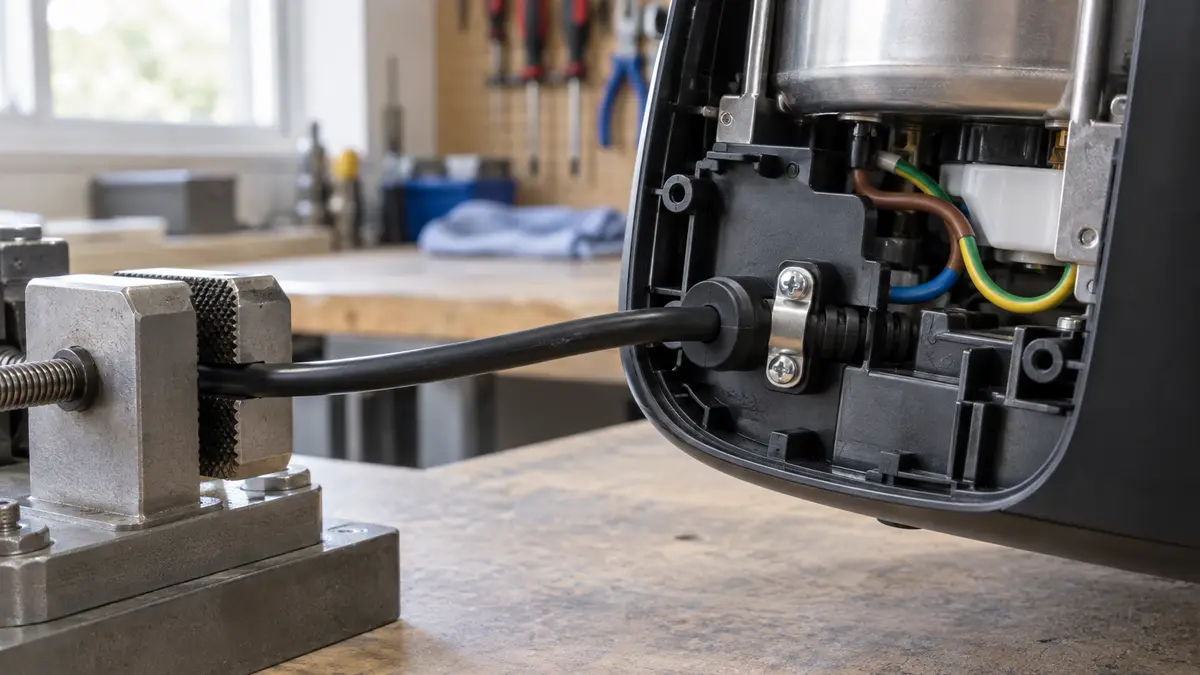
Define the check before choosing samples
Cord anchorage secures the supply lead where it enters the product. A government safety report describes a loose supply cord placing strain on internal connections and potentially exposing live parts. Checking whether the product still switches on does not reveal all of these problems.
This guide covers the mechanical check before shipment. Use our electrical import guide for the wider rules and our inspection guide for selecting production samples. Record the model, batch, cord construction, anchorage parts and assembly revision so the results identify exactly what was tested.
Agree a competent, product-specific test plan
Ask a competent electrical safety specialist or laboratory to identify the applicable product standard, edition and clauses, then issue a written procedure. Have them specify pull force, torque, loading directions, duration, repetitions, sequence, conditioning, fixture arrangement and acceptance limits. Do not borrow settings from a different appliance or replace controlled loading with a hand tug.
Agree which cord and anchorage variants need testing, how samples will be selected and whether tested units must be withheld from sale. Name the operator and reviewer. Confirm equipment calibration and a fixture that holds the product without reinforcing its anchorage. Keep it disconnected from power during mechanical testing, with any stored energy made safe.
Mark movement and record the loading
Before loading, place a clear reference mark on the cord sheath beside a fixed housing reference, as specified in the procedure. Add an orientation mark where needed to reveal rotation. Photograph the marks with a scale and record their starting positions. Use marks that do not damage the sheath, alter the grip or obscure existing defects.
Apply the agreed pull and torque through the specified fixture. Record actual settings, loading sequence, sample identity and observations. Compare the reference positions at the stages required by the plan and after unloading. Measure displacement and rotation rather than writing only 'no movement'. Compare results with the specialist's agreed limits; do not assume that any visible movement automatically means failure.
Inspect terminal strain and damage afterwards
Have the competent tester inspect internal connections using the agreed access method, without disturbing the anchorage before movement readings are complete. Compare with baseline photographs. Look for conductors pulled tight, displaced terminal entries, loosened connections, broken strands and disturbed earth connections. Do not tighten terminals or reposition wires before recording the findings.
Inspect the sheath, insulation, clamp, screws, cord entry and housing for cuts, crushing, abrasion, cracks or loosening. Check whether movement has brought wiring against sharp edges or damaged internal parts. Ask the specialist to assess affected insulation and electrical spacings, and specify any follow-up electrical safety tests. A successful power-on check cannot establish that the assembly remains safe.
Working out your own order? Send us the product on WhatsApp and we reply the same working day: WhatsApp us
Make shipment release depend on the evidence
Ask for a report containing the approved procedure, sample traceability, equipment details, actual settings, movement readings, before-and-after photographs, internal findings and the reviewer's decision. Check that the tested construction matches production. Our test report verification guide explains how to check report identity and coverage.
For a failed or inconclusive result, hold the affected stock and ask for the cause, corrective action and its batch scope. Have the specialist agree retesting and any broader checks before release. Keep tested units separately identified until their disposition is agreed. Cambridge China Bridge's own staff in China can coordinate factory access and inspection evidence, with specialist testing arranged where needed.
Frequently asked questions
What pull force should I use for cord anchorage?
Ask a competent electrical safety specialist to set the force and torque from the applicable product standard and construction. Put the settings and acceptance limits in writing before testing.
Is pulling the cable by hand enough?
A hand tug cannot demonstrate controlled force, torque or duration. Use the agreed fixture and calibrated equipment, and record the actual loading.
How do I measure cord movement?
Mark the sheath against a fixed housing reference before loading. Photograph and measure the starting and final positions, including rotation where relevant, then compare them with the agreed limits.
Can I ship if the appliance still works after testing?
Working afterwards does not establish safety. Review cord movement, terminal strain and damage, complete any specialist follow-up tests and resolve failures before releasing the affected stock.