How to check imported charger safety
A successful charging trial does not establish protection against electric shock or fire. Commission a competent electrical safety review of the exact charger and supplied power adaptor, with internal measurements and relevant laboratory tests. Factory evidence can be coordinated by Cambridge China Bridge.
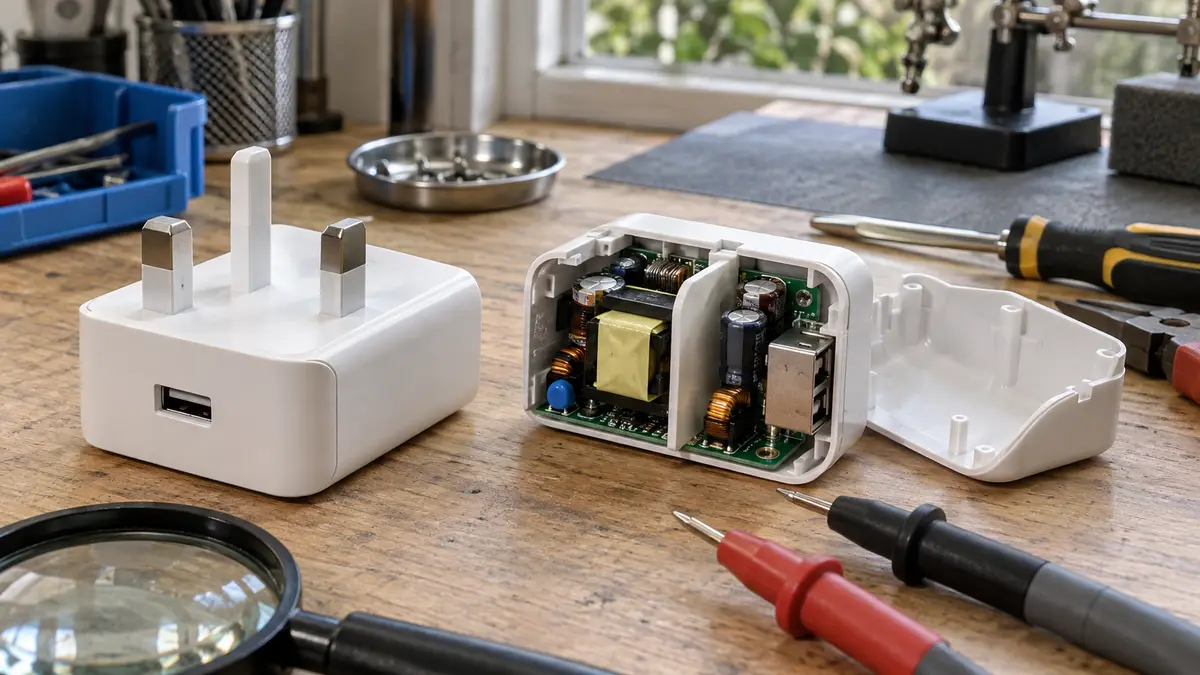
Start with the hazards a charging trial misses
The OPSS wireless charger report links poor plug contact with the socket to overheating and fire. A separate Niluoya charger recall identifies poor insulation and inadequate creepage and clearance as an electric-shock risk. These findings explain why charging a phone successfully is an incomplete purchasing check.
Assess the supplied mains adaptor as well as the charging device. Record the intended use, supply arrangement and accessories. Our markings and certification guide explains the paperwork distinctions; this guide focuses on evidence about the internal construction.
Brief a reviewer who understands charger construction
Appoint an electrical safety laboratory or engineer with relevant charger assessment experience. Ask them to explain the applicable assessment standard, its edition, the insulation arrangement and the tests needed for this configuration. Treat these as questions for the reviewer, rather than choosing a generic spacing limit yourself.
Provide production-representative samples, circuit diagrams, board layouts, transformer construction details, insulation material specifications and the component list. Identify the factory, model and design revision. Ask the reviewer to photograph the opened sample and record any missing information that prevents a conclusion. Leave dismantling and hazardous electrical tests to the specialist.
Ask for measured insulation evidence
Creepage is the shortest path along an insulating surface between conductive parts; clearance is the shortest distance through air. Ask the reviewer to map the separation between mains circuitry, accessible parts and the output circuit, including paths around the transformer, board slots, component leads and wiring.
Request the measured path, annotated photograph, applicable criterion and assessment result for each critical location. Ask how working voltage, insulation type, material properties and expected conditions affect the chosen criteria. Have the reviewer examine insulation barriers, transformer winding separation and wire routing. Photographs alone cannot establish material properties or dielectric performance.
Combine construction review with laboratory tests
Ask the reviewer to propose electric strength, insulation resistance, touch-current, temperature-rise and abnormal-operation tests where relevant. The report should explain the conditions, equipment, results and limits used. A successful charging trial answers a functional question; it does not replace this assessment.
Include plug construction and socket contact, protective components, internal connections and enclosure behaviour in the brief. Ask which findings need redesign and which need further testing. Keep unresolved safety findings open rather than accepting a supplier's statement that the charger works. Put the agreed evidence deliverables into your product specification.
Working out your own order? Send us the product on WhatsApp and we reply the same working day: WhatsApp us
Tie approval to the goods you will receive
Request a signed report identifying the tested samples, construction revision, measurements, test results, deviations and conclusion. Match its internal photographs and component details to the production configuration. Keep an identified reference sample and require review of proposed changes to transformers, insulation, boards, wiring or protective components.
Hold shipment approval while safety findings remain unresolved. After correction, obtain the specialist's assessment of the revised construction and any repeat testing needed. Use factory checks to confirm that production follows the reviewed design. Our audit and inspection report guide explains the limits of those checks. Cambridge China Bridge's staff in China can coordinate samples and factory records for the specialist review.
Frequently asked questions
Is a charger safe if it charges my phone?
Successful charging demonstrates function under the trial conditions. It does not establish internal insulation, safe separation or behaviour under faults. Ask for a competent construction review and relevant test results.
What creepage and clearance should a charger have?
Ask a competent reviewer to determine the criteria for the exact design and applicable standard. Request measured paths and the reasoning behind the limits. Do not copy a spacing value from an unrelated charger report.
Can factory photos prove charger insulation is safe?
Photos help identify construction and possible defects, but cannot establish all material properties or electrical performance. Request annotated measurements, material evidence and the relevant laboratory results.
Do I need another review if the factory changes components?
Refer changes affecting insulation, separation, heat or protective functions to the reviewer before approval. Ask whether the existing evidence still covers the revised construction and what further testing is needed.