Sourcing warehouse platform trolleys from China
Warehouse platform trolleys and the relevant parts lines carry 0% UK duty from China, with no trade remedy shown. Suppliers must supply safe work equipment. Agree the load conditions, deck construction and castors before ordering. Cambridge China Bridge sources warehouse platform trolleys.
UK duty on warehouse platform trolleys
Read from the UK Trade Tariff on 8 October 2026, heading 8716 covers trailers, other non-mechanically propelled vehicles and their parts. For this guide, the complete hand-pushed trolley candidate is 8716 80 00 00. The selected trolley and parts lines carry 0% duty from China, with no anti-dumping or countervailing measure and no suspension shown.
The tariff attaches an ozone-depleting-substance restriction and a cultural-goods export licence entry to the selected lines, plus fluorinated greenhouse gas import controls to complete trolleys, chassis and bodies. Official guidance prohibits ozone-depleting substances in new equipment except recycled halons for critical uses, and prohibits placing equipment containing banned fluorinated gases on the Great Britain market. Ask the customs broker to confirm the applicable declarations and whether the export licence entry affects the transaction.
Confirm the commodity code using drawings, propulsion details and the condition in which the goods arrive. Separate parts need their own classification; do not assume every replacement castor belongs here. Compare the wider tow tractors and platform trucks guide when choosing between hand-pushed and powered equipment.
| Goods | Commodity code | Duty | Anti-dumping or countervailing duty on China |
|---|---|---|---|
| Non-mechanically propelled warehouse platform trolleys | 8716 80 00 00 | 0% | None |
| Chassis for non-mechanically propelled trolleys | 8716 90 10 00 | 0% | None |
| Bodies for non-mechanically propelled trolleys | 8716 90 30 00 | 0% | None |
| Other trolley parts, subject to classification | 8716 90 90 98 | 0% | None |
Specify the deck, castors and load conditions
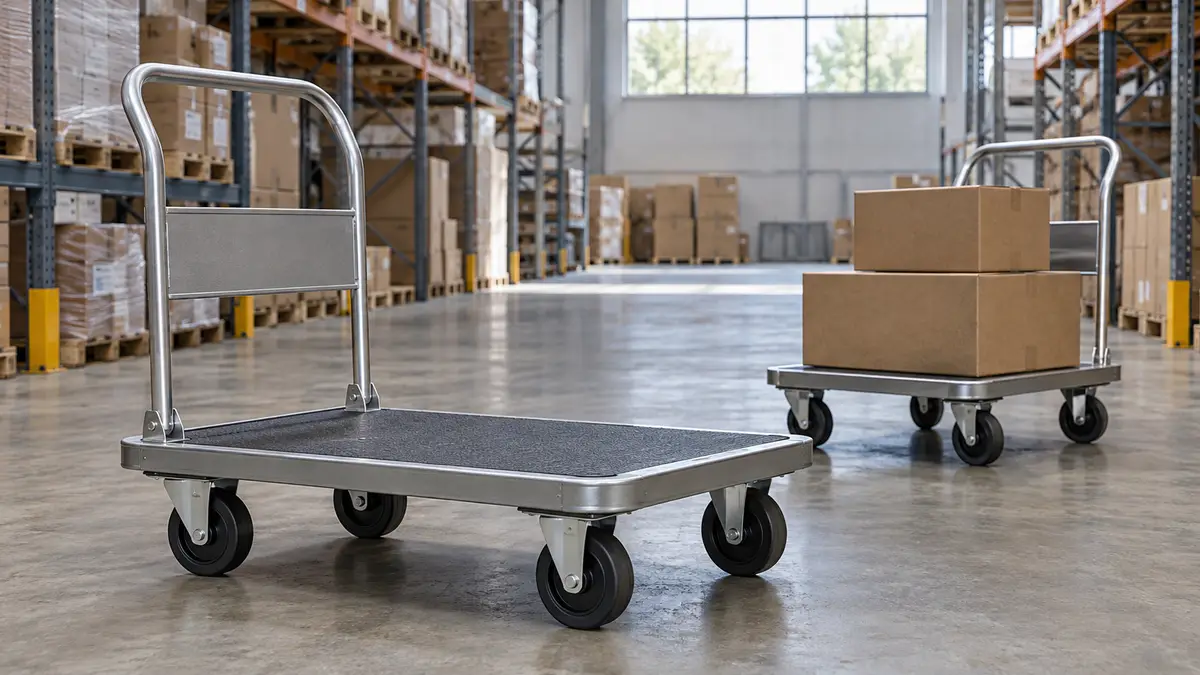
Describe the actual loads, their distribution and the warehouse route, including thresholds, floor joints and gradients. Specify deck dimensions, frame material, deck surface, handle height, folding mechanism, castor tread, bearings, mounting pattern and braking arrangement. Agree a loaded rolling test and acceptance criteria using the intended floor conditions. For drum loads, see our manual drum handling trolley sourcing guide.
Suppliers must supply safe work equipment, and adequate information must enable safe use and maintenance. Ask for instructions covering assembly, load placement, brakes, folding handles and castor replacement. Keep the approved drawing and sample available for inspection.
Worked duty example
Illustrative example, not a quote: Illustrative order of 300 heavy-duty warehouse platform trolleys under 8716 80 00 00, invoiced at £40,000 free on board, with £8,000 of freight and insurance to the UK. The customs value is £48,000. Duty at 0% is £0. Import VAT at 20% is charged on the customs value plus duty, £48,000, so it is £9,600. With no duty, the only import tax is the VAT, which a VAT-registered importer can usually reclaim. The import duty and VAT guide explains each step.
Inspection checklist
Deck and frame: check dimensions, flatness, weld continuity, sharp edges and coating coverage against the approved sample.
Castors and brakes: check tread material, bearing movement, swivel clearance and mounting security; test fitted brakes with the agreed load.
Handle and stability: check folding locks engage, handles remain secure and the loaded trolley turns without excessive flex or wheel lift.
Assembly and packing: check fasteners, supplied instructions and replacement-part identification; inspect arriving cartons for bent handles, damaged decks and missing hardware.
Working out your own order? Send us the product on WhatsApp and we reply the same working day: WhatsApp us
What goes wrong
A trolley can match the catalogue load claim yet roll poorly across floor joints. Castor substitutions change starting effort, noise and floor marking. Weak mounting plates distort, loose fasteners let wheels wobble, and a folding handle can release when its latch does not fully engage.
Check an arriving sample under the agreed load and route conditions before distributing the shipment. Record defects by batch and photograph castor markings, mounting plates and welds. Agree replacement parts by drawing and mounting dimensions rather than by a general description.
Cambridge China Bridge sources these products for UK businesses, checking the factory and the documents before shipment. See factory verification. For machinery and equipment, see machinery imports.
Frequently asked questions
What is the UK import duty on warehouse platform trolleys from China?
The supplied tariff record shows 0% duty for 8716 80 00 00 and the selected parts lines, with no anti-dumping or countervailing measure.
What safety information should come with warehouse trolleys?
Work equipment must be supplied safe, with adequate information for safe use and maintenance. Ask for assembly, loading, braking and maintenance instructions.
How do I check a trolley's load capacity?
Agree the load distribution and test conditions before ordering. Check deck deflection, frame joints, castor mountings, stability and rolling behaviour with the agreed load.
Can warehouse trolleys arrive flat-packed?
Specify the assembly method, fasteners and packing protection. Assemble an arriving sample and check deck alignment, handle locks and castor security before distribution.