Sourcing sack trucks from China
Non-powered sack trucks and the relevant parts listed here carry 0% UK duty from China, with no trade remedy recorded. Workplace supply requires safe-use information and necessary testing or examination. Agree the load, wheel type and toe plate before ordering. Cambridge China Bridge sources sack trucks.
UK duty on sack trucks
Read from the UK Trade Tariff on 8 October 2026, heading 8716 covers trailers, other non-mechanically propelled vehicles and their parts. Complete non-powered sack trucks fall within the other-vehicles line. The selected complete-truck and parts lines carry 0% duty from China, with no anti-dumping or countervailing measure or suspension recorded. See our guide to sourcing bicycle cargo trailers.
The tariff attaches a restriction on entry into free circulation concerning ozone-depleting substances, fluorinated greenhouse gas import controls on some selected lines, and a DCMS export licence entry. Official guidance requires a licence to import ozone-depleting substances into Great Britain and requires imported fluorinated gas equipment to be labelled. Ask your customs broker to confirm the applicable requirements and declaration entries for the actual truck; the supplied tariff notes do not establish a sack-truck-specific exemption.
Confirm complete trucks and separately supplied parts against their construction and arrival condition using finding your commodity code. Do not assume every replacement wheel or tyre belongs in the parts lines shown. See warehouse platform trolleys for the wider product family and UK import duty and VAT for tax calculations.
| Goods | Commodity code | Duty | Anti-dumping or countervailing duty on China |
|---|---|---|---|
| Complete non-powered sack trucks | 8716 80 00 00 | 0% | None |
| Chassis for non-powered vehicles, subject to classification | 8716 90 10 00 | 0% | None |
| Axles for non-powered vehicles | 8716 90 50 00 | 0% | None |
| Other non-powered vehicle parts, subject to classification | 8716 90 90 98 | 0% | None |
Specify the load, toe plate and wheels
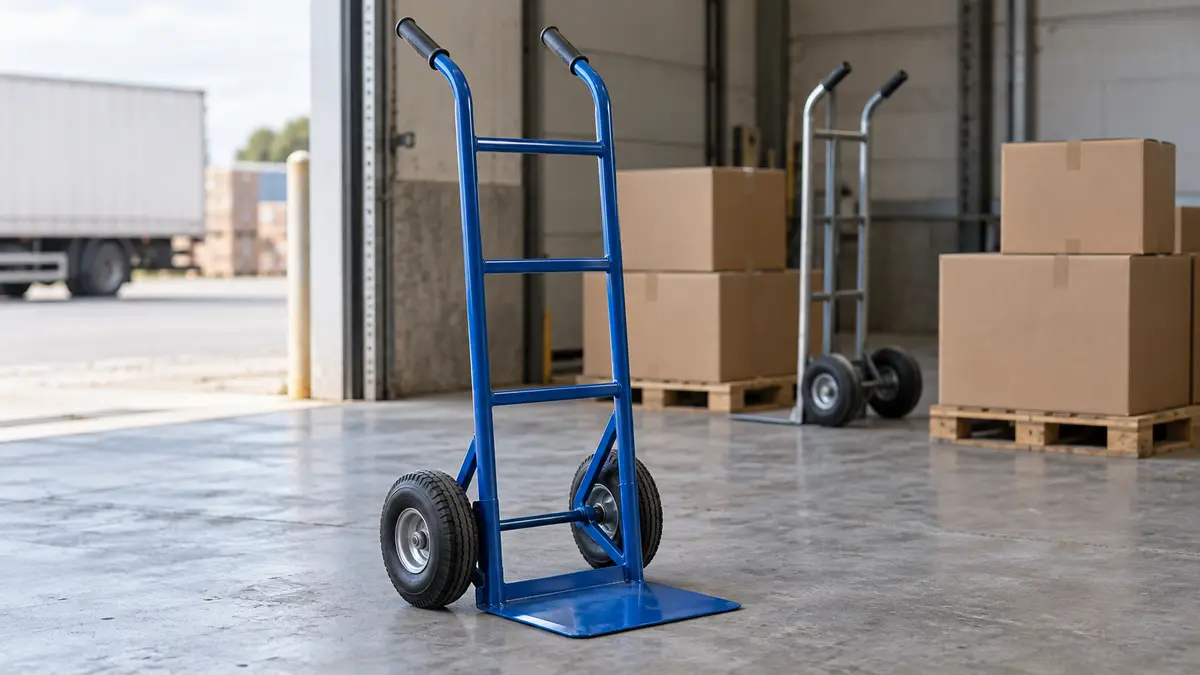
State the intended loads, their shape and how they will be secured. Agree the rated capacity and supporting test evidence, frame material, tube dimensions, toe plate width and depth, handle height and grip design. A broad carton and a narrow sack need different support. Identify whether the toe plate is fixed or folding. For drum loads, see our manual drum handling trolley sourcing guide.
Choose pneumatic or solid tyres against the intended floors, thresholds and outdoor routes. Fix wheel diameter, bearing type, axle retention and replacement-part dimensions. For folding models, approve the locking mechanism and check finger clearance through its movement. Request a sample for trials with your actual loads.
For workplace supply, HSE guidance includes safe-use information and instructions, their subsequent revisions, and testing or examination necessary to ensure compliance. Obtain model-specific instructions covering loading, securing the load, folding and maintenance, alongside evidence supporting the declared capacity.
Worked duty example
Illustrative example, not a quote: Illustrative order: 50 steel sack trucks under 8716 80 00 00, invoiced at £1,500 free on board, with £1,500 of freight and insurance to the UK. The customs value is £3,000. Duty at 0% is £0. Import VAT at 20% is charged on the customs value plus duty, £3,000, so it is £600. With no duty, the only import tax is the VAT, which a VAT-registered importer can usually reclaim. The import duty and VAT guide explains each step.
Inspection checklist
Frame and toe plate: compare dimensions with the approved drawing; check weld continuity, sharp edges, plate alignment and coating coverage around joints.
Wheels and axle: check free rotation, bearing play, tyre condition and secure axle retainers; run a loaded sample along the agreed trial route.
Folding locks: operate the mechanism repeatedly and check positive engagement, unwanted movement and finger traps.
Load and documents: test sampled trucks to the agreed protocol, check for permanent distortion, and match capacity labels and instructions to the tested model. Arrange a quality inspection before shipment and repeat condition checks on arrival.
Working out your own order? Send us the product on WhatsApp and we reply the same working day: WhatsApp us
What goes wrong
A capacity label can conceal a weak toe plate or poorly joined frame. Under load, the plate bends, wheels rub against the frame or axle retainers work loose. Folding trucks can arrive with locks that engage only when unloaded. Make the inspection include loaded operation rather than appearance alone.
A truck that rolls well on a smooth factory floor may be difficult to control over your thresholds. Trial the wheel choice and handle position with the intended load before approving production. Record wheel, bearing and axle dimensions so replacement parts fit the delivered model.
Cambridge China Bridge sources these products for UK businesses, checking the factory and the documents before shipment. See factory verification. For machinery and equipment, see machinery imports.
Frequently asked questions
What is the UK import duty on sack trucks from China?
The supplied tariff reading shows 0% duty for non-powered sack trucks under 8716 80 00 00 and the selected parts lines, with no anti-dumping or countervailing measure recorded.
What should I specify when ordering sack trucks?
Fix the intended load, supported capacity, frame material, toe plate dimensions, handle position, wheel and bearing design, axle retention and any folding lock.
Should I choose pneumatic or solid wheels?
Trial both against your loads and routes. Compare rolling effort over thresholds, tyre maintenance and stability when tilting the loaded truck.
What safety documents should I request?
Request model-specific safe-use and maintenance instructions plus testing or examination evidence supporting the declared capacity. Match the documents to the truck actually supplied.