Sourcing steel handbag feet from China
Steel handbag feet within heading 7326 carry 2% UK duty from China across the listed manufacturing routes. Confirm the code from the material and actual processing, and assess safety in the assembled bag before sale. Cambridge China Bridge sources steel handbag feet.
Duty depends on how the steel foot is made
Heading 7326 covers other articles of iron or steel. For steel handbag feet, distinguish stamped pieces without further working, forged pieces, sintered pieces and other finished articles. The table gives conditional manufacturing routes, rather than interchangeable codes for the same finished foot. Confirm that the body is steel rather than a different metal.
Read from the UK Trade Tariff on 8 October 2026, the listed routes carry 2% duty for goods from China, with no anti-dumping or countervailing duty and no steel measure recorded. The stamped and closed-die forged lines have narrowly described suspensions for other products, which do not describe handbag feet. The finished-article line attaches torture-goods import and export controls. Official guidance lists the banned imports; ask your customs broker to confirm the declaration requirement for ordinary handbag feet.
Confirm the commodity code using a drawing, material declaration and manufacturing description. Ask your customs broker to confirm whether the UK carbon border adjustment mechanism applies to your goods and what supplier emissions information may be needed; consult the UK carbon border guide. For related fittings, see buckles, eyelets and rivets.
| Goods | Commodity code | Duty | Anti-dumping or countervailing duty on China |
|---|---|---|---|
| Stamped steel feet, not further worked, subject to classification | 7326 19 90 00 | 2% | None |
| Closed-die forged steel feet, subject to classification | 7326 90 94 90 | 2% | None |
| Sintered steel feet, subject to classification | 7326 90 96 90 | 2% | None |
| Other finished steel handbag feet, subject to classification | 7326 90 98 90 | 2% | None |
Specify the foot and its attachment together
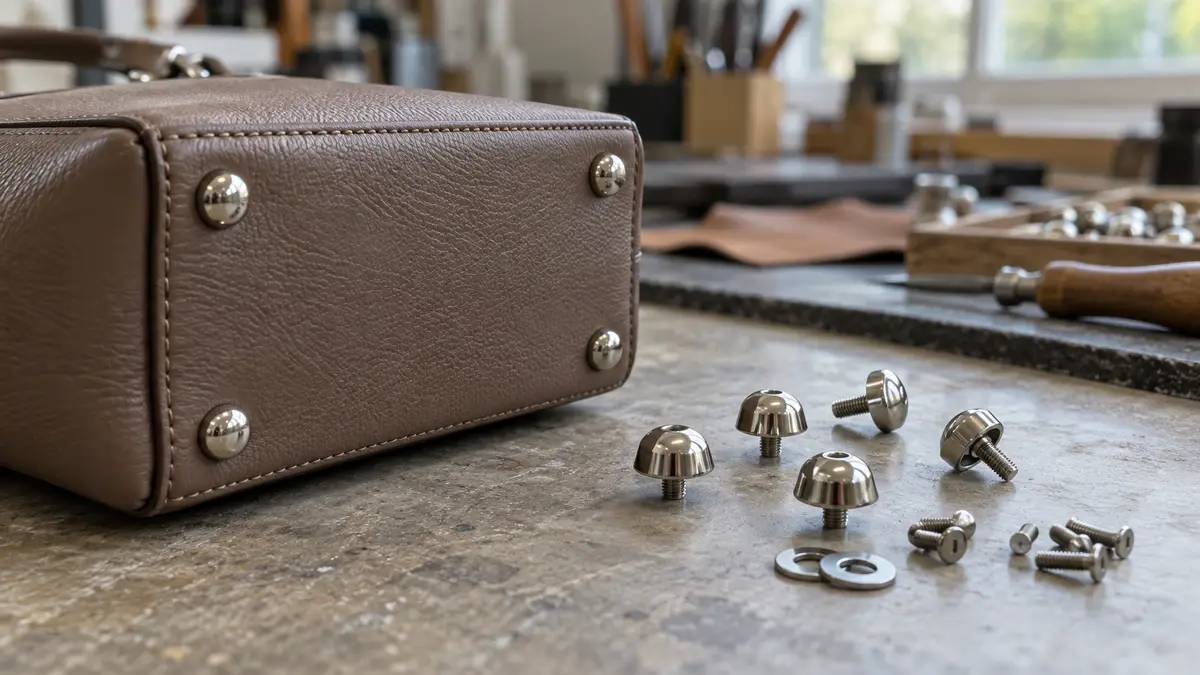
Specify body material, head profile, contact-face diameter, projection below the bag, finish and fixing method. For split-prong feet, define prong length, spacing and backing reinforcement. For screw-fixed feet, define the mating thread, screw length and washer. Supply a section drawing showing the bag base, reinforcement and lining.
Approve feet fitted to the intended bag material, rather than loose samples alone. Agree checks for pull-out, twisting, repeated placement on a surface and finish transfer onto pale fabric. Consumer products must not be sold when the seller knows, or should have known, that they are unsafe. Use the assembled bag to assess exposed points, loose feet and accessible fixing ends.
Worked duty example
Illustrative example, not a quote: Illustrative order of 5,000 finished steel handbag feet under 7326 90 98 90, invoiced at £5,000 free on board, with £700 of freight and insurance to the UK. The customs value is £5,700. Duty at 2% is £114. Import VAT at 20% is charged on the customs value plus duty, £5,814, so it is £1,162.80. Import taxes total £1,276.80; a VAT-registered importer can usually reclaim the VAT, so the lasting cost is the £114 of duty. The import duty and VAT guide explains each step.
Inspection checklist
Fit: compare head dimensions, projection and fixing geometry with the approved drawing; assemble samples through the actual base and reinforcement.
Attachment: check for spinning heads, stripped threads, cracked prongs and backing that cuts into the bag material.
Finish: compare colour with the approved sample; inspect recesses for bare metal, blistering, scratches and corrosion, and check for colour transfer.
Packing: check that screws and washers match the feet, finishes are separated against rubbing, and cartons identify each variant. Record results in the inspection checklist.
Working out your own order? Send us the product on WhatsApp and we reply the same working day: WhatsApp us
What goes wrong
A foot can look correct loose and fail after fitting. Short prongs may not grip a reinforced base, long fixing ends may catch the lining, and screws may bottom out before clamping the assembly. Thin backing can let the foot tear through the bag. Approve the complete attachment with the intended material stack.
Finish problems often hide underneath the head or around the fixing. Mixed plating shades spoil a matching hardware set, while rubbing during transport exposes the substrate. Keep an approved physical sample, agree packing separators and inspect the underside as well as the visible face.
Cambridge China Bridge sources these products for UK businesses, checking the factory and the documents before shipment. See factory verification. For repeat volumes, see container programmes.
Frequently asked questions
What is the UK import duty on steel handbag feet from China?
The listed routes within heading 7326 carry 2% duty from China. No anti-dumping or countervailing duty is recorded. Confirm the manufacturing route and final commodity code.
Which commodity code covers finished steel handbag feet?
7326 90 98 90 is a candidate for other finished steel articles. Confirm it against the material, construction and processing; the table also shows conditional routes for other manufacturing methods.
Should I order screw-fixed or split-prong handbag feet?
Choose using the bag base and reinforcement. Test whether the fixing clamps securely, stays hidden beneath the lining and resists twisting or pulling through the material.
What samples should I approve before production?
Approve the foot, finish, mating fixings and backing fitted to the intended bag base. Keep that assembly and a loose reference sample for production and arrival checks.