Sourcing semiconductor ion implanters from China
Semiconductor ion implantation machines and qualifying parts from China carry 0% UK duty throughout the relevant lines. Confirm the applicable conformity assessment, declaration and UKCA or CE marking requirements for Great Britain with the relevant authority. Check radiation-work consent before commissioning. Cambridge China Bridge sources semiconductor ion implantation machines.
Buying from China for a business? How our UK China sourcing agent service works · China sourcing agent for small orders and first imports
0% duty on semiconductor ion implanters
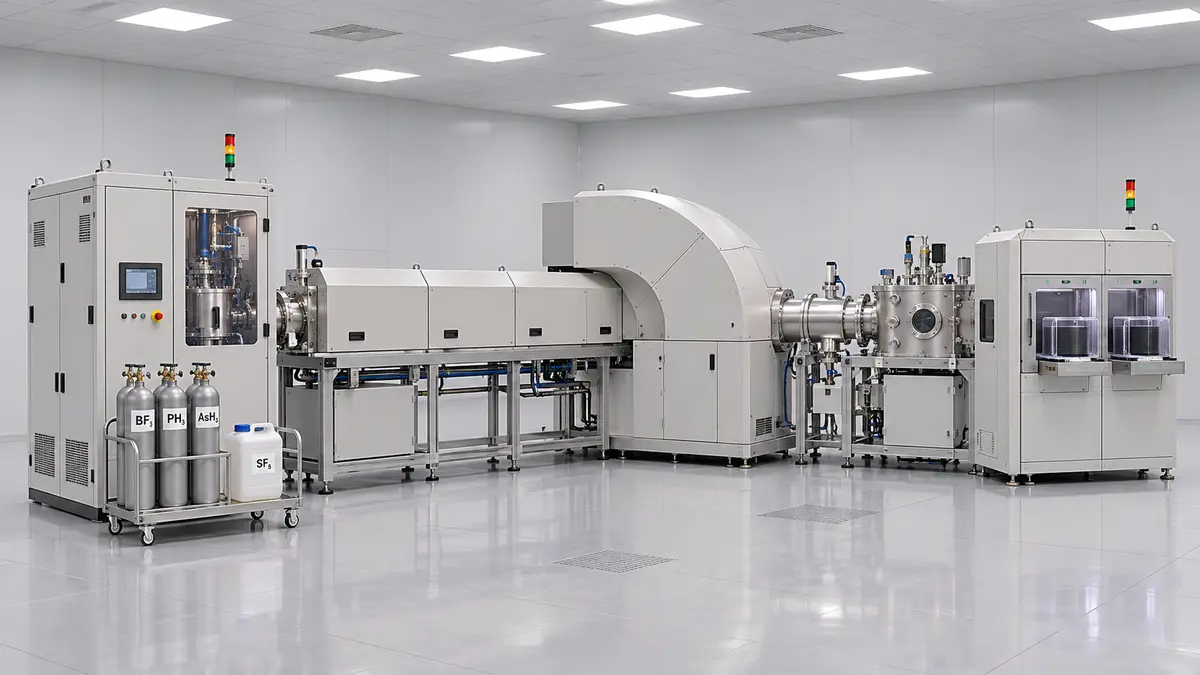
Heading 8486 covers semiconductor and display manufacturing equipment and its parts. Ion implantation machines used principally to manufacture semiconductor devices or electronic integrated circuits fit the machine description under 8486 20 00 00. Qualifying parts and accessories fall under 8486 90 00 00. The table distinguishes implantation configurations sharing a tariff code, rather than separate tariff subdivisions.
Read from the UK Trade Tariff on 1 October 2026, the supplied tariff record shows 0% duty on goods from China across these lines, with no anti-dumping or countervailing measures, suspensions or attached import controls. Machinery safety and workplace radiation requirements still need separate attention.
Confirm the commodity code using the machine's principal function, process description and component list. Avoid assuming that a separately supplied pump, instrument or electrical component qualifies as an implanter part. For related equipment within the wider heading, see semiconductor plasma etching machines.
| Goods | Commodity code | Duty | Anti-dumping or countervailing duty on China |
|---|---|---|---|
| High-current ion implanters for semiconductor devices | 8486 20 00 00 | 0% | None |
| Parts and accessories for semiconductor ion implanters | 8486 90 00 00 | 0% | None |
Specify the implant process and site interfaces
Define ion species, beam energy and current ranges, dose accuracy, dose uniformity, implant angle, wafer dimensions, handling method and throughput on your own recipes. Specify how the supplier will demonstrate each result, including measurement methods and acceptance criteria. Agree ion-source consumables, recipe access, software licences, service support and the condition of refurbished assemblies.
Match the installation drawing to site power, cooling water, vacuum, exhaust and gas connections. For supply in Great Britain, machinery needs a technical file; confirm the applicable conformity assessment, declaration and UKCA or CE marking requirements with the relevant authority. Confirm with HSE whether the proposed ionising-radiation work needs consent before commissioning; certain high-risk practices require consent before work starts. Arrange testing and certification support around the exact configuration.
Worked duty example
Illustrative example, not a quote: A refurbished semiconductor research ion implanter, illustrative order under 8486 20 00 00, invoiced at £450,000 free on board, with £15,000 of freight and insurance to the UK. The customs value is £465,000. Duty at 0% is £0. Import VAT at 20% is charged on the customs value plus duty, £465,000, so it is £93,000. With no duty, the only import tax is the VAT, which a VAT-registered importer can usually reclaim. The import duty and VAT guide explains each step.
Inspection checklist
Process results: witness implantation on your wafers and compare measured dose, uniformity, repeatability and particle results with the agreed acceptance criteria.
Beamline and vacuum: inspect the ion source, apertures, beamline, wafer chamber and vacuum records; compare refurbished components with the agreed replacement and condition list.
Safety and documents: match the machine identity to its declaration and conformity marking; review technical-file availability, shielding information and recorded interlock tests.
Arrival and commissioning: inspect packing and shock indicators, check beamline alignment and wafer handling, then repeat the agreed site acceptance tests. Use quality inspection planning to define the records.
Working out your own order? Send us the product on WhatsApp and we reply the same working day: WhatsApp us
What goes wrong
A supplier demonstrates beam current but leaves dose uniformity or wafer throughput unproven on your process. Worn ion-source components, vacuum leaks, contaminated chambers or wafer-handling faults can undermine acceptance. Require recorded tests on representative wafers and agree how failed results will be corrected before shipment.
Installation stalls when exhaust connections, cooling demand or software access differ from the quotation. Transport movement can disturb alignment, and refurbished equipment may arrive with undocumented component changes. Agree facility interfaces, packing, commissioning responsibility, recipe access and a spare-parts list before committing.
Cambridge China Bridge sources these products for UK businesses, checking the factory and the documents before shipment. See factory verification. For machinery and equipment, see machinery imports.
Frequently asked questions
What is the UK import duty on ion implantation machines from China?
The tariff record read on 1 October 2026 shows 0% duty for semiconductor manufacturing machines under 8486 20 00 00 and qualifying parts under 8486 90 00 00, with no anti-dumping or countervailing measures.
Do semiconductor ion implanters need CE or UKCA marking?
For machinery supplied in Great Britain, obtain the declaration, conformity assessment evidence and UKCA or CE marking. Check technical-file availability for the exact machine configuration.
Do I need HSE consent before using an ion implanter?
Confirm the proposed radiation work with HSE before commissioning. HSE requires consent before certain high-risk ionising-radiation practices; resolve the applicable category for your installation.
What should an ion implanter acceptance test measure?
Use your wafers and agreed recipes to check dose accuracy, uniformity, repeatability, implant angle, particle performance and throughput. Repeat agreed tests after installation.