Sourcing PET, epoxy and polyester resins from China
Bottle-grade PET chips, epoxy, alkyd and most other polyesters from China pay 6% UK duty and poly(lactic acid) 0%, with no anti-dumping duty. Under suspensions claimed with document 9Y12, polycarbonate granules pay 0% until 31 December 2026 and polyoxymethylene until 2028. Polymers are exempt from UK REACH registration, but monomers may need it; bottle-grade PET needs food contact evidence.
Buying from China for a business? How our UK China sourcing agent service works · China sourcing agent for UK manufacturers and engineering firms
Duty by resin
Read from the UK Trade Tariff on 26 September 2026, polycarbonates, alkyd resins, poly(ethylene terephthalate) and other polyesters carried 6% duty on goods from China, poly(lactic acid) 0%, and polyacetals and the residual epoxide resin line 0% for listed pharmaceutical substances and 6% otherwise, with no anti-dumping measure. Three suspensions, each claimed with document 9Y12, change that for common grades: polycarbonate in granules pays 0% until 31 December 2026; polyoxymethylene (POM) pays 0% until 31 December 2028; and from 5 August 2026 to 31 December 2028, PET pellets or granules in the lower-viscosity line with a specific gravity of 1.23 to 1.27 at 23 °C and no more than 10% modifiers or additives pay 0%. Bottle-grade PET of viscosity 78 ml/g or more has no such suspension, and some epoxy products have end-use suspensions with conditions.
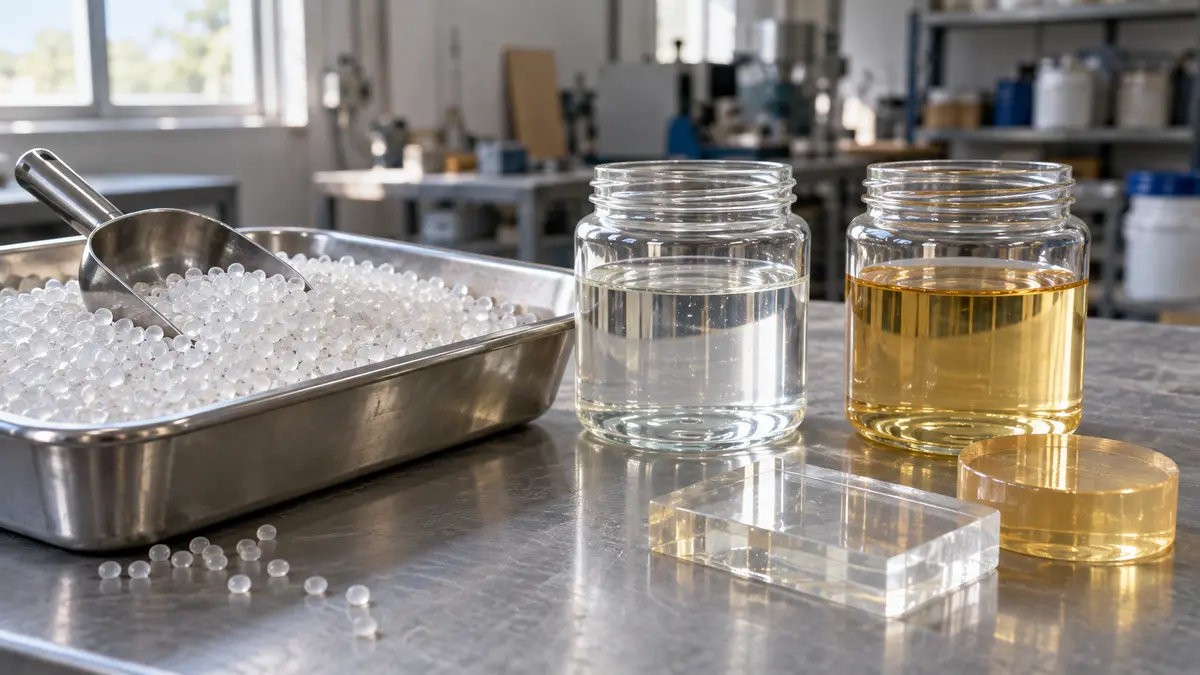
Resins must be in primary forms, such as liquids, pastes, powders or pellets; confirm the commodity code.
| Goods | Commodity code | Duty | Anti-dumping duty on China |
|---|---|---|---|
| Polyacetals | 3907 10 00 00 | 6%; polyoxymethylene 0% with 9Y12 to 31 Dec 2028 | None |
| Epoxide resins, other | 3907 30 00 85 | 0% pharmaceutical / 6% other | None |
| Polycarbonates, other | 3907 40 00 90 | 6%; granules 0% with 9Y12 to 31 Dec 2026 | None |
| Alkyd resins | 3907 50 00 00 | 6% | None |
| PET, viscosity 78 ml/g or higher, other | 3907 61 00 80 | 6% | None |
| Other PET | 3907 69 00 90 | 6%; qualifying pellets 0% with 9Y12 to 31 Dec 2028 | None |
| Poly(lactic acid) | 3907 70 00 00 | 0% | None |
REACH and food contact
Polymers are exempt from UK REACH registration, but an importer of a polymer may need to register monomers or other substances it contains above the thresholds unless they are already registered up the supply chain; ask for a UK REACH statement. Bottle-grade PET and resins for food packaging must comply with the retained plastics food contact regulation, with a declaration of compliance and migration data.
Worked duty example
Illustrative example, not a quote: 20 tonnes of bottle-grade PET chips under 3907 61 00 80, invoiced at £18,000 free on board, with £2,000 of freight and insurance to the UK. The customs value is £20,000. Duty at 6% is £1,200. Import VAT at 20% is charged on the customs value plus duty, £21,200, so it is £4,240. Import taxes total £5,440; a VAT-registered importer can usually reclaim the VAT, so the lasting cost is the £1,200 of duty. The import duty and VAT guide explains each step.
Inspection checklist
PET: intrinsic viscosity on each lot by the solution method of ASTM D4603, within the tolerance agreed for the ordered grade, moisture by Karl Fischer to ISO 15512 before and after drying, colour as CIELAB b* against the approved lot, and acetaldehyde content by headspace gas chromatography for bottle grades.
Epoxy and polycarbonate: epoxy equivalent weight to ISO 3001 and viscosity to ISO 2555 against the data sheet range, gel time at the stated hardener ratio, and for polycarbonate melt flow rate to ISO 1133-1 and yellowness on moulded plaques, so a lot that moulds differently is caught before production.
Food contact and packing: a declaration of compliance for the exact grade under retained Regulation 10/2011 with migration results for the intended use, sealed liners and moisture-barrier bags on hygroscopic resins, lot numbers on every bag matching the certificates, and a retained sample from each lot kept until the lot is used up.
Working out your own order? Send us the product on WhatsApp and we reply the same working day: WhatsApp us
What goes wrong
Resin problems show up in your process, not at the port. PET with the wrong intrinsic viscosity or high acetaldehyde spoils bottles; wet PET degrades unless it is dried and packed properly. Epoxy batches vary in epoxide equivalent weight and viscosity, which changes cure. Off-grade or recycled content is sometimes mixed in without disclosure.
Ask for a certificate of analysis per lot with intrinsic viscosity or epoxide equivalent, moisture and colour, test the first lot in your process, and at inspection check bag labels, lot codes and liner integrity.
Cambridge China Bridge sources PET, epoxy, polycarbonate and other resins, with grade, food contact and REACH questions settled before the order. See how our sourcing service works.
Frequently asked questions
What is the UK import duty on PET chips from China?
Read from the UK Trade Tariff on 26 September 2026, bottle-grade PET carried 6% from China with no anti-dumping duty; lower-viscosity PET pellets meeting a suspension's conditions enter at 0% with document 9Y12.
Is polycarbonate duty-free?
Polycarbonate in granules enters at 0% with document 9Y12 until 31 December 2026; other forms pay 6%.
Do polymers need REACH registration?
Polymers are exempt, but monomers and other substances in them may need registration by the importer.
What does bottle-grade PET need?
A declaration of compliance under the plastics food contact rules and migration data.
What duty applies to PLA?
Poly(lactic acid) carried 0% from China on 26 September 2026.