Sourcing palletisers and depalletisers from China
Palletisers and depalletisers from China have 0% ordinary UK duty across the relevant lines. Check any boom-lift measure flagged against the chosen code. Complete machinery for Great Britain needs conformity assessment, CE or UKCA marking, a declaration and English instructions. Cambridge China Bridge sources palletisers and depalletisers.
Buying from China for a business? How our UK China sourcing agent service works · China sourcing agent for small orders and first imports
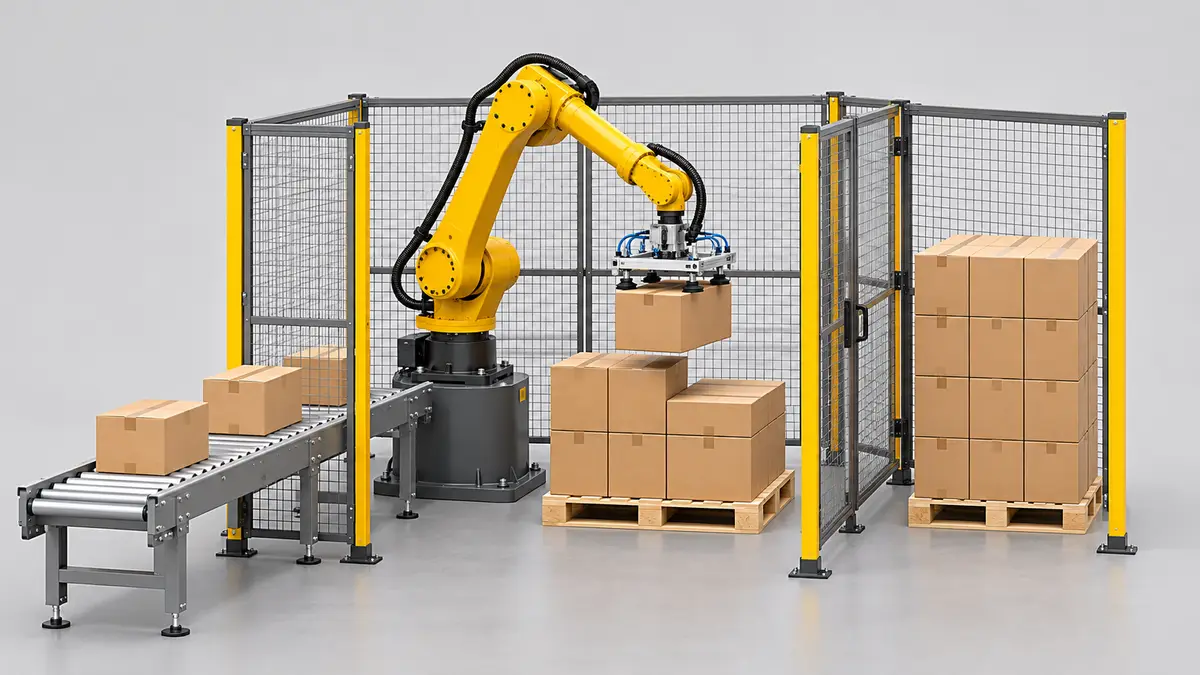
UK duty on palletisers and depalletisers
Heading 8428 covers lifting, handling, loading and unloading machinery. Compare the industrial robot and other machinery lines against the supplied palletiser or depalletiser. The conveyor rows concern separately supplied equipment, rather than automatic alternatives for a complete cell. See industrial robot arms for the wider heading.
Read from the UK Trade Tariff on 17 December 2026, the selected lines carried 0% ordinary duty for goods from China. The other machinery line also flags 71.74% provisional anti-dumping duty and registration using additional code 8C10 for the goods concerned. The official boom-lift duty notice excludes products outside its goods description. The selected robot and conveyor lines list no trade remedy or import control; none of the selected lines lists a suspension.
The registration notice requires 8C10 for the goods concerned. Ask your customs broker to confirm the registration requirement, boom-lift exclusion and declaration treatment for your palletiser or depalletiser. Confirm the commodity code using the operating description, drawings and supply boundaries. Identify separately supplied conveyors and robot equipment rather than assigning the complete order a code from its sales name.
| Goods | Commodity code | Duty | Anti-dumping or countervailing duty on China |
|---|---|---|---|
| Other handling machinery, for classification of non-robotic palletisers | 8428 90 90 80 | 0% | 71.74% residual anti-dumping (provisional) |
| Industrial robots, for classification of robotic palletising equipment | 8428 70 00 00 | 0% | None |
| Roller conveyors supplied separately for palletising lines | 8428 39 20 00 | 0% | None |
| Belt conveyors supplied separately for palletising lines | 8428 33 00 00 | 0% | None |
Specify the load, gripper and pallet pattern
Define whether the machine handles cartons, sacks, trays or complete layers. Provide representative packaging, weight variation, surface condition and pallet drawings. Agree stacking patterns, finished stack height, overhang, slip-sheet handling and pallet magazine arrangements. For depalletisers, include uneven incoming stacks, interlayer sheets and the condition of returned pallets.
Specify gripper contact surfaces, vacuum or clamping arrangements, changeover method and access for cleaning. Agree throughput using your actual products, including pallet exchange and downstream stoppages. Record the electrical supply, compressed-air demand, controller maker, layout and interfaces to adjoining equipment.
For complete machinery supplied in Great Britain, check conformity assessment, technical file arrangements, the declaration of conformity, CE or UKCA marking and English instructions. Agree who supplies the completed installation's documents and commissions the integrated cell. Have the installation team review guarding, access and isolation before approving the layout.
Worked duty example
Illustrative example, not a quote: Illustrative order: a roller conveyor transfer section for a small-business palletising cell under 8428 39 20 00, invoiced at £8,000 free on board, with £1,200 of freight and insurance to the UK. The customs value is £9,200. Duty at 0% is £0. Import VAT at 20% is charged on the customs value plus duty, £9,200, so it is £1,840. With no duty, the only import tax is the VAT, which a VAT-registered importer can usually reclaim. The import duty and VAT guide explains each step.
Inspection checklist
Loads and patterns: test representative packs through every agreed pattern and changeover. Check grip retention, layer placement, stack stability and depalletising of uneven layers.
Pallet handling: check magazine feeding, pallet alignment, slip-sheet separation and transfers. On arrival, inspect frames, grippers, sensors and cable connections for transport damage.
Protection and controls: have a competent person check guards, interlocks, emergency stops and maintenance isolation. Witness the agreed response to a dropped pack, blocked conveyor and interrupted air or power supply.
Documents and components: match the declaration, marking and English manual to the delivered configuration. Check electrical diagrams, control backups and spare gripper parts against the agreed inspection checklist.
Working out your own order? Send us the product on WhatsApp and we reply the same working day: WhatsApp us
What goes wrong
A demonstration with rigid empty cartons can hide grip loss on dusty sacks or soft packs. Small variations in carton dimensions can accumulate into unstable layers. Depalletisers can pick interlayer sheets with the load or lose their reference position on leaning stacks. Include these conditions in the factory acceptance test.
Quoted throughput may omit pallet exchange, sheet placement and recovery after stoppages. A working robot can still leave transfer gaps, awkward maintenance access or incompatible conveyor controls. Define acceptance around the complete handling cycle and repeat functional checks after installation.
Cambridge China Bridge sources these products for UK businesses, checking the factory and the documents before shipment. See factory verification. For machinery and equipment, see machinery imports.
Frequently asked questions
What is the UK import duty on palletisers from China?
The selected lines carry 0% ordinary duty. The other machinery line flags 71.74% provisional boom-lift duty and registration. Ask your broker to confirm scope and exclusion for your machine.
Do palletisers need CE or UKCA marking?
For complete machinery supplied in Great Britain, check the appropriate CE or UKCA marking, conformity assessment, declaration of conformity and English instructions for the supplied configuration.
How should I test a depalletiser before shipment?
Use representative incoming pallets, including uneven layers and interlayer sheets. Check pack separation, grip retention, discharge transfers and recovery after an agreed stoppage.
What should a palletiser specification include?
Include pack and pallet drawings, load variation, stacking patterns, gripper details, slip sheets, changeovers, utilities and conveyor interfaces. Agree throughput over the complete cycle, including pallet exchange.