Sourcing meteorological rain gauges from China
Meteorological rain gauges and their parts from China carry 0% UK duty, with no anti-dumping or countervailing duty in the supplied tariff data. Electronic models need applicable electrical compliance; wireless models must meet radio equipment requirements before sale in Great Britain. Cambridge China Bridge sources meteorological rain gauges.
Buying from China for a business? How our UK China sourcing agent service works · China sourcing agent for small orders and first imports
Rain-gauge duty and classification
Read from the UK Trade Tariff on 1 October 2026, heading 9015 covers meteorological instruments alongside surveying, hydrological and other instruments. Meteorological rain gauges fall within the meteorological instrument description at 9015 80 20 00; parts and accessories have a separate line at 9015 90 00 00. The table repeats the instrument code for different gauge designs.
The supplied lines carry 0% duty for goods from China, with no listed anti-dumping or countervailing duty and no listed suspension. The tariff also attaches a cultural-objects export licence control. Official guidance concerns exports of cultural objects from Great Britain. Ask your customs broker to confirm how the attached control applies to your shipment of new rain gauges from China.
Confirm the commodity code using the complete product specification, including any supplied logger or separate accessories. See the wider surveying-instruments guide for other products within this heading. Allow for import VAT at 20% and check the calculation in UK import duty and VAT.
| Goods | Commodity code | Duty | Anti-dumping or countervailing duty on China |
|---|---|---|---|
| Manual meteorological rain gauges | 9015 80 20 00 | 0% | None |
| Parts and accessories for meteorological rain gauges | 9015 90 00 00 | 0% | None |
Specify the collector, measurement and output
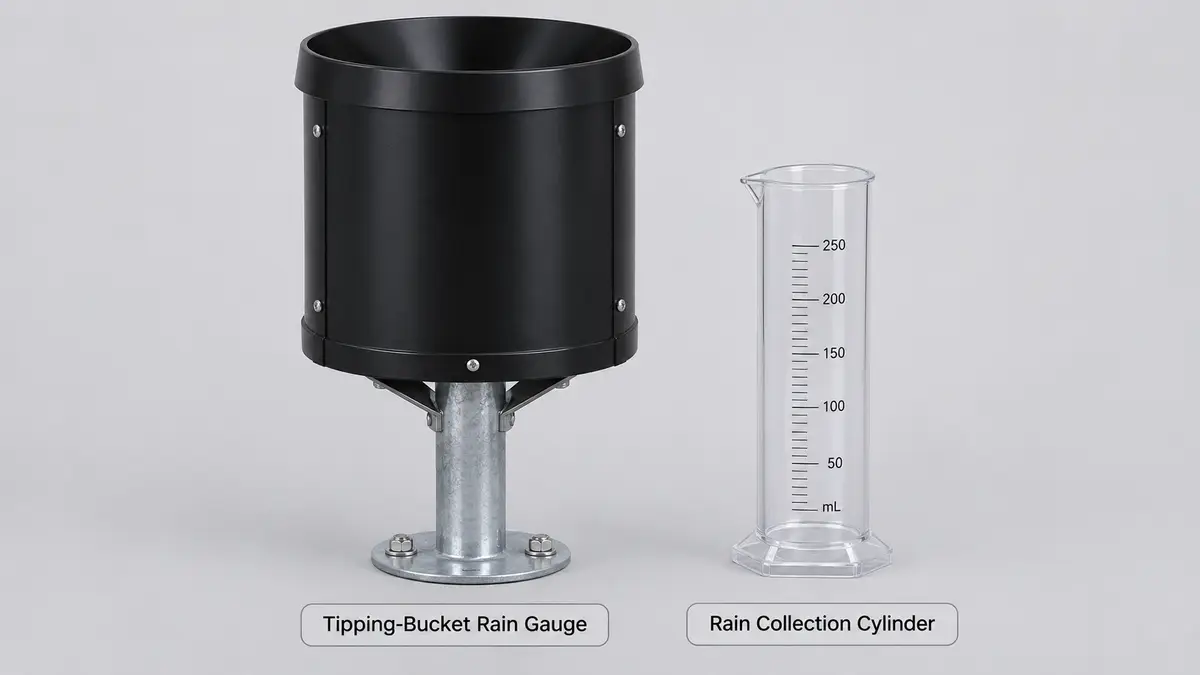
Choose manual collection, tipping-bucket or weighing measurement. Specify collector opening dimensions, material, mounting arrangement, levelling adjustment and access for cleaning. For tipping buckets, agree the rainfall represented by each tip, permissible error across the intended flow range and the calibration method. For weighing gauges, agree capacity, resolution and how evaporation or drift will be assessed.
For logged measurements, specify the pulse or wired interface, connector, cable, power supply and data format. Agree whether a logger, heater or wireless transmitter is included. Ask for sample calibration records tied to the actual model and a practical installation and maintenance guide.
For electronic instruments, confirm applicable electromagnetic compatibility, CE or UKCA marking, battery and waste electrical equipment requirements with the relevant authorities. Electrical and electronic equipment is within the hazardous-substance rules unless specifically excluded. Wireless models must meet the radio equipment essential requirements before being placed on the Great Britain market. For consumer-use models, also confirm applicable general product safety requirements with the relevant authority. Arrange a model-specific review through testing and certification.
Worked duty example
Illustrative example, not a quote: Illustrative order: 1,000 manual meteorological rain gauges under 9015 80 20 00, invoiced at £38,000 free on board, with £2,000 of freight and insurance to the UK. The customs value is £40,000. Duty at 0% is £0. Import VAT at 20% is charged on the customs value plus duty, £40,000, so it is £8,000. With no duty, the only import tax is the VAT, which a VAT-registered importer can usually reclaim. The import duty and VAT guide explains each step.
Inspection checklist
Collector and mounting: measure the opening against the drawing; check roundness, level adjustment, fixings and drainage. Look for damaged rims, loose fasteners and packing that puts pressure on the collector.
Measurement: introduce a measured quantity of water at controlled flow rates and compare the reading with the agreed calibration method. Check both sides of a tipping bucket for free movement and consistent tipping.
Logging and weather protection: connect the supplied cable to the intended logger; compare recorded pulses with observed tips. Check seals, cable entries, drainage and any heater against the agreed specification.
Records and identification: match model identifiers to calibration records and applicable conformity documents. Check that maintenance instructions explain levelling, cleaning and recalibration. Use the agreed checks in your inspection brief.
Working out your own order? Send us the product on WhatsApp and we reply the same working day: WhatsApp us
What goes wrong
A collector with the wrong opening dimensions changes the relationship between collected water and reported rainfall. A bent rim, tilted base or rubbing bucket can distort results. A gauge that performs acceptably under a slow pour can give different results at heavier flow, so test across the agreed operating range.
Pulse settings, wiring and logger scaling can disagree even when the bucket moves correctly. Check the complete measurement chain before approving shipment, then repeat the agreed functional checks on arrival. Specify protection for the collector and moving mechanism during transport.
Cambridge China Bridge sources these products for UK businesses, checking the factory and the documents before shipment. See factory verification. For components and parts, see sourcing for manufacturers.
Frequently asked questions
What is the UK import duty on rain gauges from China?
The supplied tariff data shows 0% duty for meteorological instruments at 9015 80 20 00 and parts at 9015 90 00 00, with no listed anti-dumping or countervailing duty.
How do I check a tipping-bucket rain gauge?
Use measured water at controlled flow rates, compare the result with the agreed calibration method, and check that both buckets tip freely. Compare observed tips with the logger record.
Do wireless rain gauges need radio compliance?
Yes. Check the complete model, including its transmitter and supplied accessories.
What should I put in a rain-gauge specification?
Include collector dimensions, measurement method, accuracy across the intended flow range, calibration method, mounting, cleaning access, output interface and the supplied logger or heater.