Sourcing men's knitted cargo trousers from China
Men's knitted cargo trousers from China carry a flat 12% UK duty across the relevant fibre lines, with no anti-dumping or countervailing duty recorded. For sale in Great Britain, fibre content must be labelled. Specify pocket reinforcement, stretch recovery and wash shrinkage. Cambridge China Bridge sources men's knitted cargo trousers.
Buying from China for a business? How our UK China sourcing agent service works · China sourcing agent for small orders and first imports
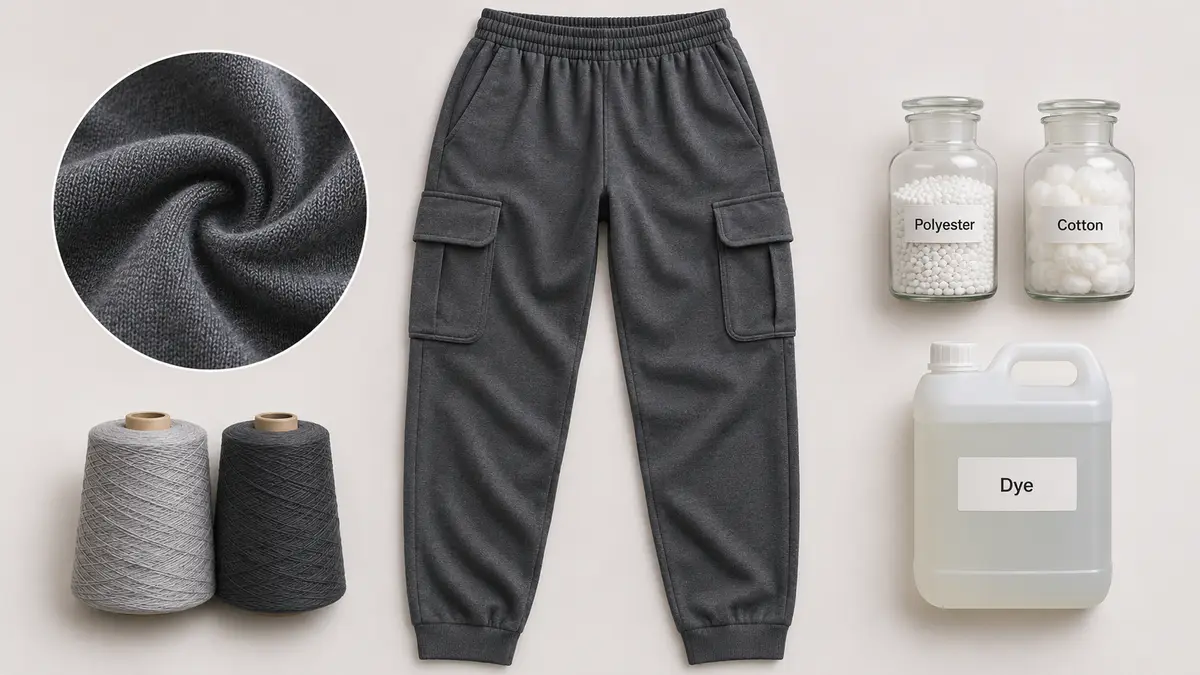
UK duty on men's knitted cargo trousers
Read from the UK Trade Tariff on 1 October 2026, heading 6103 covers men's or boys' knitted or crocheted garments, including trousers. The relevant cargo trouser lines carry a flat 12% duty for goods from China. The supplied records show no anti-dumping or countervailing duty and no suspensions. Cargo pockets do not establish the fibre classification.
The tariff attaches cat and dog fur and seal product import controls, with CITES import controls on the wool or fine animal hair and other textile material rows shown. Imports of cat and dog fur products are banned. Seal products for sale in Great Britain must qualify under the Inuit and other indigenous communities exemption and have a seal catch certificate. For any CITES-listed animal material sourced from China, ask your customs broker to confirm the species and applicable permits before ordering.
Confirm the commodity code using the fabric construction, fibre composition and garment description. Stretch alone does not identify knitted fabric. Compare the woven cargo trousers guide, which covers the woven alternative under heading 6203.
| Goods | Commodity code | Duty | Anti-dumping or countervailing duty on China |
|---|---|---|---|
| Men's knitted cargo trousers, cotton | 6103 42 00 00 | 12% | None |
| Men's knitted cargo trousers, synthetic fibres | 6103 43 00 00 | 12% | None |
| Men's knitted cargo trousers, wool or fine animal hair | 6103 41 00 00 | 12% | None |
| Men's knitted cargo trousers, other textile materials | 6103 49 00 10 | 12% | None |
Specify the knit, fit and cargo pockets
Specify fibre composition, fabric weight, knit structure, surface finish and stretch recovery. Approve waist, rise, seat, thigh, inside leg and leg opening against a graded size chart. Define the waistband construction, drawcord, fly and cuff treatment. Approve fit with the cargo pockets loaded as well as empty.
Set pocket position, usable depth, flap shape, fastening and reinforcement at attachment points. Agree acceptable pilling, colour transfer and dimensional change after the intended care process. For sale in Great Britain, the label must show fibre content, including fur and other animal parts. Consumer products must be safe in normal or reasonably foreseeable use; check exposed zip edges and fastening security.
Worked duty example
Illustrative example, not a quote: Illustrative order: 3,000 pairs of men's cotton knitted cargo trousers; FOB value and freight are illustrative, not a quotation. under 6103 42 00 00, invoiced at £21,000 free on board, with £1,800 of freight and insurance to the UK. The customs value is £22,800. Duty at 12% is £2,736. Import VAT at 20% is charged on the customs value plus duty, £25,536, so it is £5,107.20. Import taxes total £7,843.20; a VAT-registered importer can usually reclaim the VAT, so the lasting cost is the £2,736 of duty. The import duty and VAT guide explains each step.
Inspection checklist
Fabric and recovery: compare bulk fabric with the sealed sample; check fibre evidence, handle, pilling and recovery after stretching the knees and seat.
Fit and washing: measure waist, rise, thigh and inside leg before and after the agreed care process; check leg twisting, waistband distortion and shade changes.
Cargo pockets and seams: inspect attachment reinforcement, pocket symmetry and flap alignment; load pockets and operate fastenings to check sagging, tearing and seam opening.
Labels and arrival: compare fibre, size and care labels with approved artwork; reconcile carton contents with the packing list and check for dampness, mould and colour transfer. Use the inspection guide to plan sampling.
Working out your own order? Send us the product on WhatsApp and we reply the same working day: WhatsApp us
What goes wrong
A soft approval sample can hide poor recovery in bulk fabric. Knees bag, loaded cargo pockets pull the side seams down, and pocket corners tear where reinforcement is missing. Tight stitching can pucker the knit or break when the wearer bends. Washing can shorten the legs and twist the side seams.
Keep a sealed finished sample and the approved fabric specification. Check washed production samples with loaded pockets before shipment, then repeat the agreed measurements and fastening checks on arrival. Record substitutions and defects by batch before accepting the stock.
Cambridge China Bridge sources these products for UK businesses, checking the factory and the documents before shipment. See factory verification. For own-brand ranges, see sourcing for brands.
Frequently asked questions
What is the UK import duty on men's knitted cargo trousers from China?
The relevant supplied tariff lines all carry 12% duty for goods from China. No anti-dumping or countervailing duty and no suspensions are recorded.
Are stretch cargo trousers knitted or woven?
Stretch alone does not establish construction. Ask for a fabric sample and construction details. Knitted trousers fall within heading 6103; woven trousers are covered by heading 6203.
Do men's knitted cargo trousers need fibre labels?
Compare the approved wording with evidence for the actual bulk fabric.
How do I check cargo pocket strength?
Agree a pocket loading check before ordering. Test finished production trousers for pocket sagging, corner tearing, seam opening and fastening failure, then repeat the agreed check on arrival.
Sources
What most often fails: Clothing, textiles and fashion
UK OPSS + EU / EEA Safety Gate (alerts counted separately in each system) · China-origin alerts over the 24 calendar month coverage window(2024-11 – 2026-10) · 150
Combined counts are alerts from both systems, not unique products across markets. Each source uses its own publication window; the same product may appear in both. · OPSS: 2024-11 – 2026-10 · Safety Gate: 2024-11 – 2026-10
- Chemical: 91
- Entrapment: 27
- Strangulation: 22
Most-cited regulations
- REACH Regulation: 77
- General Product Safety Regulation: 35
- EN 14682: 28
Checks to ask the factory for
- Ask for laboratory testing for restricted substances relevant to the materials and intended market.
- Match the report model, material colours and component list to the order.
- Ask how raw-material declarations and supplier changes are traced by batch.
Questions for due diligence, not a certification checklist or a guarantee of compliance. Select the applicable standards and tests with a competent laboratory.
The current calendar month is partial. These are published alerts, safety reports and recalls, not a measure of all products sold or a recall rate. Hong Kong is reported separately.
All recall dataContains public sector information licensed under the Open Government Licence v3.0 (OPSS, GOV.UK product safety alerts)
Source: European Commission, Safety Gate, English XML (en), extracted 2026-10-19. XML distribution: CC0. Cambridge China Bridge analysis.