Sourcing LVT and SPC vinyl flooring from China
LVT, SPC and other vinyl floor coverings from China pay 6% UK duty, with no anti-dumping duty. As a construction product, flooring is declared against the harmonised standard EN 14041 for reaction to fire, slip resistance and formaldehyde, and the wear layer, core and click system decide how long it lasts. Cambridge China Bridge sources vinyl flooring by the container to a written specification.
Buying from China for a business? How our UK China sourcing agent service works · China sourcing agent for small orders and first imports
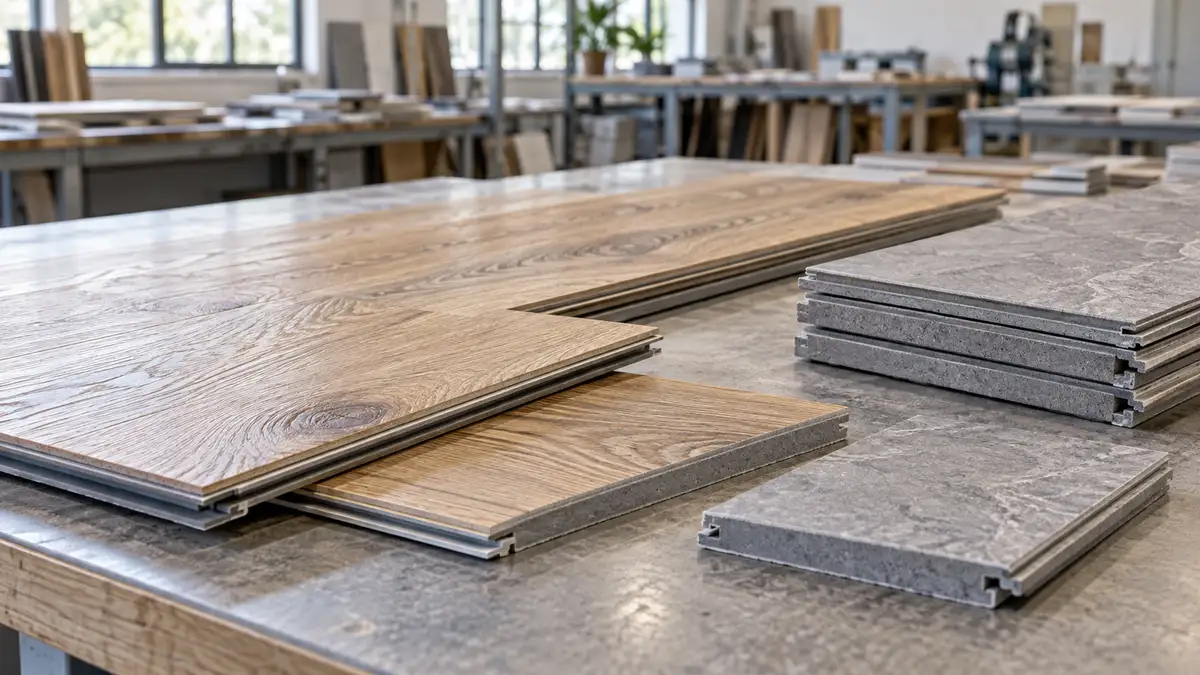
One rate for every vinyl floor
Luxury vinyl tile, rigid stone plastic composite and sheet vinyl are all floor coverings of plastics. Read from the UK Trade Tariff on 25 September 2026, every PVC line below carried 6% duty on goods from China, and none carried an anti-dumping measure. Floor coverings of other plastics carried the same 6%. For conductive products, see sourcing conductive vinyl flooring. For stair coverings, see our guide to sourcing PVC stair treads. For dance applications, see our guide to sourcing vinyl dance flooring. For sports applications, see our guide to sourcing vinyl sports flooring.
At under a pound a kilo for most of the category, flooring is bought by the container, and freight is a large share of the landed price. Quote per square metre and per container, and confirm the commodity code for each construction.
| Goods | Commodity code | Duty | Anti-dumping duty on China |
|---|---|---|---|
| PVC floor coverings on a support impregnated, coated or covered with PVC | 3918 10 10 90 | 6% | None |
| Other PVC floor coverings (LVT, SPC) | 3918 10 90 90 | 6% | None |
| Floor coverings of other plastics | 3918 90 00 90 | 6% | None |
Flooring is a construction product
Under article 4 of the retained Construction Products Regulation (EU) No 305/2011, when a construction product is covered by a designated standard, the manufacturer must draw up a declaration of performance when the product is placed on the market, and by doing so takes responsibility for the declared performance. Resilient floor coverings are covered by the harmonised standard EN 14041, which sets out the essential characteristics a manufacturer declares, among them reaction to fire, slip resistance and the release of formaldehyde, and how they are assessed and marked. Ask the factory for the declaration of performance and the test reports behind it, check that they name the product you are buying, and keep them with the shipment; the CE and UKCA guide explains the marking.
Chemicals matter for vinyl in particular. UK REACH restricts certain phthalate plasticisers in plasticised material, which is worth asking about where a core contains recycled PVC. The UK REACH guide sets out what to ask the supplier for.
Wear layer, core and click
Three numbers decide the product: the wear layer thickness, the total thickness and the core. A domestic floor and a shop floor need different wear layers, so specify the thickness in millimetres rather than a grade name, and check it on production planks at inspection. For SPC, ask for the core density and a dimensional stability test, because a core that moves with heat will open at the joints near a window.
The click profile is the other question. Some locking systems are patented and licensed, so ask whether the profile the factory offers is licensed for the market you sell into, and test that planks from the start and end of the run still lock together.
Worked duty example
Take a hypothetical order of a container of 3,000 m² of SPC click flooring, entered under 3918 10 90 90: £18,000 free on board plus £3,500 of freight and insurance gives a customs value of £21,500. The 6% duty on PVC floor coverings comes to £1,290, and import VAT is 20% of £22,790, which is £4,558. If you are VAT-registered you normally reclaim the £4,558, leaving £1,290 as the real cost at the border. Flooring is heavy for its value, so freight is a sixth of the customs value here. Step by step: UK import duty and VAT.
Inspection checklist
Indentation and castors: test residual indentation to ISO 24343-1 and castor chair performance to ISO 4918 on planks from production, against the use class claimed for commercial or domestic areas.
Colour and emissions: test colour fastness to light to ISO 105-B02 on each décor, and ask for a volatile organic compound chamber test to ISO 16000-9 for the construction of plank being shipped.
Pallets and cartons: check cartons are dry, planks are flat on arrival after acclimatising, and pallets carry batch and décor numbers that match the samples approved for the project.
Working out your own order? Send us the product on WhatsApp and we reply the same working day: WhatsApp us
What goes wrong
Vinyl flooring fails on the wear layer, the core and the joints. Wear layers measure thinner than the specification, SPC cores are brittle or too light in stone filler and snap at the click, and planks shrink, grow or curl with heat so joints open or peak near windows. Click profiles from different batches do not lock together, colour and embossing vary between batches, and cores made from recycled PVC contain restricted phthalates.
Measure wear layer and total thickness to EN ISO 24340 on samples from each batch, test dimensional stability and curling after heat to EN ISO 23999, test click joint strength and assemble planks from different batches, check slip resistance and reaction to fire against the EN 14041 declaration, test cores for restricted phthalates, and record batch numbers on every carton.
Batches and loading
Colour and embossing vary between production batches, so a customer who orders more later may not get a match. Keep batch numbers on every carton, ship a single batch per order where you can, and hold a few cartons back as a reference for the next run.
Flooring is heavy and the cartons crush at the corners, so the container loading check should look at pallet build and stacking as well as the count. Cambridge China Bridge sources vinyl flooring by the container: specification, declaration of performance, batch control and a loading check before it sails. See how our sourcing service works.
For ceramic and porcelain floor and wall tiles, which carry UK anti-dumping duty on top of the 4% rate, see our ceramic and porcelain tiles guide.
Frequently asked questions
What is the UK import duty on LVT and SPC flooring from China?
Read from the UK Trade Tariff on 25 September 2026, PVC floor coverings including LVT and SPC carried 6% duty from China, with no anti-dumping duty.
Does vinyl flooring need a declaration of performance?
Resilient floor coverings are covered by the harmonised standard EN 14041, which sets out the characteristics declared, such as reaction to fire, slip resistance and formaldehyde release. Ask the factory for the declaration and its test reports.
What should a vinyl flooring specification state?
The wear layer and total thickness in millimetres, the core type and density, the click profile and whether it is licensed, the finish and embossing, and the batch marking on each carton.
Why does reordered flooring not match?
Colour and embossing vary between production batches. Mark batch numbers on every carton, ship one batch per order where possible, and keep reference cartons.