UK resin bound pan mixer sourcing from China
Specify a forced-action pan mixer around your resin-bound recipe, site supply and proven working batch, then verify cleaning access, safety documents and UK repair support before ordering. Compare its complete delivered and supported cost with a UK-bought equivalent. China-side factory checks can be coordinated by Cambridge China Bridge.
Brief the factory for resin-bound work
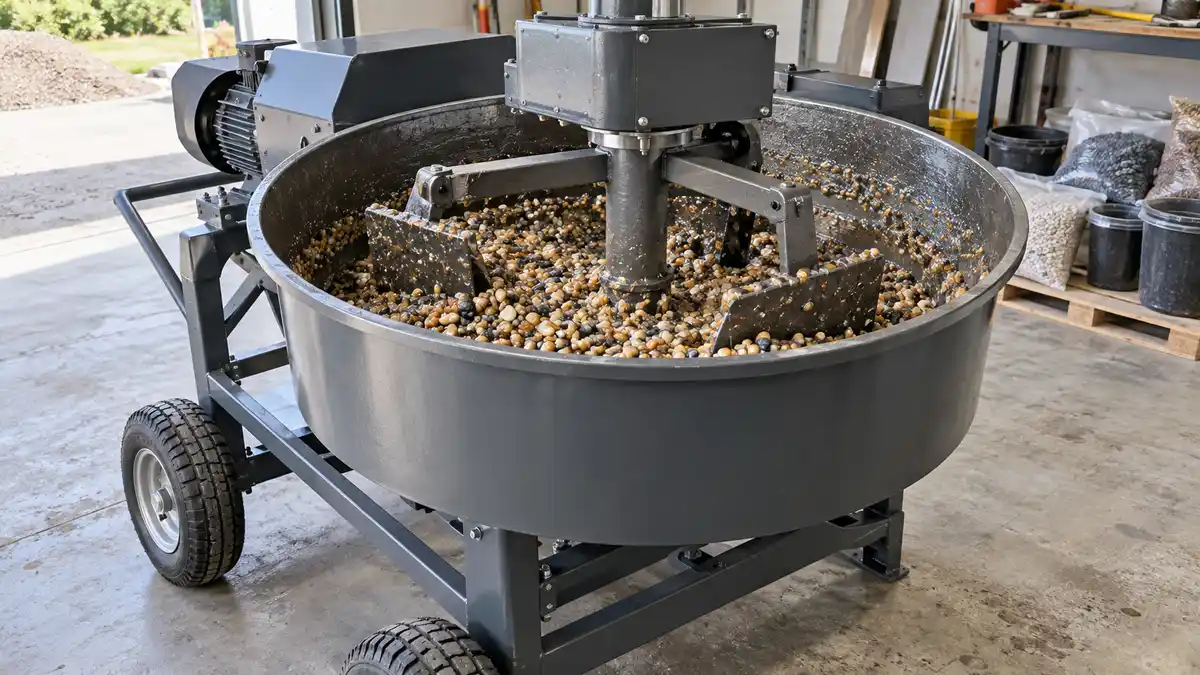
Specify a forced-action pan mixer for mixing resin and aggregate, with driven paddles. Describe your aggregate grading, resin system, intended batch and discharge method. Ask the factory to demonstrate that configuration with representative materials. A demonstration using dry aggregate alone does not establish performance with your resin-bound recipe.
Our general crushers and concrete mixers guide covers broader plant sourcing. For this purchase, approve the motor, paddle geometry, pan, discharge gate and cleaning access before approving your branding. Use product development to turn those decisions into a factory specification.
Choose the site supply before the motor
HSE recommends cordless tools or a 110V centre-tapped-to-earth supply, limiting voltage to earth to 55V. For a mixer intended to run through your yellow site transformer, ask an electrician to confirm its CTE output and suitability for the proposed machine. HSE says equipment must match the supply voltage and available current; check the specification rather than relying on the transformer’s colour.
HSE warns that damaged or faulty 230V equipment presents a high injury risk. Its construction guidance recommends damage checks every shift, weekly visual inspections and combined inspection and testing before site use, then monthly. Ask the factory to demonstrate loaded starting and sustained mixing with the intended transformer, leads and connectors. Agree the site supply with your contractor before choosing either version.
Prove working capacity, not just pan volume
For a mixer advertised by its litre class, ask whether the stated capacity means total pan volume, permissible charge or mixed material discharged. These describe different things. Record nominal pan volume separately from the working batch, including whether the batch claim uses volume or mass and which aggregate and resin recipe supports it.
Agree a witnessed batch test using your materials and mixing sequence. Weigh the inputs and discharged material, and record mixing time, motor current, spillage, unmixed pockets and residue around the paddles and gate. Check coating consistency across the discharged batch. Write the accepted working batch and test conditions into the specification, with evidence from factory verification.
Test cleaning, wear parts and UK repairs
Ask for a written cleaning method covering uncured residue and cured resin. Have the factory demonstrate access and paddle or liner removal on an isolated machine. Confirm which scrapers, cleaning products and removal methods are compatible with the pan, coatings and seals. Do not approve aggressive solvent use or hammering as a routine method without documented manufacturer guidance.
Request an illustrated parts list and drawings for paddles, liners, seals, bearings, belts, switches and the discharge gate. Confirm whether liners are replaceable or the pan must be renewed. Identify a UK repairer willing to service the actual motor and gearbox, and agree spare availability, fault diagnosis and warranty handling. Our machinery after-sales agreement guide helps define that support.
Match safety evidence to your branded mixer
For machinery placed on the Great Britain market, GOV.UK permits CE or UKCA marking under the applicable conformity route. The responsible person must compile the technical file, carry out conformity assessment and provide a Declaration of Conformity with the machinery. Request the English instruction manual and check that the declaration, labels, drawings and reports identify your actual branded model and electrical configuration.
The machinery rules require protection against dangerous contact with moving parts and provide for emergency stops, subject to exceptions. Have a competent machinery specialist assess paddle access, drive guards, discharge openings and stopping controls. Arrange witnessed checks against the agreed assessment through testing and certification. Read own-brand responsibilities, but ask a solicitor to resolve legal questions about your machinery role before approving the declaration.
Working out your own order? Send us the product on WhatsApp and we reply the same working day: WhatsApp us
Compare complete costs with a UK-bought mixer
Obtain a UK quote for an equivalent working batch, supply version and support package. Against it, assemble the China machine cost, samples, branding work, compliance checks, packing, freight, insurance, clearance, handling, delivery, unloading, transformer if needed, commissioning and initial spares. Compare cleaning labour, replacement paddles and liners, local repairs and downtime alongside the purchase cost.
Tariff example: after checking the mixing sub-codes, 8474390000 is a declarable leaf for other mixing or kneading machines. Its API shows zero third-country duty and standard VAT of 20%. Treat this as a candidate example, not a classification decision for every resin mixer. Ask your customs broker to confirm the code, applicable measures and customs and VAT values for the actual machine.
Keep separate duty and import VAT lines even when duty is nil. Compare both offers on the same VAT basis, separating recoverable VAT from costs that remain. Include the support you would otherwise obtain with the UK machine, and identify who supplies it for the import. Our landed-price guide explains the wider comparison.
Frequently asked questions
Should I buy a 110V or 230V resin-bound pan mixer?
Start with the site supply. HSE recommends a 110V CTE supply for site tools. Confirm transformer suitability and loaded starting with an electrician; assess a 230V version against the site’s electrical arrangements and inspection plan.
Does nominal pan capacity equal working capacity?
Do not assume it does. Ask what the advertised capacity measures, then witness a batch using your aggregate and resin. Record inputs, usable discharge, coating consistency and motor behaviour.
How do I remove cured resin from a pan mixer?
Obtain the manufacturer’s documented method for the actual pan, paddles, liners and seals. Demonstrate cleaning access and removal on an isolated machine. Confirm compatible products and tools before approving the order.
Is importing a resin-bound pan mixer cheaper than buying in the UK?
Compare equivalent working capacity and support. Include freight, import taxes, checks, commissioning, transformer, spares, cleaning labour and repairs. A factory quote alone cannot establish the saving.