Sourcing diamond sharpening plates from China
Diamond sharpening plates confirmed under heading 6804 carry 0% UK duty from China across the listed lines, with no anti-dumping or countervailing duty. Consumer plates supplied in Great Britain must be safe. Confirm the abrasive construction before ordering. Cambridge China Bridge sources diamond sharpening plates.
Buying from China for a business? How our UK China sourcing agent service works · China sourcing agent for small orders and first imports
UK duty and classification
Heading 6804 covers grinding and sharpening products made from natural stone, agglomerated abrasives or ceramics, including hand sharpening stones with parts of other materials. For diamond sharpening plates, establish whether the abrasive is agglomerated or surface-coated and describe the intended hand use. The table repeats the hand-sharpening line for different plate formats, subject to confirmation. See the wider sharpening whetstones guide.
Read from the UK Trade Tariff on 1 October 2026, all listed lines under heading 6804 carried 0% duty for goods from China. The file records no anti-dumping or countervailing duty and no suspensions. It attaches waste import and export controls. Official guidance says waste shipment controls apply only to waste; confirm the China import requirement with your customs broker if plates are discarded goods or scrap.
A commodity code is needed for the customs declaration. Send your broker the material description, abrasive attachment method, photographs and intended use, then confirm the commodity code. Do not select it from the supplier's product name alone.
| Goods | Commodity code | Duty | Anti-dumping or countervailing duty on China |
|---|---|---|---|
| Single-sided diamond hand-sharpening plates, subject to classification | 6804 30 00 00 | 0% | None |
Specify the grit, coating and flatness
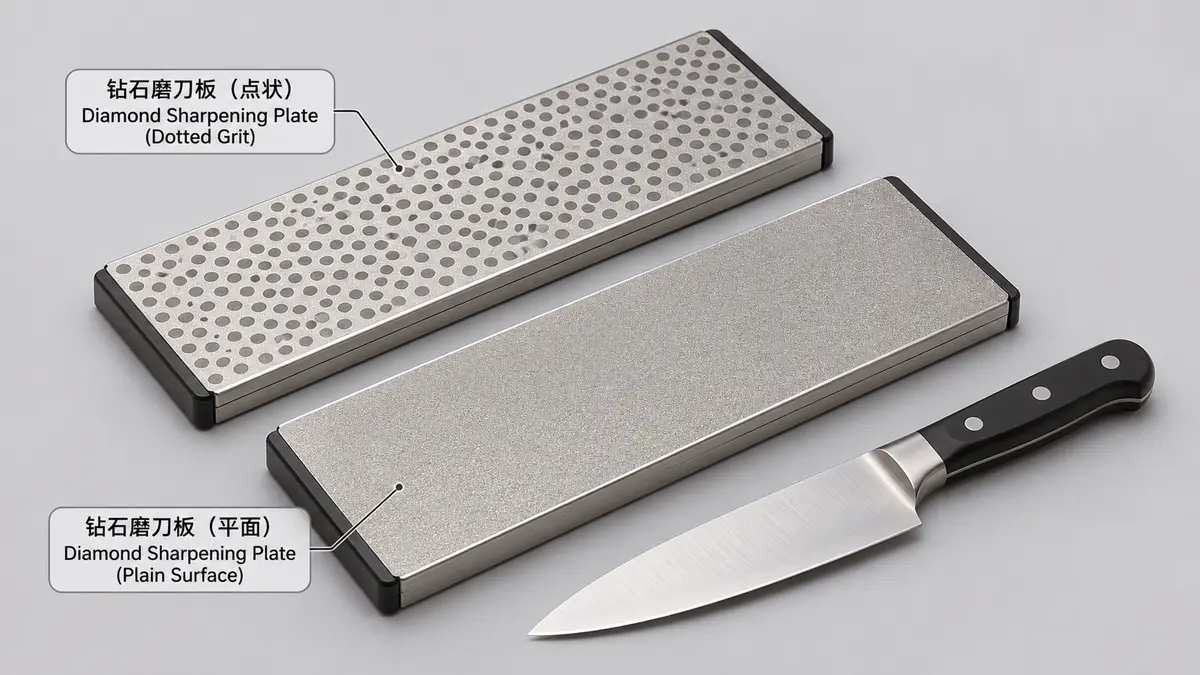
Specify the diamond particle size range and grading method, backing material, abrasive attachment method, working-face dimensions, flatness tolerance and edge finish. Identify the grit on each face and agree whether the surface is continuous or interrupted. State the intended blades, dry or lubricated use, cleaning method and storage instructions.
Approve a physical reference sample and a sharpening trial using the intended blade material. Compare scratch pattern, cutting feel, particle shedding and performance after repeated use. For consumer supply in Great Britain, the plate must be safe. Include checks for exposed sharp backing edges and a base that stays secure during sharpening.
Worked duty example
Illustrative example, not a quote: An illustrative small-business batch of assorted hand-use diamond sharpening plates, with classification confirmed under 6804 30 00 00, invoiced at £2,500 free on board, with £150 of freight and insurance to the UK. The customs value is £2,650. Duty at 0% is £0. Import VAT at 20% is charged on the customs value plus duty, £2,650, so it is £530. With no duty, the only import tax is the VAT, which a VAT-registered importer can usually reclaim. The import duty and VAT guide explains each step.
Inspection checklist
Flatness: check the working face and backing against the agreed tolerance, including corners and any rocking on a flat surface.
Abrasive: inspect grit coverage, bare patches and coarse particles, then compare sharpening performance with the approved sample.
Attachment: check for lifting coating, loose abrasive, separating backing and movement between the plate and its holder.
Finish and packing: check backing edges, grip, face identification, rust and protective packing that prevents abrasive faces rubbing together.
Working out your own order? Send us the product on WhatsApp and we reply the same working day: WhatsApp us
What goes wrong
A plate can look evenly coated but leave deep scratches because oversized particles remain on the face. A grit label alone does not establish the particle distribution. Weak attachment can leave bald patches after use, while a bent backing can give uneven contact when sharpening a chisel.
Double-sided plates can arrive with swapped grit labels, loose bases or damage caused by faces rubbing during transport. Agree the trial and rejection criteria before production, and repeat the trial on arrival samples before releasing stock. Use the quality inspection guide to brief the inspector.
Cambridge China Bridge sources these products for UK businesses, checking the factory and the documents before shipment. See factory verification. For repeat volumes, see container programmes.
Frequently asked questions
What is the UK import duty on diamond sharpening plates from China?
For plates confirmed under heading 6804, the supplied tariff data shows 0% duty on every listed line, with no anti-dumping or countervailing duty.
Which commodity code should I use for diamond sharpening plates?
6804 30 00 00 describes hand sharpening or polishing stones. Ask your broker to confirm whether your plate fits, using its construction and intended use.
How do I check the supplier's grit claim?
Ask for the particle size range and grading method. Compare a sharpening trial and scratch pattern with the approved sample, and inspect for oversized particles.
Do waste import controls apply to new sharpening plates?
Waste shipment controls apply only if the goods are waste. The tariff attaches a waste control; ask your broker to confirm the requirement if importing discarded plates or scrap from China.