Sourcing caravan covers from China
Textile caravan covers from China within heading 6307 carry 6% to 12% UK duty, depending on construction. Importers selling consumer covers are responsible for their safety. Confirm the finished cover's code and approve fit, straps and weather performance before ordering. Cambridge China Bridge sources caravan covers.
UK duty on textile caravan covers
Read from the UK Trade Tariff on 29 September 2026, heading 6307 covers other made-up textile articles. The table gives candidate lines for textile caravan covers, subject to confirming the finished construction and use. Woven and nonwoven candidates carry 6% duty for goods from China; knitted or crocheted articles carry 12%. These are construction alternatives, rather than interchangeable codes.
No anti-dumping or countervailing duty is recorded on these lines. The suspensions attached to the selected nonwoven and other non-knitted lines cover specified textile face masks, not caravan covers. All selected lines attach CITES import and export controls. If materials involve species listed in Annex A, B or C, check the required permits before importing from China or onward exporting.
The nonwoven and other non-knitted lines also attach a torture-goods import prohibition and export restriction. Listed prohibited torture goods cannot be imported; ask your customs broker to confirm applicability to the cover. The nonwoven line attaches a supplementary import unit: confirm the declaration requirement with your broker. Provide composition, construction and samples to confirm the commodity code. For the wider heading, see garden furniture covers.
| Goods | Commodity code | Duty | Anti-dumping or countervailing duty on China |
|---|---|---|---|
| Woven textile caravan covers, candidate classification | 6307 90 98 99 | 6% | None |
| Nonwoven textile caravan covers, candidate classification | 6307 90 98 20 | 6% | None |
| Hand-made caravan covers, neither knitted nor crocheted | 6307 90 98 91 | 6% | None |
| Knitted or crocheted caravan covers, alternative construction | 6307 90 10 00 | 12% | None |
Specify caravan fit, roof protection and fastening
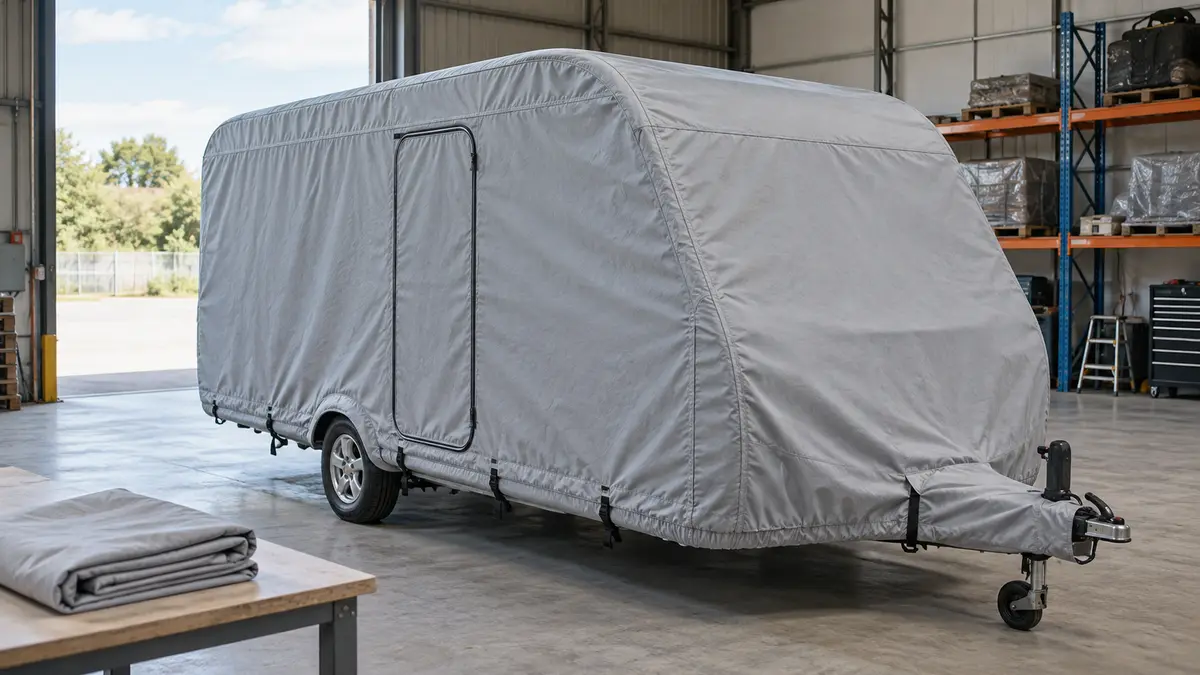
State whether the cover is for stationary storage or towing. Define the caravan body length, width, height and roof profile, and explain whether the drawbar is included in the measurement. Identify roof vents, aerials, corner projections and door position. Approve a complete sample on the intended caravan, checking that the access opening aligns without pulling the fabric tight.
Specify fibre composition, fabric construction, roof and side materials, coatings, inner surface, seams and reinforcement. Agree strap routing, buckle positions, elastic hems and a way to secure loose strap ends. Trial water resistance, drying, colour transfer and abrasion against representative painted surfaces. Consumer-product importers are responsible for safety; include fastening and handling risks in sample review. Record the agreed checks for quality inspection. For shade sails, see our garden shade sail sourcing guide.
Worked duty example
Illustrative example, not a quote: Illustrative only: 800 woven caravan covers in mixed sizes under 6307 90 98 99, invoiced at £25,000 free on board, with £800 of freight and insurance to the UK. The customs value is £25,800. Duty at 6% is £1,548. Import VAT at 20% is charged on the customs value plus duty, £27,348, so it is £5,469.60. Import taxes total £7,017.60; a VAT-registered importer can usually reclaim the VAT, so the lasting cost is the £1,548 of duty. The import duty and VAT guide explains each step.
Inspection checklist
Fit and access: measure finished covers against the agreed drawing and trial the intended caravan, checking roof projections, corner clearance and door-opening alignment.
Fabric and seams: compare roof panels, side panels, inner surface and reinforcement with the retained sample; inspect holes, skipped stitches and tearing beside seams.
Straps and closures: check buckle operation, strap retention, attachment stitching and zip movement; look for exposed hard parts that could rub the bodywork.
Performance and packing: repeat agreed water, drying and rubbing trials; check size identification, care wording, pack contents, dampness and mould.
Working out your own order? Send us the product on WhatsApp and we reply the same working day: WhatsApp us
What goes wrong
A cover can match the advertised body length but be too tight over roof fittings or have its door opening on the wrong side. Wind movement can rub fabric, buckles or trapped grit against paintwork. Compare the complete fitted sample with the agreed strap routing and reinforcement, rather than approving a loose fabric swatch.
Bulk fabric substitutions can change water resistance, drying and seam strength. Water can enter through stitching even when the panel fabric passes a trial, while a cover packed damp can arrive musty. Test the assembled cover and keep storage and towing uses distinct in the specification and instructions.
Cambridge China Bridge sources these products for UK businesses, checking the factory and the documents before shipment. See factory verification. For own-brand ranges, see sourcing for brands.
Frequently asked questions
What is the UK import duty on caravan covers from China?
The selected heading 6307 lines carry 6% for woven, nonwoven and hand-made candidates, or 12% for knitted or crocheted covers. Confirm the finished product's code. The recorded face-mask suspensions do not cover caravan covers.
Which commodity code applies to a nonwoven caravan cover?
6307 90 98 20 is a candidate for nonwoven covers within this heading. Give your broker the complete material construction, coatings, sample and intended use before confirming classification.
How do I specify the right caravan cover size?
Define body dimensions, roof fittings, corner projections and door position. Explain whether the drawbar is included. Trial the complete cover on the intended caravan and check access and strap routing.
Can a storage caravan cover also be used for towing?
Do not assume so. Specify the intended use and seek evidence for the complete cover and fastening arrangement. A stationary fit trial does not demonstrate performance during towing.