Sourcing cordless forensic UV lamps from China
Battery-powered forensic UV lamps and their dedicated parts from China carry a flat 4% UK duty, with no listed trade remedies. Employers must protect workers’ eyes and skin from hazardous artificial optical radiation. Specify wavelength and measured output before ordering. Cambridge China Bridge sources battery-powered forensic UV lamps.
Buying from China for a business? How our UK China sourcing agent service works · China sourcing agent for small orders and first imports
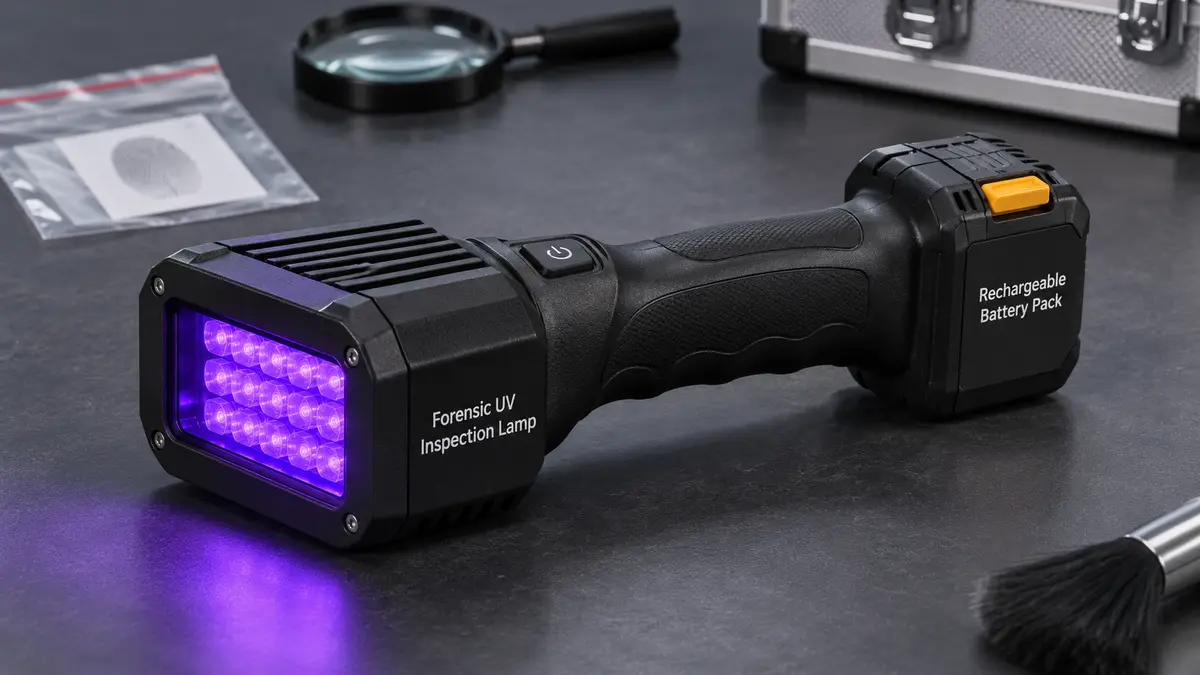
Flat duty on portable forensic UV lamps
Read from the UK Trade Tariff on 30 September 2026, heading 8513 covers portable electric lamps designed to operate from their own energy source, and their parts. This guide concerns battery-powered forensic UV lamps used to examine fluorescence. The table separates product variants sharing the lamp code from dedicated parts.
Both 8513 10 00 00 for lamps and 8513 90 00 00 for parts carry 4% duty on goods from China. The supplied tariff record lists no anti-dumping or countervailing duty, suspensions or attached import controls. Import VAT is normally 20%; see import duty and VAT.
Confirm the commodity code against the lamp’s function, power source and supplied components. Do not automatically classify separately supplied batteries, chargers or protective eyewear as lamp parts. See the wider torches and head torches guide for other portable lamps.
| Goods | Commodity code | Duty | Anti-dumping or countervailing duty on China |
|---|---|---|---|
| Forensic UV lamps powered by replaceable batteries | 8513 10 00 00 | 4% | None |
| Dedicated parts for portable forensic UV lamps | 8513 90 00 00 | 4% | None |
Specify the UV source, filters and usable output
Specify the emission wavelength and bandwidth, irradiance at an agreed working distance, beam coverage, visible-light leakage and output throughout battery discharge. Define the fluorescence target and viewing conditions. Request a spectral report for the complete lamp with its fitted filter, then compare samples using the same target, distance and ambient lighting.
Agree battery chemistry, replaceability, charging connections, switch operation, cleaning method and filter replacement. Request optical safety information for the intended use: employers must protect workers’ eyes and skin from hazardous artificial optical radiation. Arrange controlled sample evaluation rather than judging safety from apparent brightness.
For equipment within the hazardous-substance rules, the importer must be able to demonstrate compliance when the product safety authority requests it. Electromagnetic compatibility rules cover electrical equipment liable to generate electromagnetic disturbance, subject to exceptions; check their application to the lamp’s electronic driver. Confirm applicable battery and WEEE obligations with the relevant authority, and transport testing requirements for lithium models with the relevant transport authority or freight forwarder. Use testing and certification to match evidence to the supplied model.
Worked duty example
Illustrative example, not a quote: 50 battery-powered forensic UV lamps, illustrative order only under 8513 10 00 00, invoiced at £12,000 free on board, with £900 of freight and insurance to the UK. The customs value is £12,900. Duty at 4% is £516. Import VAT at 20% is charged on the customs value plus duty, £13,416, so it is £2,683.20. Import taxes total £3,199.20; a VAT-registered importer can usually reclaim the VAT, so the lasting cost is the £516 of duty. The import duty and VAT guide explains each step.
Inspection checklist
Optical output: compare production samples with the agreed spectral report, fitted filter and fluorescence target; measure output at the specified distance and through the agreed operating period.
Filters and housing: check filter identity, scratches, fit and retention, lens cleanliness, battery-door seals and switch operation. Repeat the functional check after the agreed handling and cleaning tests.
Battery and charging: verify the supplied cell model, polarity, contacts and charging connection; monitor temperature during charging and operation, and compare run time with the approved sample.
Documents and identification: match model and batch identification to reports, instructions and supplied accessories. Check battery and WEEE markings against the approved artwork during inspection.
Working out your own order? Send us the product on WhatsApp and we reply the same working day: WhatsApp us
What goes wrong
A substituted emitter or filter can change fluorescence contrast while the lamp still appears to work. Visible-light leakage, uneven illumination and output that falls as the battery discharges can make sample comparisons unreliable. Keep the approved lamp, spectral report and fluorescence target together as the acceptance reference.
Other failure points include loose filters, scratched optics, intermittent battery contacts and charging heat. Record faults against the batch and repeat the agreed optical and electrical checks after any component substitution. A working lamp alone does not establish its suitability for the buyer’s forensic method.
Cambridge China Bridge sources these products for UK businesses, checking the factory and the documents before shipment. See factory verification. For components and parts, see sourcing for manufacturers.
Frequently asked questions
What is the UK import duty on forensic UV lamps from China?
Battery-powered portable lamps under 8513 10 00 00 and dedicated parts under 8513 90 00 00 carry 4% duty. The supplied tariff record lists no anti-dumping or countervailing duty.
Which wavelength should I specify for a forensic UV lamp?
Choose it for your fluorescence target and examination method. Agree bandwidth, filter, working distance and viewing conditions, then compare samples with measured spectral output.
Does battery power remove the need for UV safety checks?
No. Request optical safety information for the intended working conditions.
What should I request for rechargeable forensic UV lamps?
Request the cell identity, charging specification, run-time results and matching product reports. For lithium models, confirm applicable transport testing and test-summary requirements with the relevant transport authority or freight forwarder.
Sources
What most often fails: Lighting products
UK OPSS + EU / EEA Safety Gate (alerts counted separately in each system) · China-origin alerts over the 24 calendar month coverage window(2024-12 – 2026-11) · 327
Combined counts are alerts from both systems, not unique products across markets. Each source uses its own publication window; the same product may appear in both. · OPSS: 2024-12 – 2026-11 · Safety Gate: 2024-12 – 2026-11
- Electric shock: 243
- Fire: 67
- Chemical: 38
Most-cited regulations
- Low Voltage Directive: 218
- EN 60598: 109
- EN 60598-1: 85
Checks to ask the factory for
- Ask for an accredited laboratory test report to the relevant product standard, such as BS EN 60335 where applicable.
- Check plug, fuse and cable markings against the approved pre-shipment sample.
- Ask the factory to identify insulation, earthing and access-to-live-parts checks for this model.
Questions for due diligence, not a certification checklist or a guarantee of compliance. Select the applicable standards and tests with a competent laboratory.
The current calendar month is partial. These are published alerts, safety reports and recalls, not a measure of all products sold or a recall rate. Hong Kong is reported separately.
All recall dataContains public sector information licensed under the Open Government Licence v3.0 (OPSS, GOV.UK product safety alerts)
Source: European Commission, Safety Gate, English XML (en), extracted 2026-11-09. XML distribution: CC0. Cambridge China Bridge analysis.