Sourcing automotive intercoolers from China
Automotive intercoolers and related parts have listed UK duty rates of 2% to 4% from China, with 0% suspensions for specified goods. Confirm classification and suspension eligibility; consumer-use products must be safe before sale in Great Britain. Cambridge China Bridge sources automotive intercoolers.
UK duty on automotive intercoolers
Read from the UK Trade Tariff on 30 September 2026, heading 8708 covers motor-vehicle parts and accessories. The selected lines concern coolers, radiator parts and intercooler brackets. Treat them as classification candidates, not interchangeable codes. A charge-air intercooler cools intake air; distinguish it from the coolant radiator covered in our engine cooling radiator guide.
The selected China-origin lines carry ordinary duty of 2% or 4%, with no anti-dumping or countervailing duty recorded. The supplied tariff records show 0% suspensions for the specified ribbed aluminium cooler and qualifying compressed-air supply assemblies, with exclusions for mixtures, preparations and combined products containing them. They also attach an ozone-depleting-substance restriction on entry into free circulation and a cultural-goods export-licence measure. Confirm the declaration requirements and relevance of these controls with your customs broker.
Send the broker drawings, materials, vehicle applications and details of whether the shipment contains complete coolers, separate parts or manufacturing components. Use finding your commodity code before ordering. Do not budget for a suspension simply because a supplier calls its product an intercooler.
| Goods | Commodity code | Duty | Anti-dumping or countervailing duty on China |
|---|---|---|---|
| Ribbed aluminium compressed-air cooler for specified vehicle assembly | 8708 91 20 20 | 2% | None |
| Other radiators, a candidate line for complete automotive intercoolers | 8708 91 35 90 | 4% | None |
| Other radiator parts, including qualifying compressed-air supply assemblies | 8708 91 99 90 | 2% | None |
| Specified radiator or intercooler mounting brackets for manufacture | 8708 99 97 58 | 2% | None |
Specify the core, connections and vehicle fit
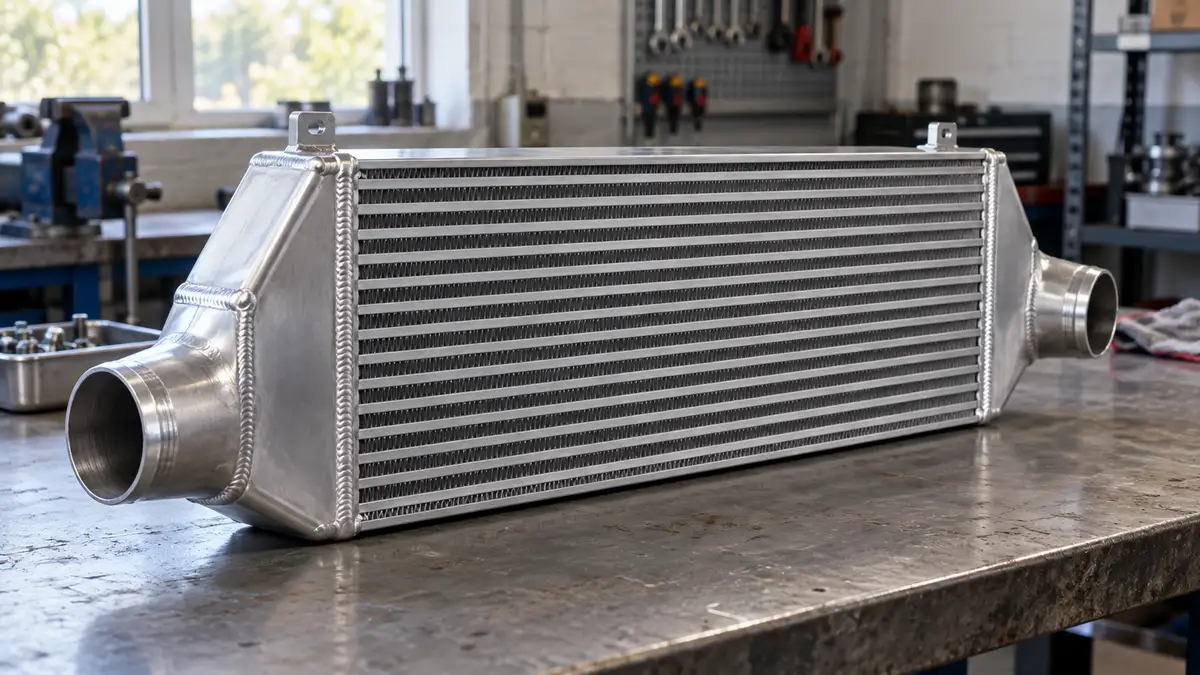
Order against the vehicle application and original part cross-reference. Fix air-to-air or liquid-cooled construction, core dimensions, tube-and-fin or bar-and-plate design, tank material, inlet and outlet orientation, hose connections, sensor bosses and mounting positions. Record whether seals, brackets and hoses are included. For rear axle orders, see our rear axle sourcing guide.
Agree leak-test pressure, hold period and acceptance criteria with the supplier rather than accepting an unexplained test stamp. For performance claims, request heat-rejection and pressure-drop results with the airflow, inlet temperature and test conditions identified. Trial-fit the approved sample with the intended pipework and surrounding vehicle parts.
For consumer-use intercoolers sold in Great Britain, general product safety rules apply where specific safety provisions do not cover the relevant risk. Products must be safe under normal or reasonably foreseeable use before being placed on the market. Keep installation information and product-specific test evidence with the purchasing file.
Worked duty example
Illustrative example, not a quote: Illustrative order of 50 automotive intercoolers under 8708 91 35 90, invoiced at £6,000 free on board, with £1,500 of freight and insurance to the UK. The customs value is £7,500. Duty at 4% is £300. Import VAT at 20% is charged on the customs value plus duty, £7,800, so it is £1,560. Import taxes total £1,860; a VAT-registered importer can usually reclaim the VAT, so the lasting cost is the £300 of duty. The import duty and VAT guide explains each step.
Inspection checklist
Fit: compare mounting centres, connection orientation, hose seating and sensor bosses with the approved drawing and trial-fit sample.
Integrity: inspect brazed joints, tank seams and welds; witness the agreed leak test and record results against the batch.
Cleanliness: check passages for loose metal, flux residue and debris, and inspect fins for crushing or blocked airflow.
Packing: check protected ports, supported brackets, matching part labels and batch identification; inspect arrival cartons for impact damage before releasing stock.
Working out your own order? Send us the product on WhatsApp and we reply the same working day: WhatsApp us
What goes wrong
A cooler can match the catalogue photograph yet have reversed connections, misplaced brackets or a different core. Leaking seams lose boost pressure, while loose internal debris can enter the intake system. A larger-looking core does not prove improved cooling or acceptable pressure drop.
Freeze the drawing and approved sample before production. Ask the factory to disclose changes to core construction, tanks and joining processes. Separate damaged or failed arrival stock, retain the batch identity and compare failures with the pre-shipment test records. Avoid treating a manufacturing-only tariff description as a general aftermarket exemption.
Cambridge China Bridge sources these products for UK businesses, checking the factory and the documents before shipment. See factory verification. For machinery and equipment, see machinery imports.
Frequently asked questions
What is the UK import duty on intercoolers from China?
The selected lines carry 2% or 4% ordinary duty. Specified coolers and compressed-air supply assemblies have 0% suspensions. No anti-dumping or countervailing duty is recorded for these lines.
Which commodity code should I use for an automotive intercooler?
8708 91 35 90 is a candidate for a complete cooler. Confirm it against the construction and vehicle use; industrial-assembly goods, separate parts and brackets have different descriptions.
How do I check whether an intercooler fits?
Use the vehicle application, original part cross-reference and dimensioned drawing. Trial-fit a sample, checking mounts, pipework, sensor bosses and clearance around surrounding parts.
What testing should I request from the Chinese factory?
Agree a recorded leak test with defined acceptance criteria. Request heat-rejection and pressure-drop evidence under stated conditions, and check cleanliness inside the air passages.