Sourcing rear axle assemblies from China
The supplied rear-axle-related lines carry 2% to 4% UK duty from China before conditional suspensions. Demonstrate compliance with applicable product safety requirements before sale. Specify vehicle fitment, axle load and differential ratio. Cambridge China Bridge sources automotive rear axle assemblies.
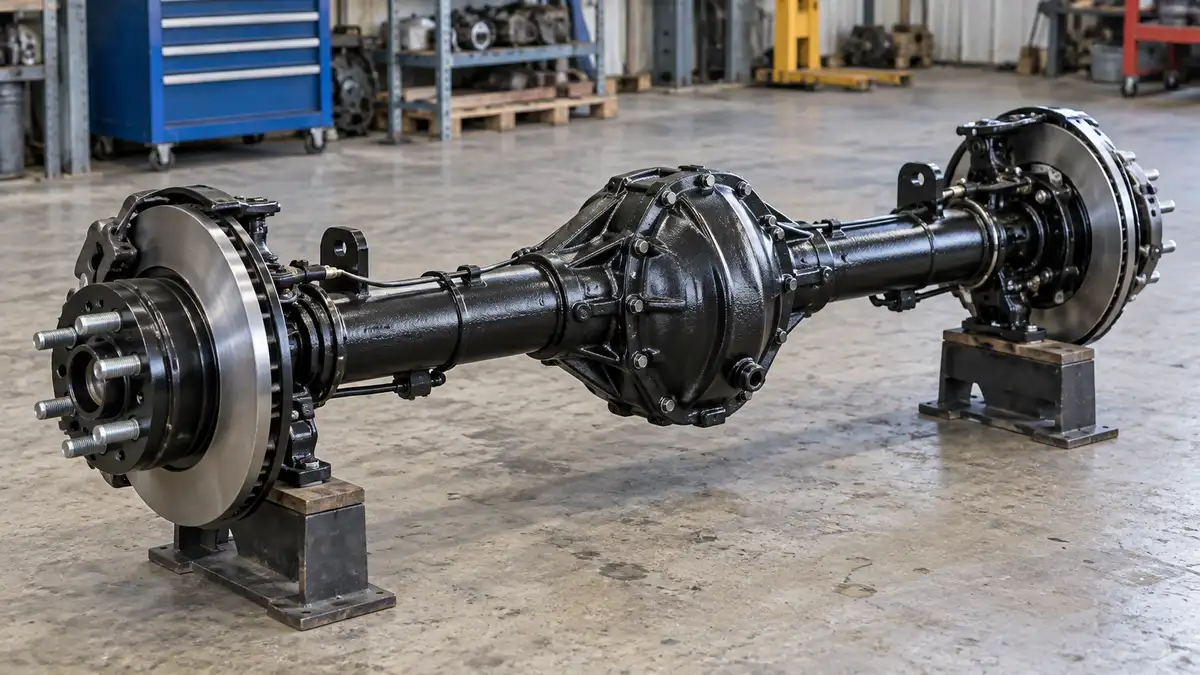
UK duty on rear axle assemblies
Read from the UK Trade Tariff on 30 September 2026, heading 8708 covers motor vehicle parts and accessories. Its axle branch includes drive axles with differentials, non-driving axles and their parts. The table separates qualifying industrial-assembly axles from replacement components. The supplied facts do not include a general aftermarket code for complete rear axle assemblies. See the wider automotive aftermarket guide.
The selected lines carry 2% or 4% duty for goods from China and record no anti-dumping or countervailing duty. Codes 8708 50 20 90 and 8708 50 99 35 list product-specific 0.00 % suspensions; the former also lists authorised-use relief. Their scope notes are truncated, so ask your broker to check the complete conditions. Confirm the commodity code against the actual assembly, components and intended use before claiming relief.
The selected lines attach an ozone-depleting-substance restriction on entry into free circulation and a cultural-goods export-licence measure. Ask the relevant authority to confirm restrictions on ozone-depleting substances in new equipment and any exception for recycled halons for critical uses. Obtain the supplier's material declaration and ask your customs broker to confirm the declaration and document requirements for goods from China, and whether the listed export measure affects the transaction.
| Goods | Commodity code | Duty | Anti-dumping or countervailing duty on China |
|---|---|---|---|
| Rear axles for qualifying industrial vehicle assembly, other | 8708 50 20 90 | 2% | None |
| Other parts for non-driving rear axles | 8708 50 91 90 | 4% | None |
| Rear drive-axle constant velocity joints meeting the tariff description | 8708 50 99 35 | 2% | None |
| Rear drive-axle inboard joint tripod spiders meeting the tariff description | 8708 50 99 60 | 2% | None |
Specify fitment, axle load and differential ratio
Order by the original vehicle manufacturer's part reference, application list and approved drawing. Distinguish a driven rear axle from a non-driving beam and state whether the assembly is newly manufactured or remanufactured. Fix mounting centres, hub interfaces, shaft splines, flange connections, rated axle load and included brackets. For a driven axle, specify the final-drive ratio, differential type, lubricant and breather arrangement.
List whether hubs, bearings, shafts, brakes, wheel-speed sensors and wiring are included. Define bearing preload, gear backlash, sealing, corrosion protection and transport supports against the agreed design. Agree load, fatigue, rotation and leak testing with a competent laboratory. Obtain reports identifying the actual construction; a dimensional inspection alone cannot establish durability.
Products should only be sold after compliance with applicable product safety regulations has been demonstrated appropriately. Identify the safety evidence needed for the intended vehicle application before approving production. Use testing and certification support to organise the evidence review.
Worked duty example
Illustrative example, not a quote: Illustrative order only: 300 rear drive-axle inboard joint tripod spiders under 8708 50 99 60, invoiced at £9,500 free on board, with £1,500 of freight and insurance to the UK. The customs value is £11,000. Duty at 2% is £220. Import VAT at 20% is charged on the customs value plus duty, £11,220, so it is £2,244. Import taxes total £2,464; a VAT-registered importer can usually reclaim the VAT, so the lasting cost is the £220 of duty. The import duty and VAT guide explains each step.
Inspection checklist
Identity: match the assembly, packaging and packing list to the approved part reference, vehicle application, differential ratio, included components and batch.
Geometry: check mounting centres, hub faces, flange connections, shaft splines and bracket positions against the drawing and agreed fitment fixture.
Function: witness agreed rotation and leak tests; check measured backlash and preload records, seals, breathers and sensor connections where fitted.
Arrival condition: inspect housings, welds, boots, machined faces and transport supports for damage, corrosion and contamination. Reconcile received components before releasing stock. Plan sampling with the inspection guide.
Working out your own order? Send us the product on WhatsApp and we reply the same working day: WhatsApp us
What goes wrong
An axle can fit its mounting points yet have the wrong differential ratio, flange, spline or sensor connection. A non-driving beam can have incorrect bracket alignment. Excessive backlash, bearing preload errors, damaged seals and blocked breathers can cause noise, overheating or leakage. Hold affected stock while the supplier investigates against the agreed drawing and test records.
A sample does not control later changes to housing material, weld procedures, heat treatment or bearings. Require written agreement before substitutions and connect inspection records to each production batch. Do not treat a component code or a suspension on a shared code as proof that a complete aftermarket rear axle qualifies.
Cambridge China Bridge sources these products for UK businesses, checking the factory and the documents before shipment. See factory verification. For machinery and equipment, see machinery imports.
Frequently asked questions
What is the UK import duty on rear axles from China?
The selected axle-related lines carry 2% or 4%, before conditional suspensions. The supplied facts omit a general aftermarket code for complete rear axles; have your broker confirm the actual assembly's classification.
What should I send a Chinese rear axle factory?
Send the vehicle application, original part reference and drawing. Specify driven or non-driving construction, axle load, mounting geometry, differential ratio and all included hubs, brakes, shafts and sensors.
Can I use a parts code for a complete rear axle?
Do not assume so. The table includes separate component lines and a qualifying industrial-assembly line. Ask your broker to classify the complete assembly using its construction and intended use.
How do I inspect a rear axle before shipment?
Check identity and fitment against the drawing, verify differential ratio and included parts, witness agreed rotation and leak tests, and review backlash, preload and batch-linked test records.