Courier vs air freight from China: cost, size and clearance
Express courier usually suits a few loose cartons going door to door, with the carrier clearing customs itself. Forwarder-managed air cargo suits palletised or heavy goods, shipments where you want your own customs broker, and deliveries that need a booked slot. Between those, get both quotes for the same packed shipment and delivered scope before deciding.
Buying from China for a business? How our UK China sourcing agent service works · China sourcing agent for repeat and full-container programmes
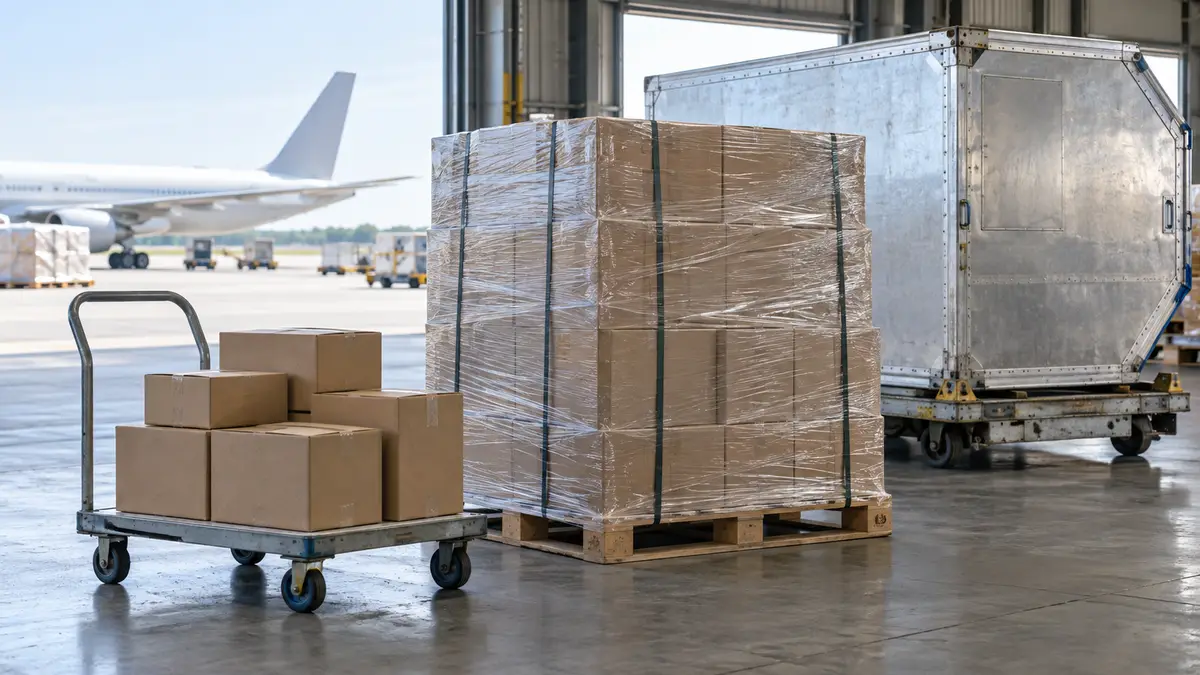
The shipment usually decides the service
Start from the finished packing, not the product. Ask the factory for the carton count, outer dimensions, gross weights and whether the goods will be palletised, with photographs of the packed goods. The table shows which way each feature points. If every row points the same way, you rarely need to quote both.
Whether to fly at all is a separate decision, covered in air or sea freight: when is air worth the cost. This guide assumes you have already decided the goods must go by air.
| Shipment feature | Points to express courier | Points to forwarder-managed air cargo |
|---|---|---|
| Shape of the shipment | A few loose cartons one person can lift | Pallets, crates or heavy single pieces |
| Handling | Each carton can survive sorting on its own | Goods should stay palletised from factory to door |
| Customs clearance | You accept the carrier's own clearance arrangement | You want your own broker and to see the declaration first |
| Delivery | A normal business address with no booking needed | A warehouse slot, tail-lift or unloading equipment |
| Contents | Accepted by the carrier's parcel network as packed | Need special acceptance, documents or handling |
Why the cheaper option changes with size
Courier and air cargo both charge on chargeable weight, the greater of actual and volumetric weight, but they build the price differently. A courier rate covers collection, flight, its own clearance and delivery in one price per shipment. Air cargo adds separate charges for collection, origin handling, the airline, destination terminal handling, clearance and delivery, several of them fixed per shipment, which weigh heavily on a small consignment and much less on a large one.
So small shipments tend to favour the courier and larger, palletised ones the forwarder, with a middle band where either can win. If your shipment sits in that band, ask each provider to show its chargeable-weight calculation from your packed dimensions and an itemised delivered total. The method for comparing them is in comparing freight forwarder quotes. For checking the shipment's weight and payment fields, see how to read an air waybill.
Clearance is the hidden difference
A courier normally clears your goods through its own customs arrangement and may bill duty, import VAT and its own fee to the importer after delivery. Ask before booking whether you can use your own broker instead, how documents and release instructions are exchanged, and what the courier charges for clearance; if a fee arrives that you did not expect, see disputing courier clearance fees. For bulk parcel declarations and records, see our courier bulk clearance guide.
With air cargo, you or your forwarder choose the broker and can review the goods description, value and commodity code before the declaration is made. Whichever service you use, HMRC says appointing someone to deal with customs does not remove your responsibility for the declaration, and the terms of representation should be agreed in writing; see the customs agent guide.
Packing and delivery differ too
Courier parcels usually pass through sorting hubs as individual cartons, so each one must survive that on its own and carry its own label. Air cargo can stay palletised from the factory to your door, which suits fragile goods and multi-carton orders that must arrive together. Agree the packing with the factory before the booking, not after the courier rejects a carton.
For delivery, a courier expects a standard address that can receive parcels in working hours. If your site needs a booked slot, a tail-lift or a forklift, tell the forwarder at quote stage. For the step-by-step courier booking itself, use the urgent courier guide.
Working out your own order? Send us the product on WhatsApp and we reply the same working day: WhatsApp us
Common mistakes
Booking a courier on product dimensions and paying for the volumetric weight of the real cartons; sending pallets into a parcel network that splits them; assuming a door-to-door courier price includes duty and import VAT; and finding out after delivery that your own broker could not be used. Each is avoided by sending both providers the same packed-shipment details and delivery requirements first.
Cambridge China Bridge's staff in China can check the finished packing against the booking before collection, so you do not book transport for goods that are not ready or packed differently from the quote. For deadline-driven orders, see urgent orders from China.
Frequently asked questions
Is express courier cheaper than air freight from China?
Often for a few loose cartons, because one price covers collection, flight, clearance and delivery. For pallets and heavier shipments, air cargo's fixed charges are spread further and it can cost less. Quote both for the same packed shipment.
Why is my lightweight courier shipment expensive?
Bulky cartons can have a higher volumetric weight than actual weight. Ask for the calculation using the finished outer dimensions.
Can I use my own customs broker with a courier?
Ask before booking. Confirm whether the courier supports your broker, how documents and release instructions are exchanged, and whether charges or delivery change.
Does a door-to-door courier price include import VAT and duty?
Usually not. Ask whether duty, import VAT and a clearance fee will be billed separately, and to whom, before the goods are collected.