Will a Chinese extractor fan ventilate my UK home?
A China-made extractor fan can be suitable, but its advertised airflow cannot establish performance through your proposed ductwork. Agree the installed airflow target, replacement-air route, controls and electrical position with your UK installer, then obtain commissioning evidence. Cambridge China Bridge can gather the factory information.
Agree the requirements for your UK nation
Ask your installer to record the property's nation, whether the work concerns a new or existing dwelling, and whether extraction is intermittent or continuous. Ask them to identify the applicable ventilation guidance, room airflow targets and approval route before you order. This guide concerns domestic bathrooms and kitchens; commercial kitchens need a separate design assessment.
England's Approved Document F covers ventilation in England, and earlier editions continue to apply to buildings subject to previous regulatory standards. Ask which edition applies to your project. For Wales, Scotland or Northern Ireland, ask the installer and local building-control or building-standards service to confirm the local guidance and completion evidence rather than adopting England's specification.
Select against the complete duct route
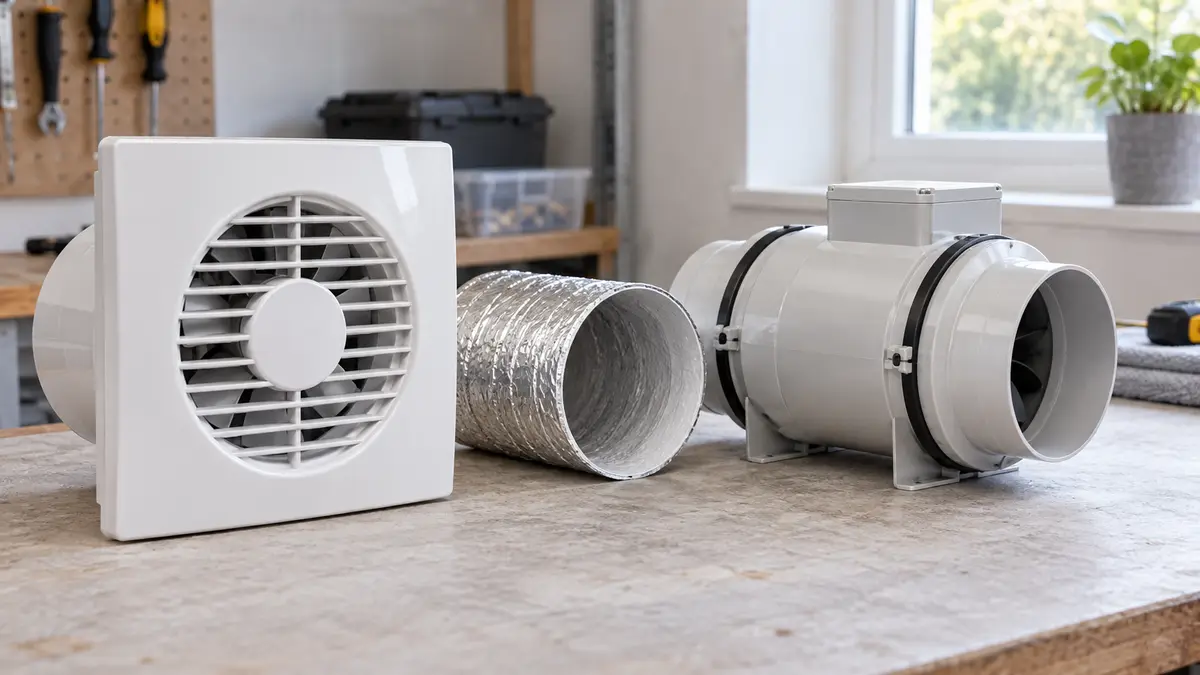
Send the factory a drawing showing duct dimensions, length, bends, flexible sections, grilles, backdraught shutters and the outdoor outlet. Ask for the exact model's airflow-versus-pressure curve and supporting test report. Have your installer calculate the route's resistance and check the airflow available at that resistance, rather than selecting from an unrestricted airflow claim.
Agree how the duct will be supported, sealed, accessed for cleaning and protected against condensation where relevant. Include the installed airflow target, accepted duct arrangement and fan setting in your product specification. If the proposed route leaves insufficient airflow, revise the duct or fan selection before approving production.
Provide a route for replacement air
Ask the installer to show where outdoor replacement air enters and how it reaches the bathroom or kitchen when internal doors are closed. Include existing ventilation equipment, door transfer paths and the final floor finish in the review. A fan cannot deliver its intended extraction if the incoming-air path is too restrictive.
A recirculating cooker hood returns air to the room; ask how moisture will be extracted outdoors separately. Flag any open-flued appliance to the installer for an assessment of the interaction with extraction. Do not approve changes to air inlets or door gaps until the complete ventilation arrangement has been reviewed.
Specify controls that suit the room
Agree how extraction starts, how boost is selected and what happens after the light or switch is turned off. Ask whether the design needs continuous background operation, a run-on timer, humidity sensing or manual override. Have the installer choose the control arrangement and settings for the applicable project requirements.
Request the wiring diagram and supply needs for the selected controller, including any permanent supply. Trial the sample for starting, boost, sensor response, noise and recovery after a power interruption. Record the accepted motor and controller combination through the sample-to-production guide, so substitutions trigger a fresh review.
Have the electrician approve the actual position
Give the electrician a measured bathroom layout showing the bath, shower, fan, switches and any separate power supply. Ask them to assess the precise electrical location, enclosure protection, protective devices, isolation and manufacturer's installation restrictions. A supplier's bathroom label does not establish suitability for the position you intend.
Use our electrical imports guide for product documents and our electrician checks guide for the related bathroom-location and electrical approval questions. Obtain a fan-specific decision before ordering, including any relocation, wiring changes and installation paperwork.
Working out your own order? Send us the product on WhatsApp and we reply the same working day: WhatsApp us
Make commissioning evidence part of acceptance
England's dwelling ventilation guidance says mechanical ventilation systems must be commissioned to provide adequate ventilation and a commissioning notice must be given to building control. Ask your installer to confirm how this applies to your work. For the other UK nations, agree the applicable commissioning and submission arrangements with the local service.
Request a signed record comparing design and measured installed airflow, identifying the fan, duct arrangement, operating settings, test conditions, instrument and calibration evidence. Include control checks, electrical paperwork and operating and cleaning instructions. Agree who corrects shortfalls and retests. A tissue test or factory airflow report alone does not demonstrate the completed installation's airflow.
Frequently asked questions
Is the airflow on the fan listing enough?
No. Ask for airflow at the resistance of your complete duct route. Have the installer agree the target and measure the completed installation.
Can a recirculating cooker hood remove kitchen moisture?
It returns air to the room. Ask your installer to specify how moisture will be extracted outdoors and how replacement air will reach the kitchen.
Can I install an imported fan above my shower?
Have your electrician assess the measured position, enclosure protection, supply, protective devices and installation instructions before ordering.
What proof should I get after the fan is installed?
Ask for signed airflow results against the design target, control checks, electrical paperwork and maintenance instructions. Agree the applicable local commissioning notice or submission with your installer.