Sourcing survey mapping drones from China
Survey mapping drones from China carry 0% UK duty across the relevant heading 8806 lines, with no anti-dumping or countervailing duty listed. Confirm the applicable UK class-mark requirements with the CAA before placing a new model on the UK market. Verify the mapping payload and positioning evidence. Cambridge China Bridge sources survey mapping drones.
Buying from China for a business? How our UK China sourcing agent service works · China sourcing agent for small orders and first imports
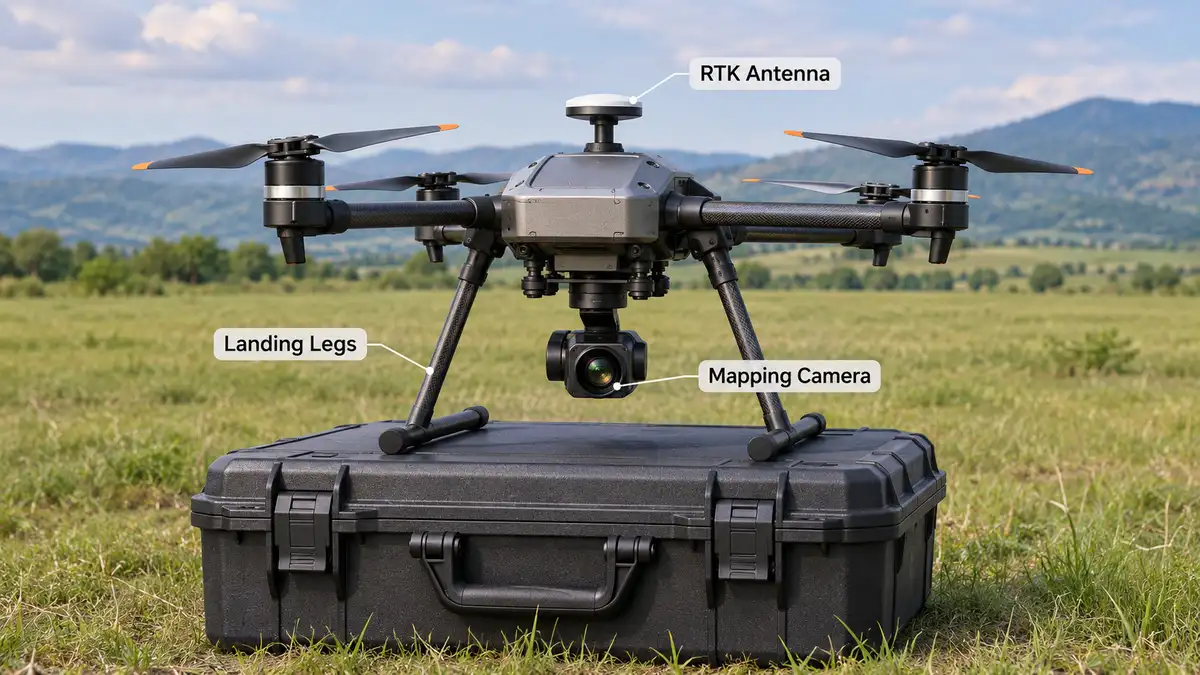
Zero duty on survey mapping drones
Heading 8806 covers unmanned aircraft. For survey mapping drones, classification depends on maximum take-off weight, whether flight is remote-controlled only, and the integrated camera configuration. Obtain the manufacturer's flight-mode description rather than choosing a code from the product name.
Read from the UK Trade Tariff on 6 October 2026, the relevant lines carry 0% duty for goods from China, with no anti-dumping or countervailing duty and no suspensions listed. The tariff attaches a DCMS Export Licence entry. Official guidance describes cultural-object export licensing from Great Britain; ask your customs broker to confirm how this entry applies to your import. Other heading lines attach fluorinated greenhouse gas import controls; confirm the requirement with your broker if those lines apply.
Confirm each model's commodity code before shipment. The wider drones and aircraft guide covers the broader product family. Allow for 20% import VAT and use the duty and VAT guide for the calculation.
| Goods | Commodity code | Duty | Anti-dumping or countervailing duty on China |
|---|---|---|---|
| Remote-only camera multi-rotors, maximum take-off weight over 250 g to 7 kg | 8806 22 10 00 | 0% | None |
| Other civil remote-only drones, maximum take-off weight over 250 g to 7 kg | 8806 22 90 10 | 0% | None |
| Civil remote-only drones, maximum take-off weight over 7 kg to 25 kg | 8806 23 00 10 | 0% | None |
| Other civil drones, maximum take-off weight over 250 g to 7 kg | 8806 92 00 10 | 0% | None |
| Other civil drones, maximum take-off weight over 7 kg to 25 kg | 8806 93 00 10 | 0% | None |
Specify the mapping system and deliverables
Specify the airframe, mapping camera or laser-scanning payload, lens, shutter type, calibration records and payload mounting. State the coordinate system, height reference, required ground detail and acceptance tolerances. Ask for raw images or scan data, positioning logs and processed survey outputs from the same demonstration flight.
Define the positioning correction method, base-station compatibility, image-trigger timing and processing software. Agree whether software access depends on subscriptions, accounts or internet connectivity. Check that exported data opens in your existing survey workflow and that the aircraft carries the intended payload during acceptance flights.
Confirm the applicable UK class-mark requirements with the CAA before placing a new drone model on the UK market. For radio equipment placed on the Great Britain market, the importer must ensure the manufacturer has completed the relevant conformity assessment. Request evidence matching the supplied aircraft, controller and firmware.
Worked duty example
Illustrative example, not a quote: 7 survey mapping drones, illustrative order under 8806 92 00 10, invoiced at £15,000 free on board, with £800 of freight and insurance to the UK. The customs value is £15,800. Duty at 0% is £0. Import VAT at 20% is charged on the customs value plus duty, £15,800, so it is £3,160. With no duty, the only import tax is the VAT, which a VAT-registered importer can usually reclaim. The import duty and VAT guide explains each step.
Inspection checklist
Configuration: match the aircraft, payload, controller and firmware to the approved specification; check serial numbers, payload mounts, propellers and transport damage.
Mapping output: process sample data in your software; compare results with independently surveyed checkpoints and inspect image sharpness, coverage gaps and height-reference settings.
Positioning and flight: inspect correction and image-timing logs; test correction loss, return-to-home and battery behaviour with the agreed payload under suitable flight conditions.
Documents and batteries: check the class-mark evidence, radio reports, calibration records and English manual against the delivered kit; inspect battery condition and transport test summaries. Use the inspection guide to brief the inspector.
Working out your own order? Send us the product on WhatsApp and we reply the same working day: WhatsApp us
What goes wrong
A positioning receiver's claimed accuracy can be mistaken for the accuracy of the finished map. Incorrect camera calibration, mistimed image triggers, weak correction reception or a mismatched height reference can undermine the result. Accept the system against independent checkpoints and the agreed deliverables.
A factory demonstration can use a different camera, firmware or software licence from the shipped kit. Missing calibration files, locked export functions and incompatible base-station data can stop the buyer's workflow. Record the demonstrated configuration and repeat the processing check on arrival.
Cambridge China Bridge sources these products for UK businesses, checking the factory and the documents before shipment. See factory verification. For machinery and equipment, see machinery imports.
Frequently asked questions
What is the UK import duty on survey mapping drones from China?
The relevant heading 8806 lines carry 0% duty for goods from China, with no anti-dumping or countervailing duty listed in the supplied tariff record. Import VAT is normally 20%.
Do survey mapping drones need a UK class mark?
Ask for the model's supporting evidence before ordering.
How do I check a mapping drone's accuracy?
Process a demonstration dataset in your software and compare the finished output with independently surveyed checkpoints. Agree the coordinate system, height reference and acceptance tolerances beforehand.
Does a mapping drone use the same code as a camera drone?
Not necessarily. Check maximum take-off weight, flight modes and whether the camera is permanently integrated. A model with automated flight capability needs a classification review beyond the remote-only description.