Sourcing steel crowd barriers from China
Steel crowd-control barriers within heading 7326 carry 2% UK duty from China, with no duty variation across the listed barrier options. HSE says barriers used for crowd management should be risk assessed: specify the intended use before choosing the design. Cambridge China Bridge sources steel crowd-control barriers.
Duty on steel crowd-control barriers
Read from the UK Trade Tariff on 8 October 2026, heading 7326 covers other articles of iron or steel. The residual code 7326 90 98 90 is a candidate for fabricated tubular crowd-control barriers. The table shows product variants under that same code, rather than separate tariff classifications. Confirm the finished construction and intended function before declaring it.
The supplied tariff facts show 2% duty for Chinese goods under this code, with no anti-dumping or countervailing duty, suspension or steel measure. They attach an import prohibition and an export restriction concerning torture and repression goods. The government notice describes a ban covering specified goods; the tariff flag alone does not establish that an ordinary barrier is prohibited. Ask your customs broker to confirm the control requirement for the actual goods, including any later export.
Confirm the commodity code using drawings, photographs and a description of the assembled barrier. The site's published background places heading 7326 within the forthcoming UK carbon border adjustment mechanism; ask the factory for emissions information when planning future imports. For related steel articles within the wider heading, see steel security bollards.
| Goods | Commodity code | Duty | Anti-dumping or countervailing duty on China |
|---|---|---|---|
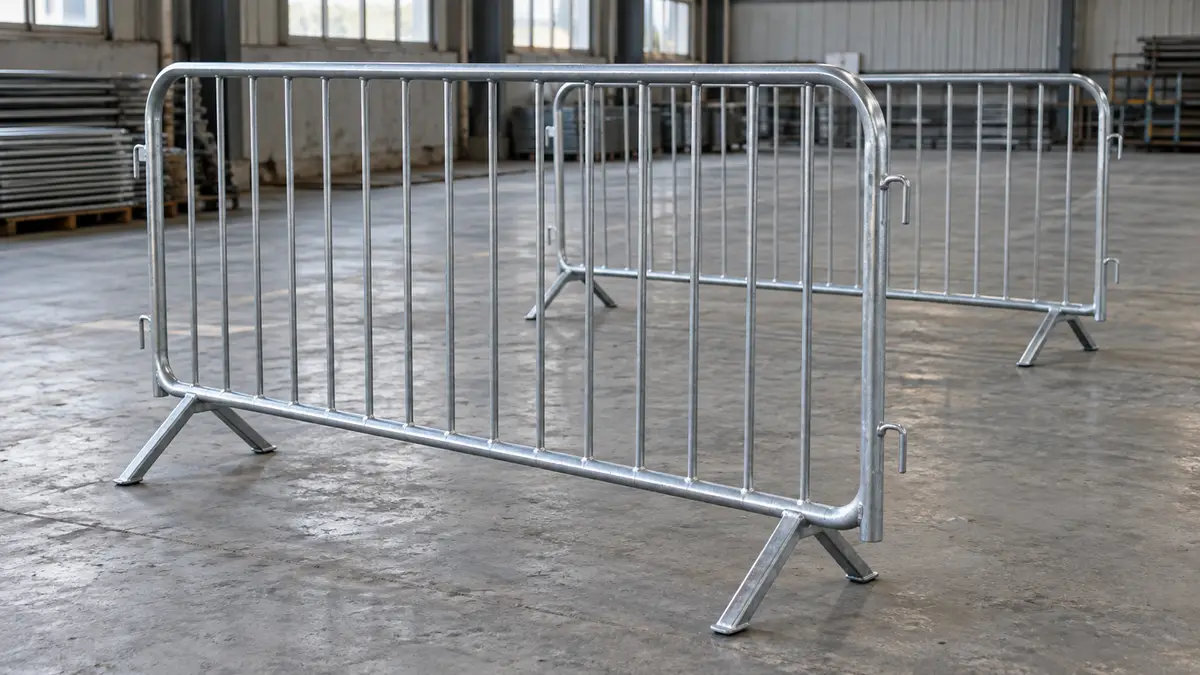
| Tubular steel crowd-control barriers with fixed feet | 7326 90 98 90 | 2% | None |
Specify the feet, connections and intended crowd load
Describe whether the barrier will guide queues, separate pedestrian routes or resist audience pressure. HSE says barriers used for crowd management should be risk assessed. Its selection guidance considers layout, ground conditions, weather and wind or crowd pressure. Ask for evidence supporting the proposed use rather than accepting a photograph or a generic strength claim. For road applications, see our guide to steel road safety barriers.
Specify panel dimensions, tube wall thickness, infill spacing, steel grade, fixed or removable feet, foot orientation and connector geometry. Supply a physical reference if new panels must join an existing fleet. Agree whether galvanising follows welding, how coating defects are repaired, and how panels and loose feet are secured for transport.
HSE states that articles supplied for use at work must be safe, so far as reasonably practicable, and accompanied by adequate information for safe use. Request instructions covering assembly, connections, ground suitability, storage, maintenance and use limitations. Agree the supporting product evidence before approving bulk manufacture.
Worked duty example
Illustrative example, not a quote: Illustrative batch of interlocking steel barriers for an event-equipment hire business under 7326 90 98 90, invoiced at £30,000 free on board, with £5,000 of freight and insurance to the UK. The customs value is £35,000. Duty at 2% is £700. Import VAT at 20% is charged on the customs value plus duty, £35,700, so it is £7,140. Import taxes total £7,840; a VAT-registered importer can usually reclaim the VAT, so the lasting cost is the £700 of duty. The import duty and VAT guide explains each step.
Inspection checklist
Dimensions: compare panel height, width, tube walls, infill spacing and foot geometry with the approved drawing; check packed panels for bending.
Connections: assemble adjoining panels and join them to your reference barrier; check hook alignment, engagement and removable-foot retention.
Welds and finish: examine frame corners, infill welds and foot sockets for cracks, missed welds, sharp edges, bare steel and blocked drainage openings.
Arrival condition: unpack sample bundles, assemble the supplied feet, check rocking and connector damage, and reconcile loose parts and instructions against the packing list. Use the agreed inspection plan.
Working out your own order? Send us the product on WhatsApp and we reply the same working day: WhatsApp us
What goes wrong
Panels can look alike but fail to connect because hook positions or tube profiles differ. Thin tubing, distorted frames and incomplete welds undermine the agreed design. Oversized feet obstruct walking routes, while poorly retained removable feet separate during handling. Check assembled samples before approving production.
Coating can conceal weld defects, and transport abrasion exposes steel at contact points. Ask for photographs before coating and inspect protected contact areas on arrival. Treat a queue-barrier description as insufficient evidence for use against crowd pressure; select the design around the intended deployment and its risk assessment.
Cambridge China Bridge sources these products for UK businesses, checking the factory and the documents before shipment. See factory verification. For repeat volumes, see container programmes.
Frequently asked questions
What is the UK import duty on steel crowd-control barriers from China?
The supplied tariff facts show 2% under candidate code 7326 90 98 90, with no anti-dumping or countervailing duty. Confirm classification for your finished barrier.
Will Chinese barriers fit my existing hire fleet?
Only approve compatibility after joining samples to your existing panels. Match connector position, hook shape, tube profile and foot arrangement in the purchase specification.
Can queue barriers be used in front of a stage?
Do not assume suitability from appearance. HSE says crowd-management barriers should be risk assessed. Ask for evidence that the proposed design suits the intended crowd pressure and layout.
Should I order galvanised or powder-coated barriers?
Choose around exposure, handling and appearance. Specify the coating process and repair method, then inspect weld areas, sockets and transport contact points against approved samples.