Sourcing stainless steel wall ties from China
Stainless steel cavity wall ties under the candidate codes here pay 2% UK duty from China, with no anti-dumping duty shown. For Great Britain, legitimately CE-marked construction products remain accepted. Match the tie to the designed cavity and verify its performance documents. Cambridge China Bridge sources stainless steel cavity wall ties.
Duty and classification for cavity wall ties
Heading 7326 covers other articles of iron or steel. Wire ties and strip ties need separate classification checks based on their construction and manufacture. The table repeats candidate codes for different tie forms; it does not establish a final classification. For the wider structural product family, see steel structures and fabrications.
Read from the UK Trade Tariff on 30 September 2026, the candidate lines carry 2% duty for goods from China, with no anti-dumping or countervailing duty and no steel measure shown. The listed suspensions concern other specified products, not these wall ties. The residual other-articles code carries torture and repression import-prohibition and export-restriction controls; confirm their relevance with your customs broker.
Give your broker the drawing, material form and manufacturing process to confirm the commodity code. Import VAT is normally 20%. Confirm with HMRC or your customs broker whether and when UK CBAM applies to goods under heading 7326; ask the supplier for emissions data before ordering.
| Goods | Commodity code | Duty | Anti-dumping or countervailing duty on China |
|---|---|---|---|
| Other steel wire articles: straight wire wall ties, subject to classification | 7326 20 00 90 | 2% | None |
| Other steel articles: flat strip wall ties, subject to classification | 7326 90 98 90 | 2% | None |
Specify the cavity, tie ends and stainless material
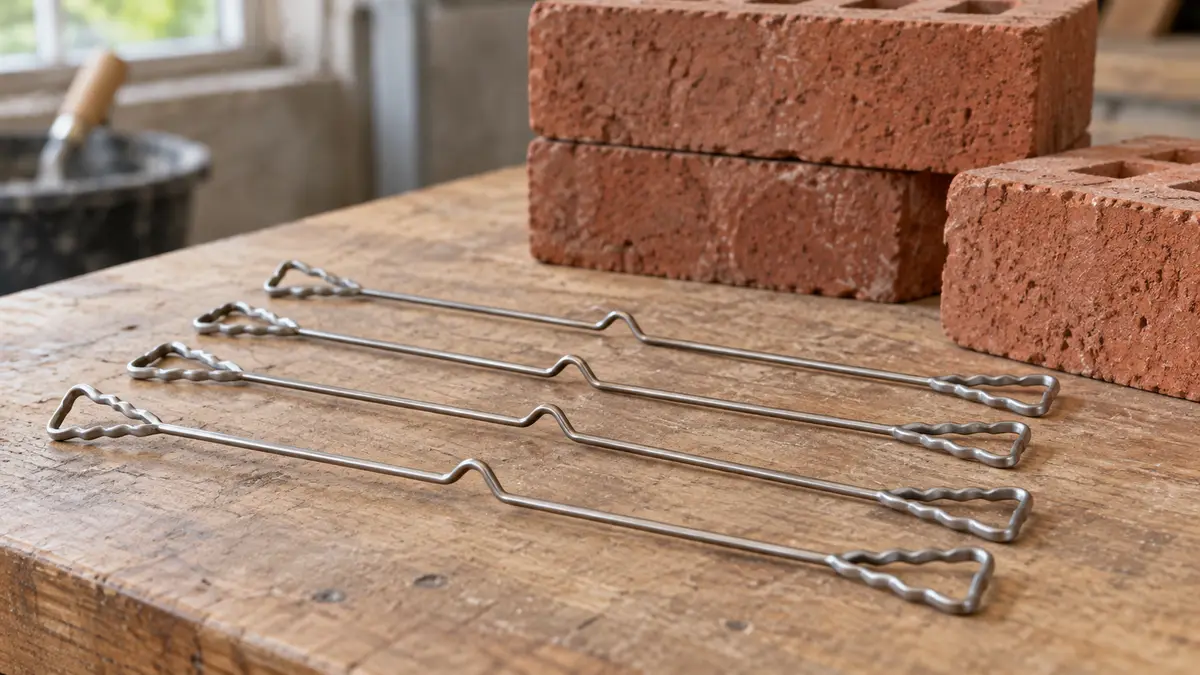
State the wall construction, design cavity width, overall tie length, embedment at each end and intended tension and compression performance. Specify wire diameter or strip thickness, end profile, drip position and any insulation retaining clip. Have the project designer approve the tie selection rather than letting the factory choose a substitute from a photograph.
Specify the stainless material and require batch-linked material certificates. Request the declaration of performance, supporting test reports and installation instructions for the exact tie supplied. In England, Approved Document A's guidance for certain small buildings recommends austenitic stainless wall ties complying with the masonry ancillary-component standard; confirm the applicable project specification.
For Great Britain, legitimately CE-marked construction products can continue to be supplied without additional UK marking. Check that the documents identify the supplied design and intended use before approving the label.
Worked duty example
Illustrative example, not a quote: Illustrative order of 30,000 stainless steel wire cavity wall ties under 7326 20 00 90, invoiced at £5,000 free on board, with £700 of freight and insurance to the UK. The customs value is £5,700. Duty at 2% is £114. Import VAT at 20% is charged on the customs value plus duty, £5,814, so it is £1,162.80. Import taxes total £1,276.80; a VAT-registered importer can usually reclaim the VAT, so the lasting cost is the £114 of duty. The import duty and VAT guide explains each step.
Inspection checklist
Geometry: measure length, wire diameter or strip thickness, end shape and drip position against the approved drawing; check the retaining clip fits.
Material: match the material certificate to the production batch and arrange material verification where the evidence is unclear.
Performance documents: match the declaration, test report, label and installation instructions to the same tie design and cavity range.
Arrival condition: check for bent ties, burrs, contamination, mixed lengths and missing batch labels; retain samples and photographs for inspection records.
Working out your own order? Send us the product on WhatsApp and we reply the same working day: WhatsApp us
What goes wrong
A tie can resemble the approved sample but differ in wire thickness, end anchorage or material. A report for a different tie shape or cavity range does not establish the performance of the delivered batch. Compare the production drawing and documents before accepting a substitution.
Mixed lengths and transit damage make site selection unreliable. Keep each design and length separately labelled, check bundle counts on arrival and quarantine stock with unclear identity. Do not supply construction products in Great Britain when you have reason to believe they do not comply with the applicable requirements.
Cambridge China Bridge sources these products for UK businesses, checking the factory and the documents before shipment. See factory verification. For repeat volumes, see container programmes.
Frequently asked questions
What is the UK import duty on stainless steel cavity wall ties from China?
The candidate lines in the supplied tariff snapshot carry 2% duty, with no anti-dumping or countervailing duty shown. Confirm the code for the actual tie and manufacturing process.
Do cavity wall ties need UKCA marking as well as CE marking?
Check the underlying assessment and documentation for the supplied tie.
What should I send a Chinese wall tie factory?
Send the approved drawing, cavity range, stainless material, dimensions, end details, required performance, clip requirements and packaging labels. Ask for documents covering that exact design.
How do I check wall ties when they arrive?
Compare dimensions and end profiles with the approved sample, match batch identity to material and performance documents, and separate bent, contaminated or mixed-length stock.