Sourcing small wind turbines from China
Buy against annual energy yield at your site's hub-height wind conditions, not the advertised kilowatt rating. Require the tested rotor–controller–load configuration, a power curve with uncertainty, and documented overspeed protection. A factory spin test cannot establish annual generation.
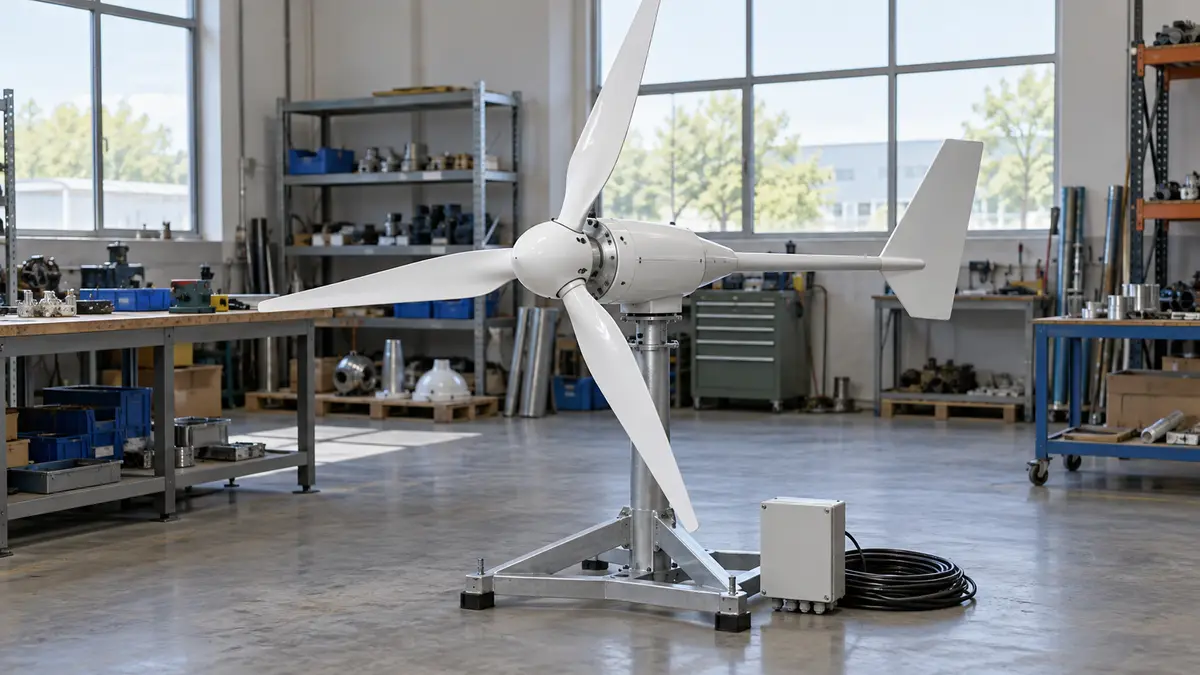
Start with annual generation, then choose the turbine
Ask an installer or wind assessor to estimate annual generation using the proposed turbine's power curve, wind conditions at hub height, tower height and local obstructions. The US Department of Energy's Small Wind Guidebook explains this approach. Use it as technical guidance, not UK regulatory guidance.
For competing offers, request the rated-output wind speed, rotor diameter, cut-in behaviour, electrical measurement point and the exact controller, inverter or battery configuration used during testing. Compare output delivered to the intended load rather than mixing generator-terminal figures with usable system output.
IEC 61400-12-1:2022 covers power-performance measurement, including small turbines connected to a network or battery bank, and requires assessment of uncertainty alongside measured power curves and derived energy production. Request the complete model-specific report, not a graph copied into a brochure.
Put the agreed configuration and acceptance evidence into a product specification. If the project combines wind, solar and storage, specify the interfaces alongside the equipment covered in our solar and battery sourcing guide.
Where to look in China
Qingdao, Shandong: Qingdao Anhua New Energy describes manufacturing small and medium wind equipment, with motor-testing and rotor-balancing facilities. Its published address is in the Sino-German Science and Technology Park, Aoshanwei Subdistrict, Jimo District. Ask separately for the assembly and test-site addresses before arranging a factory visit.
Treat this supplier information as a route to a shortlist. Manufacturer descriptions are self-published claims, not independent endorsements or evidence of UK compliance.
Inspect the protection system, not just a spinning rotor
Use IEC 61400-2:2013 as a small-wind safety reference when commissioning technical review. Its scope includes protection mechanisms, electrical and mechanical systems, support structures, foundations and connection to the load. Ask the reviewer to identify which reports cover the supplied system and which elements remain unassessed.
Loss of load and overspeed: require the supplier to explain and document what happens when the battery is full, the inverter trips or the electrical load disappears. Agree a safe, engineered demonstration of the protection sequence, stopping method and restart behaviour. Do not improvise an open-circuit test on a running turbine.
Dump-load mismatch and overheating: for systems using a dump load, record its resistance, continuous heat-dissipation rating, controller limits, enclosure and mounting clearances. Bergey's EXCEL 1 manual illustrates the issue: unsuitable resistance can damage its controller, and dump loads need protection against overheating and fire. Its numerical limits belong to that model; require the Chinese supplier's own limits.
Rotor assembly and vibration: inspect blade damage, blade-tip spacing, hub fasteners, locking arrangements and the tower adapter against approved drawings and the supplier's torque schedule. Bergey's assembly checklist includes evenly spaced blade tips and secure fasteners; use the ordered model's tolerances rather than copying another turbine's values.
Electrical and shipment checks: verify generator, controller and inverter identities; cable polarity; protective-earth arrangements; supplied protection devices; and component quantities. Record serial numbers and measured results. Agree which checks belong in the pre-shipment inspection, and which require specialist testing. Our machinery sourcing service is the relevant starting point for coordinating this scope.
Great Britain compliance and grid connection
For machinery placed on the Great Britain market or put into service, assess compliance with the Supply of Machinery (Safety) Regulations 2008. The UK legislation site's current text was checked on 15 October 2026. Government guidance permits CE or UKCA marking for this regime and requires conformity assessment, a technical file and an accompanying declaration of conformity. Obtain English installation, operating and maintenance instructions.
Match the declaration, identification plate, instructions and technical evidence to the actual supplied configuration. Ask a competent reviewer to determine the complete applicable product-law scope for the turbine and its electrical package; a machinery declaration alone should not be treated as the entire compliance assessment.
For grid-connected systems, have the UK installer establish the applicable G98 or G99 connection route with the distribution network operator before equipment selection. Request the exact generating-unit or inverter type-test reference and supporting report. The Energy Networks Association explains that a compliant register status is indicative and the network operator retains the right to review suitability.
The machinery discussion here concerns Great Britain. Obtain separate advice for Northern Ireland and a site-specific installation review before ordering the tower and foundation.
UK duty on complete small wind generating sets
The UK Trade Tariff entry for 8502310097 sits under wind-powered generating sets, within the residual 'Other' category. On 15 October 2026, it showed 0% third-country duty and 20% standard import VAT.
The table concerns complete small wind generating sets fitting this classification. Have your customs agent review separately presented towers, inverters, batteries and spare parts against the actual shipment. Use our guide to finding the right commodity code when preparing the classification request.
Recheck the commodity page for the declaration date. The 0% figure is the displayed standard duty rate; the example does not depend on qualifying for a conditional suspension.
| Goods | Commodity code | Duty |
|---|---|---|
| Complete small wind-powered generating sets within the residual Other category | 8502310097 | 0% |
Working out your own order? Send us the product on WhatsApp and we reply the same working day: WhatsApp us
Worked import-tax example
Hypothetical figures only, not a quotation or market-price estimate: complete wind generating sets cost £10,000, with £1,000 freight and insurance to the UK border. Assume no other customs-value adjustments. Customs value is £11,000; duty at 0% is £0.
Assume a further £500 of delivery and incidental expenses to the documented first UK destination, not already included, and no other additions. HMRC requires relevant destination expenses and duty to be included in the import VAT value. The VAT base is therefore £11,000 + £0 + £500 = £11,500. Import VAT at 20% is £2,300.
Total on these assumptions is £13,800, comprising goods, the stated transport and incidental expenses, duty and import VAT. Installation and site works are outside this example. It models an equipment import, not the VAT treatment of a subsequent installation contract. Our UK import duty and VAT guide explains the wider calculation.
Frequently asked questions
Does a factory video prove the advertised power?
No. Use a model-specific power-performance report with the test configuration and uncertainty assessment. Treat a witnessed factory run as evidence only of the functions and measurements actually demonstrated.
Must every small wind turbine include a dump load?
Specify the protection design for the chosen system. Ask how it controls the turbine when its normal electrical load is unavailable; where a dump load is used, require its model-specific ratings and installation requirements.
Can I accept CE marking as proof of grid-connection suitability?
Assess product conformity and the network connection separately. Have the installer check the applicable G98 or G99 evidence for the exact equipment and the distribution network operator's requirements.
Sources
- US Department of Energy — Small Wind Guidebook
- IEC 61400-12-1:2022 — power-performance measurement
- Qingdao Anhua New Energy — company profile and address
- IEC 61400-2:2013 — small-wind safety
- Bergey EXCEL 1 — owner's manual
- UK legislation — Supply of Machinery (Safety) Regulations 2008
- UK government — machinery regulations in Great Britain
- HSE — Buying new machinery
- Energy Networks Association — G98 and G99 connection guide
- UK Trade Tariff — 8502310097
- HMRC — calculating the import VAT value