Sourcing rotary frequency converters from China
Rotary frequency converters from China carry 0% UK duty under 8502 40 00 90, with no listed trade remedies. Before sale in Great Britain, confirm the applicable electrical safety conformity documents and marking with the relevant product safety authority or a compliance adviser. Match the tested model to the converter supplied. Cambridge China Bridge sources rotary frequency converters.
Duty on rotary frequency converters
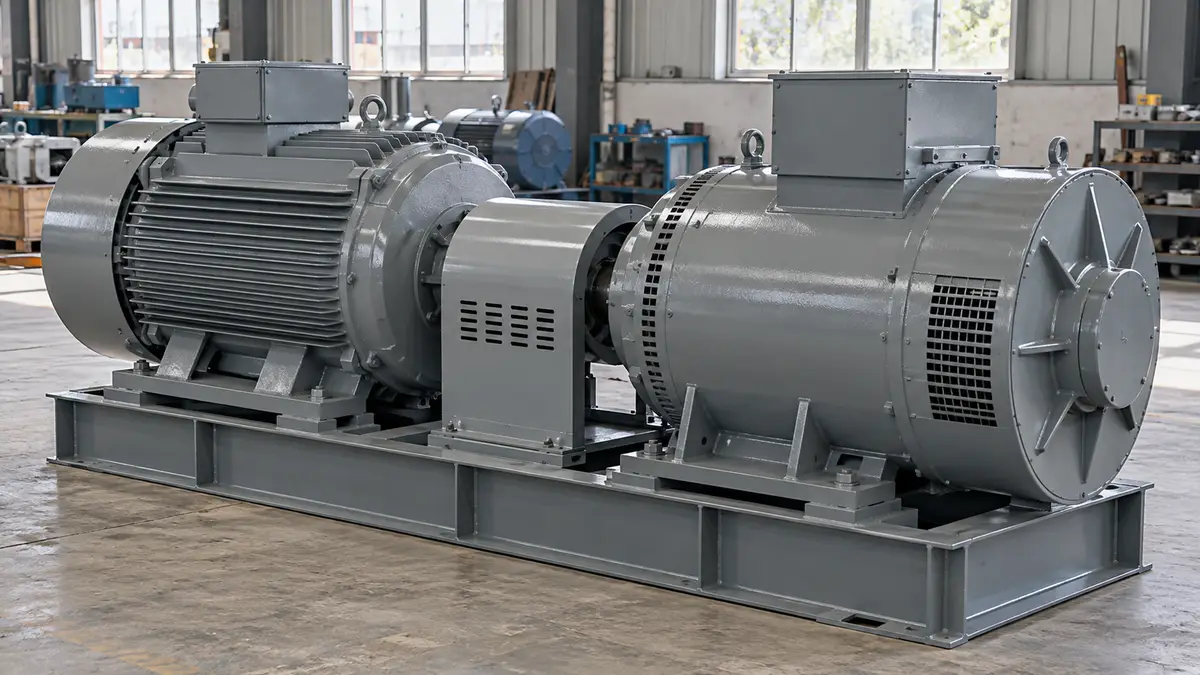
Heading 8502 covers electric generating sets and rotary converters. This guide concerns rotary frequency converters that use a rotating motor-generator assembly to change the supply frequency. For the wider heading, see generators from China. For water-powered equipment, see our hydroelectric generating set sourcing guide. For petrol-powered equipment, see our petrol inverter generator sourcing guide. For phase conversion, see our rotary phase converter sourcing guide. For diesel rotary UPS equipment, see our diesel rotary UPS sourcing guide.
Read from the UK Trade Tariff on 1 October 2026, electric rotary converters under 8502 40 00 90 carried 0% duty on goods from China. The supplied tariff record lists no anti-dumping or countervailing duty, suspension or import control for this line. The table shows example configurations under the same tariff line, rather than separate tariff subdivisions.
Give your customs broker the operating description, assembly drawing and input and output ratings to confirm the commodity code. Describe the rotating conversion mechanism clearly rather than relying on the supplier's use of the word converter. The import duty and VAT guide explains the tax calculation.
| Goods | Commodity code | Duty | Anti-dumping or countervailing duty on China |
|---|---|---|---|
| Rotary frequency converters with an open motor-generator assembly | 8502 40 00 90 | 0% | None |
Specify the supply and the driven load
Write down input voltage, frequency and phase arrangement, required output voltage and frequency, continuous output rating and the equipment being supplied. Agree starting current, allowable voltage and frequency variation, operating duty, cooling arrangement and ambient conditions. Ask for a wiring diagram showing the motor, generator, controls and protective devices.
Specify mounting dimensions, lifting points, terminal access, coupling guards and bearing access. Agree a factory load test using the intended type of load, including starting and load changes. Record output voltage, frequency, current, winding temperature and vibration against the limits in your purchase specification.
For equipment within the electrical safety rules, confirm the applicable technical documentation, declaration of conformity, CE or UKCA marking and importer identification requirements with the relevant product safety authority or a compliance adviser. The importer must ensure accompanying instructions are in easily understandable English. Electromagnetic compatibility rules cover equipment liable to generate electromagnetic disturbance, subject to exceptions. Ask a testing and certification adviser to confirm the applicable scope for the complete assembly.
Worked duty example
Illustrative example, not a quote: Illustrative order: a rotary frequency converter with a separate control cabinet under 8502 40 00 90, invoiced at £20,000 free on board, with £1,500 of freight and insurance to the UK. The customs value is £21,500. Duty at 0% is £0. Import VAT at 20% is charged on the customs value plus duty, £21,500, so it is £4,300. With no duty, the only import tax is the VAT, which a VAT-registered importer can usually reclaim. The import duty and VAT guide explains each step.
Inspection checklist
Identity and documents: match motor, generator and control-cabinet plates to the ordered model, drawings, test reports and declaration. Check the English instructions explain connections, starting, stopping and maintenance.
Electrical performance: witness the agreed load test and record voltage and frequency during starting and load changes. Check insulation resistance, protective earth continuity and protective-device operation through a competent tester.
Mechanical condition: check coupling alignment, guard fastening, bearing noise, vibration, cooling airflow and access for servicing. Look for transport damage, loose terminals and moisture before energising the unit.
Arrival checks: compare the delivered assembly with the factory test record, inspect crate damage and mounting points, and repeat agreed commissioning checks after installation. Use a written inspection brief.
Working out your own order? Send us the product on WhatsApp and we reply the same working day: WhatsApp us
What goes wrong
A converter can produce the requested frequency without supplying the required continuous load. Voltage may sag when the connected equipment starts, while poor cooling causes overheating during sustained operation. A no-load demonstration does not establish performance with the buyer's equipment.
Misaligned couplings, inadequate balancing and damaged bearings can cause vibration and noise. Another risk is documentation for a different motor, generator or cabinet configuration. Require approval before component substitutions and keep the test record tied to the assembly actually shipped.
Cambridge China Bridge sources these products for UK businesses, checking the factory and the documents before shipment. See factory verification. For components and parts, see sourcing for manufacturers.
Frequently asked questions
What is the UK import duty on rotary frequency converters from China?
The supplied tariff record gives 0% duty under 8502 40 00 90, with no listed anti-dumping or countervailing duty, suspension or import control.
What should I put in a rotary frequency converter specification?
Input and output voltage, frequency and phases, continuous output, starting load, operating duty, cooling, mounting details and agreed performance limits.
What documents should accompany a rotary frequency converter?
Accompanying instructions must be in understandable English.
How do I test a rotary frequency converter before shipment?
Run the agreed load and starting tests. Record output voltage and frequency, temperature and vibration, and check insulation, protective earth continuity, guards and component identity.