Sourcing self-propelled rollers from China
Buy against a named drum, vibration and engine configuration, then require a working demonstration and matching noise evidence before shipment. Both self-propelled road-roller tariff lines currently carry 0% UK duty and 20% import VAT. A cheap roller with unsuitable vibration settings or an unapproved engine can still be an expensive purchase.
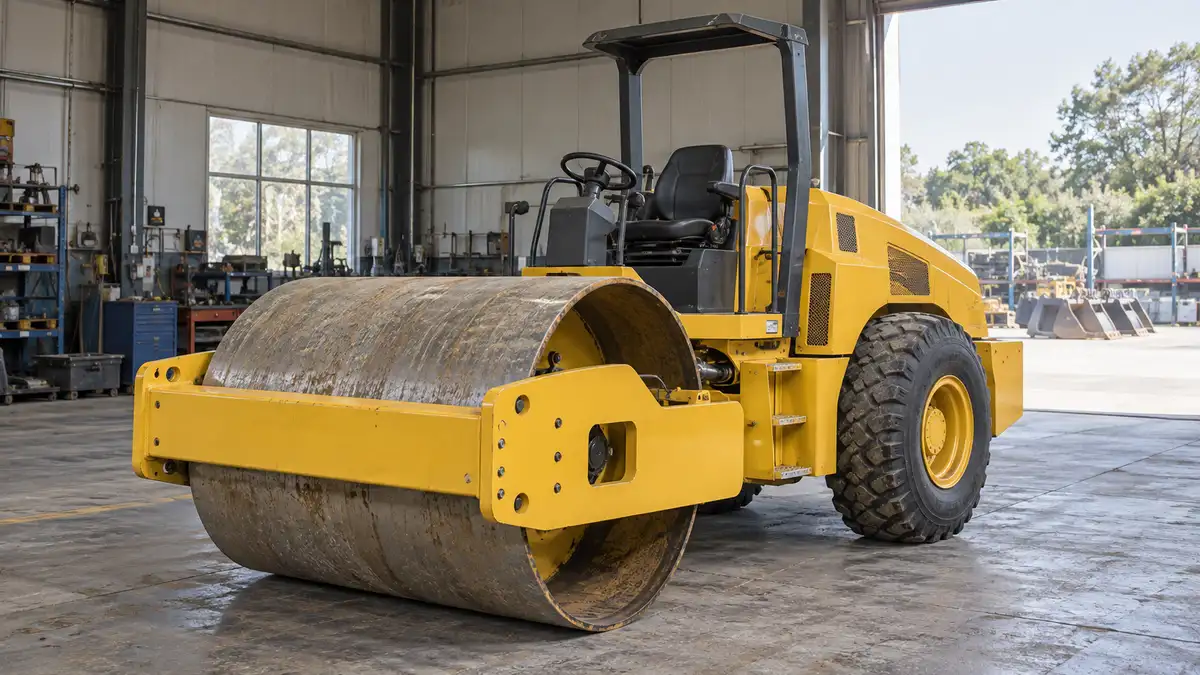
Specify the compaction system, not just the machine weight
Start the enquiry with the material and task: asphalt surfacing, granular sub-base or earthworks. Ask each bidder to identify the proposed single-drum, tandem-drum or pneumatic-tyred configuration. Record drum width, operating weight, drive arrangement, vibration frequency, nominal amplitude and centrifugal force. For asphalt work, include the water-spray and scraper arrangements. Put these requirements into a product specification before comparing quotations.
Do not accept 'vibratory roller' as a complete specification. Require the supplier to identify every selectable vibration setting and explain its intended use. BOMAG identifies drum bouncing, over-compaction and aggregate crushing as risks its amplitude-control technology addresses. That is a reason to assess vibration behaviour on representative material, rather than accept a video of the machine running stationary.
Name the engine, hydraulic pump and vibration motor in the agreed configuration. Require written approval for substitutions and a final component list before shipment. Request transport dimensions, lifting instructions, the articulation transport-lock procedure and an illustrated parts catalogue.
Where to look in China
Two documented manufacturing locations offer concrete starting points. In Jiangsu, XCMG's XS263J roller brochure identifies its Road Machinery Business Unit at No. 1 Taoshan Road, Xuzhou Economic and Technological Development Zone. Treat this older brochure as evidence of the location and product specialism; request current export specifications rather than ordering from its historical engine specification.
In Shandong, Shantui identifies its No. 2 main-machine factory in Shantui Chongwen Industrial Park, Jining High-tech Zone. Its factory description explicitly includes road rollers among the products manufactured there. Ask which plant will assemble the quoted roller and where the acceptance demonstration will take place.
For comparing manufacturers, the Shanghai construction-machinery fair bauma CHINA is another route. The organiser's Chinese visitor information lists two Pudong venues for 2026: Shanghai World Expo Exhibition & Convention Center, 23–26 November, and Shanghai New International Expo Centre, 24–27 November. Arrange meetings around the required roller configuration and request the export document pack in advance; follow the exhibition discussion with a factory demonstration.
UK machinery, engine and outdoor-noise checks
This section concerns placing a new roller on the market or putting it into service in Great Britain. Northern Ireland has separate guidance. The Supply of Machinery (Safety) Regulations 2008 remain operative: the responsible person must address the applicable safety requirements, compile the technical file, provide operating instructions and complete conformity assessment. Obtain the declaration accompanying the machine and compare its identification with the delivered model. Government guidance permits CE or UKCA marking for machinery in Great Britain, subject to the applicable conformity route. See CE, UKCA and ISO explained.
Use BS EN 500-4:2011, 'Mobile road construction machinery. Safety. Specific requirements for compaction machines', as a specific reference when discussing the supplier's safety evidence. Ask which requirements and tests the assessment covers for this roller. A reference to a standard should lead to identifiable evidence for the supplied configuration.
For a new combustion-engine roller, obtain the engine type-approval evidence and photographs of its approval markings. Government guidance requires new non-road mobile machinery sold in the UK to have a type-approved engine with markings proving the approval. Match the installed engine to that evidence; do not treat a description of Chinese domestic emissions compliance as proof of UK approval.
Vibrating and non-vibrating rollers fall under outdoor-noise limits and noise marking. Under the Noise Emission in the Environment by Equipment for Use Outdoors Regulations 2001, check the guaranteed sound power indication, declaration and conformity-assessment evidence. Ask which assessment body was involved and whether its role matches the chosen conformity route.
The noise-testing transition matters for a 2026 purchase. From 13 April 2026, equipment subject to noise limits generally uses the new Schedule 6A measurement methods and is also assessed against the old Schedule 6 methods. Equipment whose first item was placed on the market or put into service before 22 May 2025 may continue using the old methods until 22 May 2028. Ask the manufacturer to document the model's first-market date and the basis used in its noise report.
Use Cambridge China Bridge's machinery sourcing service to bring the agreed configuration, supplier documents and inspection brief together before shipment.
UK commodity codes and duty
The distinction is between self-propelled vibratory road rollers and other self-propelled road rollers. Classify the actual machine being supplied. The table does not cover a tow-behind roller or a separately imported attachment.
The official commodity pages, checked on 10 October 2026, show 0% third-country duty and 20% standard import VAT for both lines. No anti-dumping measure is listed on either page. Recheck the measures for Chinese origin and the declaration date before importing.
| Goods | Commodity code | Duty | Anti-dumping duty on China |
|---|---|---|---|
| Self-propelled vibratory road rollers | 8429401000 | 0% | None listed |
| Other self-propelled road rollers | 8429403000 | 0% | None listed |
Worked duty and import VAT example
Hypothetical calculation, not a market price or quotation: assume a new vibratory roller under 8429401000 costs £60,000, with £5,000 freight and insurance to the UK border. Assume these are the only customs-value adjustments. Customs value = £65,000; duty = £65,000 × 0% = £0.
Assume a further £1,000 of transport and other incidental expenses to the first UK destination, not already included, and no other additions. Import VAT value = £65,000 + £0 + £1,000 = £66,000. Import VAT = £66,000 × 20% = £13,200. Total duty plus import VAT = £13,200.
HMRC requires the import VAT value to include relevant incidental expenses to the first UK destination, and transport to a further destination when known at importation. Avoid counting the same freight twice. Our UK import duty and VAT guide explains the calculation.
Working out your own order? Send us the product on WhatsApp and we reply the same working day: WhatsApp us
Acceptance tests that reveal roller-specific problems
Write a test brief for the actual serial-numbered machine. Ask a competent operator to demonstrate travel, steering, service and parking brakes, operator safety controls and every contracted vibration mode in a controlled area. Agree test conditions and acceptance limits from the manufacturer's instructions and your intended work; do not invent a universal braking distance or compaction target.
For asphalt rollers, observe spray coverage across the full drum width and inspect filters, nozzles and scraper contact. BOMAG warns that inadequate water coverage can let asphalt stick to the drum and damage the freshly laid surface. Include nozzle cleaning and water-system operation in the demonstration, rather than checking only that the water tank exists.
For the vibration system, record mode selection and behaviour on representative material, following the operating instructions. Look for bouncing or unstable behaviour and ask the supplier to explain it against the selected settings. After the run, inspect for hydraulic leaks, loose mounts, damaged hoses and abnormal articulation play. These are proposed acceptance checks, not claims that every Chinese roller has those defects.
Photograph the drum, machine plate, installed engine markings and component identities. Record the test conditions, results and unresolved defects in the pre-shipment inspection report. Keep document review and physical test results together so an engine or configuration change cannot pass unnoticed.
Before releasing the shipment, identify who will diagnose faults in the UK and how parts will be ordered by serial number. Agree the supply of spray nozzles, scraper parts, vibration mounts, filters and relevant seals, plus access to hydraulic diagrams and diagnostic information. Put responsibility for labour, parts and warranty claims into a machinery after-sales service agreement.
Related help: testing and certification support and how we verify factories and inspect orders.
Frequently asked questions
Does 0% duty mean there is no import tax?
No. Both listed roller codes carry 20% import VAT. In the hypothetical example, £65,000 customs value plus £1,000 additional destination expenses produces £13,200 import VAT.
Is a CE-marked roller enough to approve the purchase?
Request the declaration and supporting conformity evidence for the actual configuration, plus engine approval and outdoor-noise evidence. Then carry out the agreed physical acceptance tests. The marking alone does not answer those purchasing questions.
What should I request before visiting a factory?
Ask for the final configuration, draft declaration, engine approval markings, noise report, operating instructions and parts catalogue. Arrange a demonstration of the offered machine on representative material, including vibration, braking and any asphalt water-spray system.
Sources
- UK Trade Tariff: vibratory road rollers, 8429401000
- UK Trade Tariff: other road rollers, 8429403000
- XCMG XS263J brochure: Road Machinery Business Unit location
- Shantui: No. 2 main-machine factory
- Shanghai construction-machinery fair: Chinese visitor information
- Supply of Machinery (Safety) Regulations 2008: regulation 7
- Government machinery guidance for Great Britain
- BSI: BS EN 500-4:2011
- Non-road mobile machinery: engine approval and markings
- Outdoor Noise Regulations 2001: regulation 7
- Government outdoor-noise guidance, including the 2026 transition
- HMRC: calculating the import VAT value
- BOMAG: amplitude control and compaction risks
- BOMAG Americas: water coverage and asphalt sticking