Sourcing rugby balls from China
Inflatable rugby balls from China carry 2% UK duty, with no anti-dumping or countervailing measure recorded in the supplied tariff facts. Consumer rugby balls sold in Great Britain must be safe under normal or reasonably foreseeable use. Specify wet grip, air retention and construction before ordering. Cambridge China Bridge sources rugby balls.
UK duty on inflatable rugby balls
Read from the UK Trade Tariff on 29 September 2026, heading 9506 covers sports and exercise equipment. Its inflatable-ball line, 9506 62 00 00, carries 2% duty for goods from China. The supplied facts record no anti-dumping or countervailing measure and no suspension on this line. The table shows rugby-ball variants sharing that commodity line.
The UK Trade Tariff attaches a cultural-goods export licence measure to this line. Ask your customs broker to confirm its relevance to any planned onward export. The supplied facts list no import control for this inflatable-ball line.
Confirm the commodity code against the actual construction, particularly for non-inflatable novelty products. For other inflatable sports balls within the wider heading, see the football sourcing guide.
| Goods | Commodity code | Duty | Anti-dumping or countervailing duty on China |
|---|---|---|---|
| Inflatable match rugby balls | 9506 62 00 00 | 2% | None |
Specify the cover, grip and bladder
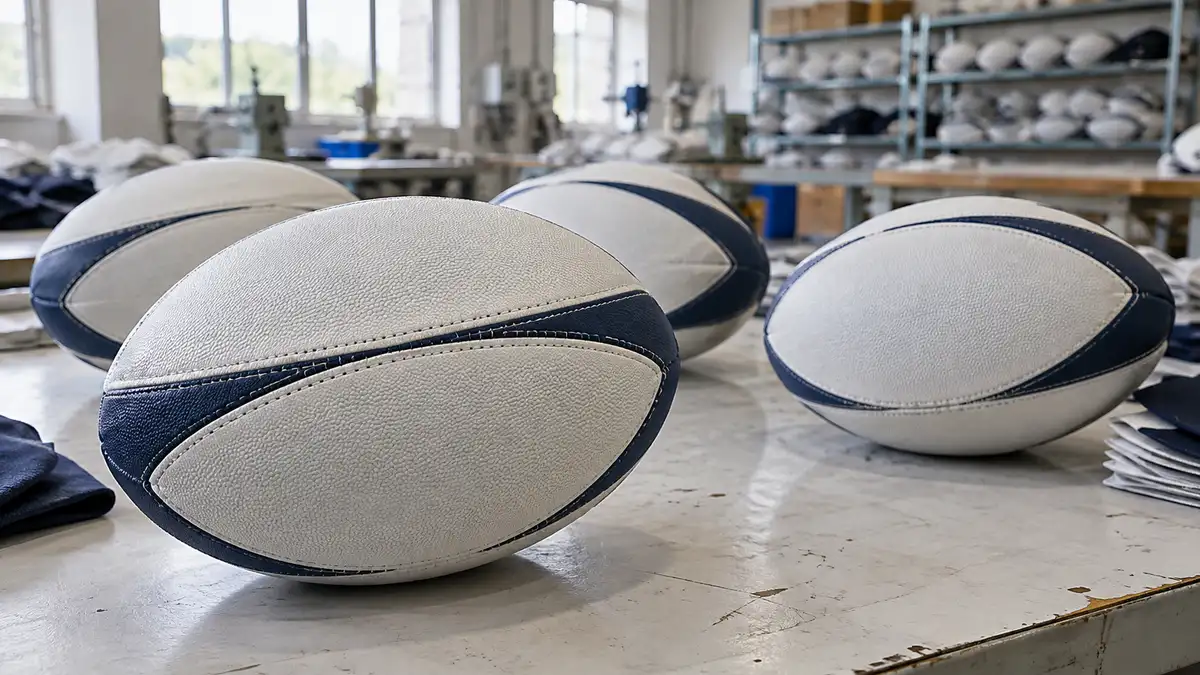
State whether the ball is for matches, training, junior use or promotion. Agree dimensions, weight, oval profile, cover compound, backing, surface texture, stitching or bonding, bladder material and valve position. Record the inflation pressure and acceptable pressure loss in the specification rather than relying on a catalogue description.
Approve a finished sample for dry and wet grip, passing feel, shape and print. Agree an air-retention test and seam-strength checks with the factory. Consumer products supplied in Great Britain must be safe in normal or reasonably foreseeable use. Plan product safety assessment alongside performance checks.
Worked duty example
Illustrative example, not a quote: Illustrative order of 500 inflatable training rugby balls under 9506 62 00 00, invoiced at £2,500 free on board, with £350 of freight and insurance to the UK. The customs value is £2,850. Duty at 2% is £57. Import VAT at 20% is charged on the customs value plus duty, £2,907, so it is £581.40. Import taxes total £638.40; a VAT-registered importer can usually reclaim the VAT, so the lasting cost is the £57 of duty. The import duty and VAT guide explains each step.
Inspection checklist
Shape and construction: inflate samples to the agreed pressure, measure dimensions and weight, and inspect panel alignment, seams and valve seating against the approved sample.
Grip and finish: compare wet and dry handling, rub printed areas, and inspect for exposed threads, sharp edges, lifting panels and uneven texture.
Air retention: record starting and finishing pressure over the agreed test period, check valve leakage, and repeat inflation and deflation.
Traceability and packing: check the producer’s name and address and product or batch reference on the ball or packaging, where reasonable to provide them. Open packed cartons and inspect for crushing, moisture and print transfer.
Working out your own order? Send us the product on WhatsApp and we reply the same working day: WhatsApp us
What goes wrong
Watch for balls that lose pressure through the valve, become slippery when wet, distort after inflation or open along the seams. A substituted cover compound or bladder can change handling and air retention even when the artwork looks correct.
Keep the approved sample and written acceptance criteria available during quality inspection. Check production samples rather than relying on a presentation sample, and agree how failed balls will be separated and corrected before shipment.
Cambridge China Bridge sources these products for UK businesses, checking the factory and the documents before shipment. See factory verification. For own-brand ranges, see sourcing for brands.
Frequently asked questions
What is the UK import duty on rugby balls from China?
The supplied tariff facts show 2% duty for inflatable balls under 9506 62 00 00, with no recorded anti-dumping or countervailing measure.
What should I specify for training rugby balls?
Specify dimensions, weight, cover material, wet grip, bladder, valve, seam construction, inflation pressure and acceptable pressure loss. Approve a finished sample.
How do I check whether rugby balls leak?
Inflate samples to the agreed pressure and record pressure loss over the agreed test period. Check the valve and seams, then repeat inflation and deflation.
What safety rule applies to consumer rugby balls in Great Britain?
The General Product Safety Regulations require applicable consumer products to be safe in normal or reasonably foreseeable use. Assess safety alongside grip, seams and air retention.