Sourcing quartz worktops and engineered stone
Engineered quartz and other artificial stone slabs and worktops from China pay 0% UK duty, with no anti-dumping duty. Cutting engineered stone releases respirable crystalline silica, which has a UK workplace exposure limit of 0.1 mg/m3 over 8 hours, so fabricators need silica content and safe working information. Cambridge China Bridge sources quartz slabs and cut-to-size worktops.
Buying from China for a business? How our UK China sourcing agent service works · China sourcing agent for small orders and first imports
Zero duty
Read from the UK Trade Tariff on 25 September 2026, articles of cement, concrete or artificial stone, including agglomerated engineered stone and prefabricated components, carried 0% duty on goods from China, with no anti-dumping measure. Natural granite and marble worktops are classified under the stone headings instead, so confirm the commodity code for the material.
Stone is heavy, so the container weight limit, not its volume, sets the landed price; ask the factory for slab weights and the container payload with the quote.
| Goods | Commodity code | Duty | Anti-dumping duty on China |
|---|---|---|---|
| Articles of artificial stone and concrete, other (engineered quartz) | 6810 99 00 00 | 0% | None |
| Tiles, flagstones and similar articles, other | 6810 19 00 00 | 0% | None |
| Prefabricated structural components for building | 6810 91 00 00 | 0% | None |
Silica dust and fabricators
Engineered quartz is mostly crystalline silica bound in resin, and cutting, grinding or polishing it releases respirable crystalline silica. HSE sets the workplace exposure limit at 0.1 mg/m3 as an 8-hour time-weighted average, under the Control of Substances Hazardous to Health Regulations, and publishes guidance on controlling stone dust.
Fabricators and their customers now ask about silica content and safe working methods before they buy. Ask the factory for the silica content of each product, a safety data sheet, and fabrication guidance, and consider supplying cut-to-size, pre-finished worktops that reduce cutting on site.
Slab quality
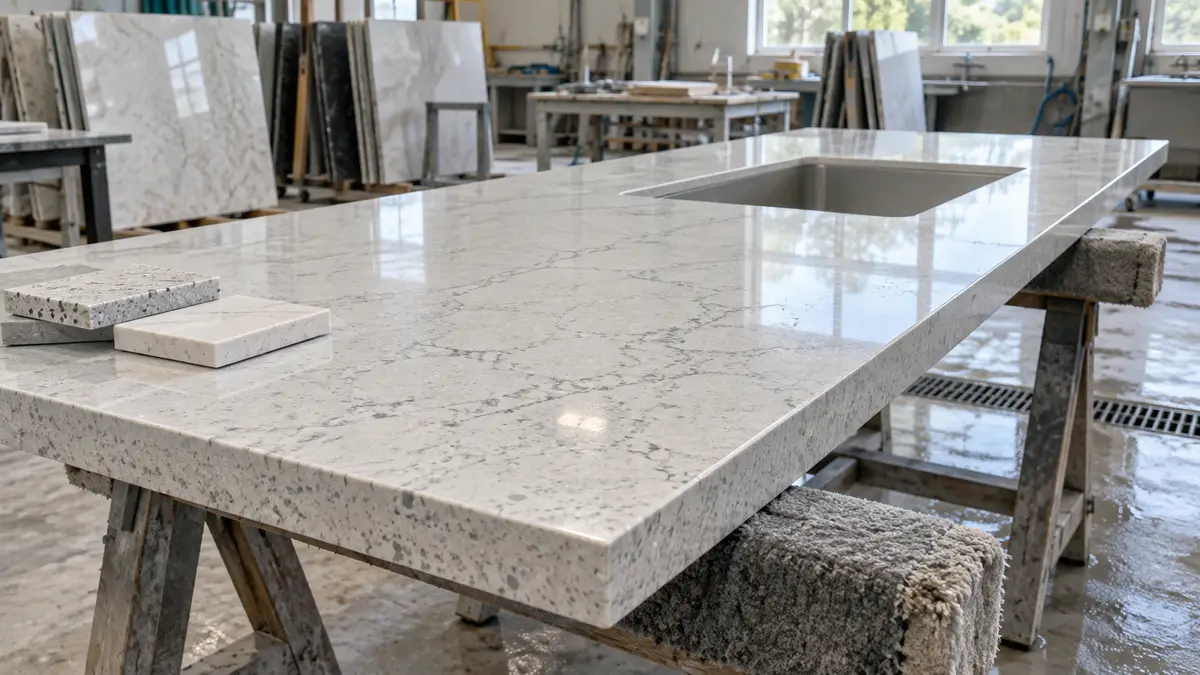
Colour consistency between batches, resin pooling, cracks and pits, thickness tolerance and flatness are the checks. Approve slab samples from the production batch, keep batch numbers on every slab so a kitchen is fitted from one batch, and inspect polished faces under good light at inspection.
For cut-to-size worktops, the drawing is the product: sink and hob cut-outs, edge profiles and upstands must be final before cutting.
Worked duty example
For a made-up shipment of a container of 60 engineered quartz slabs under 6810 99 00 00, add the £3,000 of freight and insurance to the £15,000 free-on-board price and customs sees £18,000. Duty on engineered stone slabs is zero, leaving import VAT of £3,600, 20% of the customs value. For a VAT-registered buyer that is a cash-flow cost rather than a lasting one. Freight is a sixth of the customs value here, because slabs are heavy. The duty and VAT guide walks through the calculation.
Per slab, freight is £50 against no duty, so how many slabs the factory fits in a container, and how they are braced, decides the landed cost.
Inspection checklist
Product standard and declared values: BS EN 15388 covers agglomerated stone slabs and cut-to-size products for vanity and kitchen tops, and the BS EN 14617 series sets the test methods, including apparent density and water absorption (part 1) and flexural strength (part 2). Ask for the test report behind each declared value, for the product you are buying.
Dimensions on production pieces: measure thickness at several points on each sampled slab, check flatness with a straight edge and feeler gauges, and for worktops check length, width, cut-out positions and edge profiles against the approved drawing, within the tolerances agreed in the order.
Surface, batch and silica information: compare colour, veining and gloss against the approved sample under daylight, with a gloss meter reading recorded for both, check the batch number on each slab edge, and confirm the safety data sheet for each product states its crystalline silica content before the slabs ship.
Working out your own order? Send us the product on WhatsApp and we reply the same working day: WhatsApp us
What goes wrong
Engineered stone fails on colour, surface and breakage. Slabs from different batches differ in colour and veining, so a kitchen made from mixed batches looks patchy, resin pools and pits spoil the polished face, and hairline cracks open during fabrication. Thickness and flatness fall outside tolerance, colours yellow in sunlight when resin is not UV-stable, and corners break on A-frames that were not strapped properly.
Keep a batch number on every slab and ship one batch per colour, check colour and veining against the approved sample under daylight, measure thickness at several points and flatness with a straight edge, check gloss and the surface for pits and cracks, ask whether the resin is UV-stable for outdoor or sunny use, and inspect A-frames, strapping and edge protection at loading.
Crating
Slabs travel on A-frames and worktops in crates; most claims are cracked corners and edges. Specify the frames, strapping and edge protection, and photograph the stowage at the container loading. Specify A-frames, crates and edge protection when comparing shipping quartz worktops from China to the UK.
Cambridge China Bridge sources quartz slabs and cut-to-size worktops, with silica information, batch control and crating settled before shipment. See how our sourcing service works.
Related guides: Sourcing quartz and quartzite from China.
Frequently asked questions
What is the UK import duty on quartz worktops from China?
Read from the UK Trade Tariff on 25 September 2026, articles of artificial stone, including engineered quartz, carried 0% duty from China, with no anti-dumping duty.
What is the UK exposure limit for silica dust?
HSE sets the workplace exposure limit for respirable crystalline silica at 0.1 mg/m3 as an 8-hour time-weighted average.
What should a quartz supplier provide to fabricators?
The silica content of each product, a safety data sheet and fabrication guidance, so dust can be controlled.
How do I keep a kitchen's worktops the same colour?
Keep batch numbers on every slab and fit each job from one batch; approve samples from the production batch.