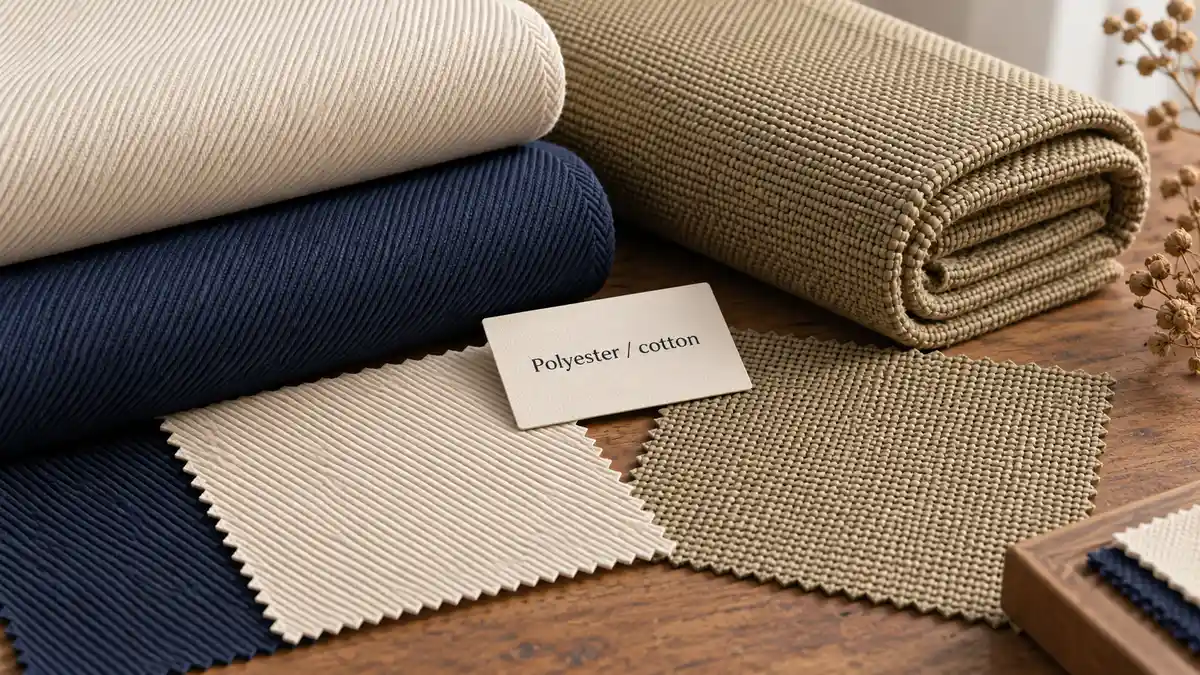
Polyester-cotton twill and canvas from China
Woven fabrics of polyester or other synthetic staple fibres mixed mainly with cotton from China, containing less than 85% synthetic fibre and weighing more than 170 g/m², such as workwear twill, drill, gabardine and canvas, pay 8% UK duty on all 16 lines of heading 5514, with no anti-dumping duty. Buyers check blend, weight, strength, shrinkage and azo dyes.
Buying from China for a business? How our UK China sourcing agent service works · China sourcing agent for small orders and first imports
8% duty
Read from the UK Trade Tariff on 27 September 2026, heading 5514 covers woven fabrics of synthetic staple fibres containing less than 85% by weight of such fibres, mixed mainly or solely with cotton, of a weight exceeding 170 g/m². All 16 leaves, unbleached or bleached, dyed, of yarns of different colours and printed, in plain weave, 3- or 4-thread twill and other weaves, carried 8% on goods from China, with no anti-dumping measure, no registration and no suspension.
Lighter cotton-rich blends up to 200 g/m² with more cotton than synthetic fibre are heading 5210 at 0% (see our polycotton woven fabrics guide), and fabrics of 85% or more polyester staple are heading 5512 (see our spun polyester fabrics guide), so the blend and weight decide the rate; confirm the commodity code.
| Goods | Commodity codes | Duty | Anti-dumping duty on China |
|---|---|---|---|
| Unbleached or bleached, polyester, plain weave | 5514 11 00 00 | 8% | None |
| Unbleached or bleached, polyester, 3- or 4-thread twill | 5514 12 00 00 | 8% | None |
| Unbleached or bleached, other polyester woven fabrics | 5514 19 10 00 | 8% | None |
| Unbleached or bleached, other woven fabrics | 5514 19 90 00 | 8% | None |
| Dyed, polyester, plain weave | 5514 21 00 00 | 8% | None |
| Dyed, polyester, 3- or 4-thread twill | 5514 22 00 00 | 8% | None |
| Dyed, other polyester woven fabrics | 5514 23 00 00 | 8% | None |
| Dyed, other woven fabrics | 5514 29 00 00 | 8% | None |
| Of yarns of different colours, polyester, plain weave | 5514 30 10 00 | 8% | None |
| Of yarns of different colours, polyester, 3- or 4-thread twill | 5514 30 30 00 | 8% | None |
| Of yarns of different colours, other polyester woven fabrics | 5514 30 50 00 | 8% | None |
| Of yarns of different colours, other woven fabrics | 5514 30 90 00 | 8% | None |
| Printed, polyester, plain weave | 5514 41 00 00 | 8% | None |
| Printed, polyester, 3- or 4-thread twill | 5514 42 00 00 | 8% | None |
| Printed, other polyester woven fabrics | 5514 43 00 00 | 8% | None |
| Printed, other woven fabrics | 5514 49 00 00 | 8% | None |
Dyes and labelling
Entry 43 of Annex XVII to UK REACH bans azo dyes that can release listed aromatic amines above 30 mg/kg in textile articles that may come into direct and prolonged contact with the skin, including clothing and fabrics intended for use by the final consumer, so ask for azo test reports for each colour.
Workwear and uniforms made from these fabrics need a fibre composition label using the names in the retained Textile Fibre Names Regulation (EU) No 1007/2011, and protective clothing claims bring their own conformity rules.
Specifying polyester-cotton
Specify blend ratio, yarn count, density, weave, weight in g/m², width, tensile and tear strength, abrasion resistance, colour fastness to washing, light and rubbing, shrinkage, finishes (water-repellent, soil release), and roll length and packing. For yarn sourcing, see our spun polyester and acrylic yarn guide.
Worked duty example
Take a hypothetical order of 8,000 metres of dyed polyester-cotton twill, entered under 5514 22 00 00: £16,000 free on board plus £1,200 of freight and insurance gives a customs value of £17,200. The 8% duty on polyester-cotton twill comes to £1,376, and import VAT is 20% of £18,576, which is £3,715.20. If you are VAT-registered you normally reclaim the £3,715.20, leaving £1,376 as the real cost at the border. Step by step: UK import duty and VAT.
Inspection checklist
Composition: check blend ratio and weight in a laboratory, because the blend and weight decide the heading.
Performance: check tear strength, abrasion, shrinkage and colour fastness against the specification.
Rolls: check width, length, weaving faults and shade variation between rolls.
Working out your own order? Send us the product on WhatsApp and we reply the same working day: WhatsApp us
What goes wrong
Polyester-cotton orders fail on weight, strength and shade. Fabric is lighter than ordered, tear strength is below the workwear specification, colour fades in industrial washing, and rolls differ in shade.
Test samples before shipping. See our quality inspection guide.
Cambridge China Bridge sources polyester-cotton twill and canvas for UK workwear, uniform and bag makers, checking the mill first. See factory verification.
Frequently asked questions
What is the UK import duty on polyester-cotton twill from China?
Read from the UK Trade Tariff on 27 September 2026, heavier polyester-cotton woven fabrics under 5514 carried 8% from China.
Why is lighter polycotton 0%?
Cotton-rich blends up to 200 g/m² are heading 5210, which carried 0%.
Are azo dyes restricted?
Yes. UK REACH Annex XVII entry 43 bans azo dyes releasing listed amines above 30 mg/kg in skin-contact textiles.
What fails most often?
Fabric lighter than ordered, low tear strength and colour loss in industrial washing.