Sourcing paper padded mailers from China
Paper padded mailers confirmed as envelopes under heading 4817 carry 0% UK duty from China. Confirm the complete construction before using that code, and confirm with the relevant timber-regulation authority any timber due-diligence requirements for virgin paper placed on the GB market. Cambridge China Bridge sources paper padded mailers.
Buying from China for a business? How our UK China sourcing agent service works · China sourcing agent for small orders and first imports
Envelope duty and classification
Read from the UK Trade Tariff on 6 November 2026, heading 4817 covers paper envelopes, correspondence cards and containers holding assorted paper stationery. The envelope line is 4817 10 00 00. The table repeats that line for different mailer styles; these are not separate tariff subdivisions. See the wider envelope guide.
The supplied tariff record shows 0% duty for envelopes from China, with no anti-dumping or countervailing duty, suspensions or attached import controls. That does not establish the position under timber regulations: confirm with the relevant timber-regulation authority what source due diligence applies to the importer first placing virgin paper on the GB market and how bamboo-based and recovered products are treated.
Confirm the commodity code using a finished sample and the complete material breakdown, including the padding, coatings and any plastic layer. Do not classify a mailer solely from its paper exterior. For the tax calculation, see UK import duty and VAT.
| Goods | Commodity code | Duty | Anti-dumping or countervailing duty on China |
|---|---|---|---|
| Plain paper padded envelopes, subject to classification confirmation | 4817 10 00 00 | 0% | None |
Specify the padding, usable space and closure
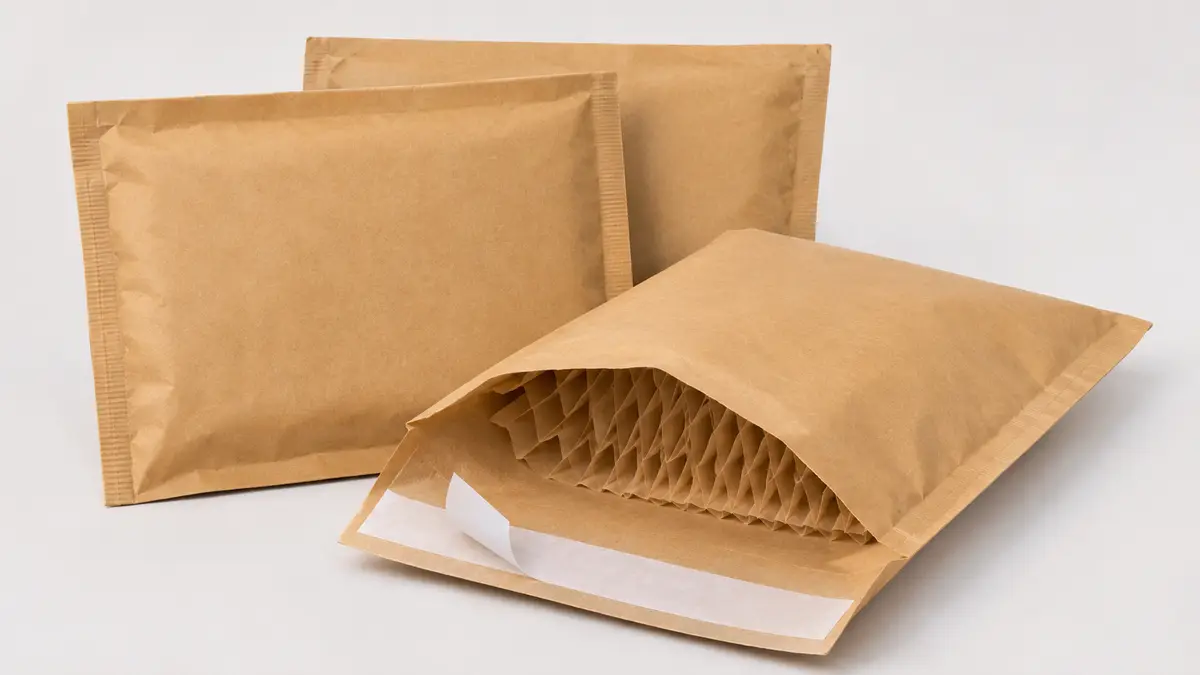
Specify usable internal dimensions with your actual contents inserted, rather than external dimensions alone. Agree paper grammage, fibre composition, padding construction, seam width, flap overlap and finished thickness. Describe whether the cushioning is shredded paper, folded paper or a honeycomb structure, and approve a cut-open sample showing every layer.
Agree seal adhesion after storage, liner release, tear-strip operation, print position and address-label adhesion. Test the packed mailer with the intended contents for puncture, seam splitting and cushioning collapse. Keep an approved sample and a written acceptance specification for repeat orders.
Packaging must use the minimum weight and volume needed to keep its contents safe and hygienic. Choose the padding around the actual product rather than adding bulk without testing. Request pulp-source documentation for virgin paper and evidence supporting any recycled-content claim.
Worked duty example
Illustrative example, not a quote: Illustrative order: 24,000 plain paper padded envelopes, with classification confirmed under 4817 10 00 00, invoiced at £5,300 free on board, with £2,500 of freight and insurance to the UK. The customs value is £7,800. Duty at 0% is £0. Import VAT at 20% is charged on the customs value plus duty, £7,800, so it is £1,560. With no duty, the only import tax is the VAT, which a VAT-registered importer can usually reclaim. The import duty and VAT guide explains each step.
Inspection checklist
Fit: check the usable opening and internal space with the intended contents, including clearance below the seal.
Layers: cut open samples to compare paper, padding coverage and hidden films against the approved construction.
Closure: check liner release, seal adhesion, side seams and tear-strip operation after packing.
Arrival: check cartons for damp, flattened cushioning and odour; count contents and compare print and label adhesion with the approved sample.
Working out your own order? Send us the product on WhatsApp and we reply the same working day: WhatsApp us
What goes wrong
A mailer can match the external size yet have too little usable space because the padding and seams take up room. Uneven padding leaves exposed areas, while compressed cushioning provides less protection. Weak seams split around corners, and damp paper can curl or lose strength.
Seal adhesive can lose tack in storage or bond unevenly across the flap. A factory may substitute a film-backed lining while keeping the same paper exterior. Compare opened samples with the approved construction before shipment and on arrival; use the quality inspection guide to agree how defects will be recorded.
Cambridge China Bridge sources these products for UK businesses, checking the factory and the documents before shipment. See factory verification. For repeat volumes, see container programmes.
Frequently asked questions
What is the UK import duty on paper padded mailers from China?
The supplied tariff record shows 0% for envelopes under 4817 10 00 00, with no anti-dumping or countervailing duty. Confirm that the finished padded mailer belongs in this line.
Does a paper exterior establish the commodity code?
Confirm the complete construction, including the cushioning, coatings and any plastic lining. Send a finished sample and material breakdown to your customs broker.
Do timber rules apply to paper padded mailers?
Confirm with the relevant timber-regulation authority what timber due diligence applies to the business first placing virgin paper on the GB market, usually the importer, and whether bamboo-based and recovered products are excluded.
How should I test the cushioning?
Pack your actual product, then check puncture resistance, seam strength and cushioning collapse. Compare usable space and padding coverage with the approved sample.