Private label foundation from China: shades and duty
Liquid foundation from China pays 0% UK duty under 3304 99 00 00, so the commercial risk is shade, not tax. Approve a dried-down retained standard for every shade, agree in writing how each batch is compared with it, and test the formula in its final bottle and pump before the first order. Cambridge China Bridge sources private label foundation.
Buying from China for a business? How our UK China sourcing agent service works · China sourcing agent for small orders and first imports
0% duty, and the import VAT that remains
Read from the UK Trade Tariff on 29 September 2026, all supplied lines of heading 3304 carry 0% duty for goods from China, with no recorded anti-dumping or countervailing duty and no listed suspensions. Liquid foundation sits under 3304 99 00 00; the other rows are for powders and for lip and eye products in the same range, not alternative foundation codes. The tariff record attaches CITES controls to this line and a mercury export control across the heading, so ask your customs broker to check the actual ingredients. Lip and eye products have their own guides: lipstick and eyeshadow palettes.
Illustrative order only, not a quotation: 200 bottles invoiced at £6,000 free on board, with £600 of freight and insurance. The customs value is £6,600, duty is £0, and import VAT at 20% is £1,320, which a VAT-registered importer can usually reclaim. See the import duty and VAT guide.
| Goods | Commodity code | Duty | Anti-dumping or countervailing duty on China |
|---|---|---|---|
| Other make-up preparations, including liquid foundation | 3304 99 00 00 | 0% | None |
| Make-up powders, for comparison with liquid foundation | 3304 91 00 00 | 0% | None |
| Lip make-up preparations, for accompanying ranges | 3304 10 00 00 | 0% | None |
| Eye make-up preparations, for accompanying ranges | 3304 20 00 00 | 0% | None |
Plan the shade range before you ask for samples
Decide the undertone families and depth steps you want before the first sample request, and say whether you are choosing from the factory's existing shade library or asking for custom matches to a reference. Custom matching takes more sample rounds; a library shade can be approved faster but may already be sold to other brands. Ask the factory its minimum batch per shade, because a wide launch range multiplies it.
Ask how each shade is built: from a set of base shades blended to a recipe, or from separate pigment premixes. Blended ranges are easier to keep consistent, but a change to one base moves every shade made from it. Give each approved shade a code that links your name for it to the factory's formula code, so a reorder cannot pick up the wrong recipe.
Approve shades dried down, under agreed light
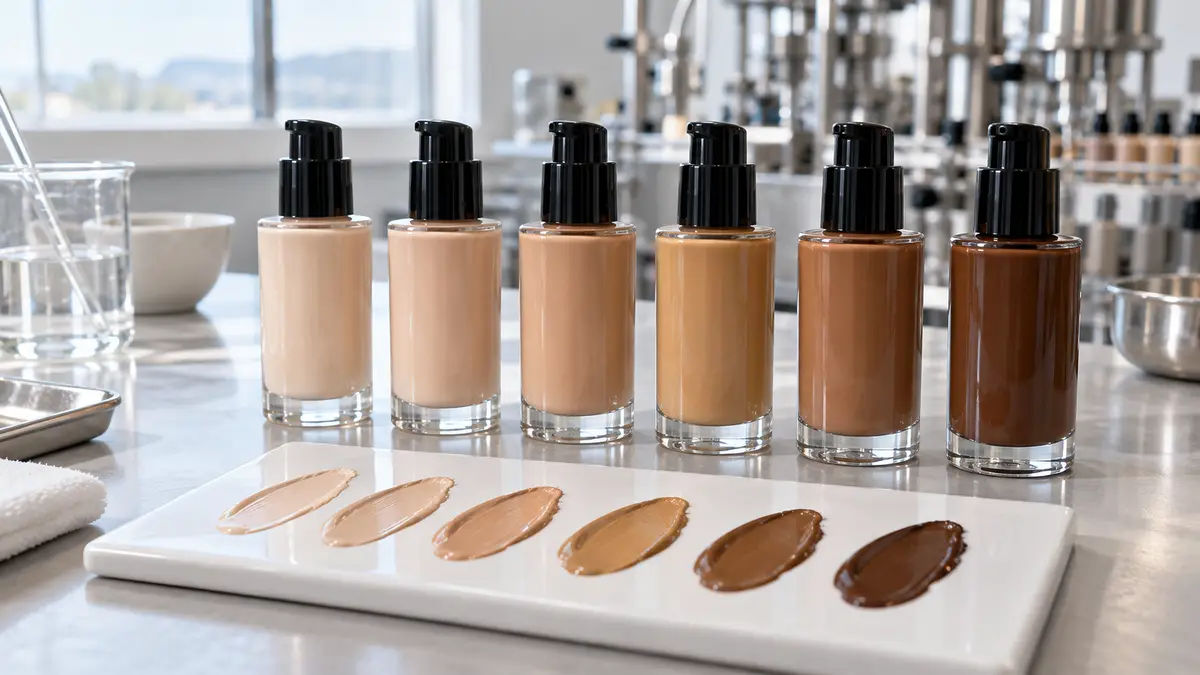
Foundation changes colour as it dries, so a shade approved wet from a fresh laboratory sample can look darker or warmer in use. Approve each shade after the drying time you agree, as a drawdown on a card and on skin, under lighting you name in writing, and photograph it against the reference.
Keep a sealed retained standard for every approved shade on both sides, yours and the factory's. If the factory has a colour-measuring instrument, agree the method and the tolerance it will report against, and ask for the reading with each batch. Without an instrument, side-by-side drawdowns against the retained standard under the same lighting are the minimum.
Hold every batch to the standard
For each production batch, ask for a drawdown beside the retained standard, the batch number and the filling date before the goods are packed. On samples from the batch, check dried colour, coverage, odour, separation and sediment, then fill quantity, leaks, pump priming and closure fit on filled bottles.
Test the formula in the exact bottle and pump it will be sold in, because a pump can clog or dispense unevenly with one viscosity and not another; our guide to formula and packaging compatibility trials covers how to commission that work. Require written approval before any change to pigments, preservatives, fragrance or packaging.
What most often fails: Cosmetics
UK OPSS + EU / EEA Safety Gate (alerts counted separately in each system) · China-origin alerts over the 24 calendar month coverage window(2024-12 – 2026-11) · 165
Combined counts are alerts from both systems, not unique products across markets. Each source uses its own publication window; the same product may appear in both. · OPSS: 2024-12 – 2026-11 · Safety Gate: 2024-12 – 2026-11
- Other / unclassified: 142
- Chemical: 18
- Burns: 2
Most-cited regulations
- Cosmetic Products Regulation: 153
- Regulation (EC) 1223/2009: 7
- Cosmetic Products Enforcement Regulations 2013: 5
Checks to ask the factory for
- Ask the factory to identify the applicable product safety requirements and supporting tests.
- Compare the final sample, labels and instructions with the agreed specification.
- Ask for batch traceability and documented review of any safety-related design changes.
Questions for due diligence, not a certification checklist or a guarantee of compliance. Select the applicable standards and tests with a competent laboratory.
The current calendar month is partial. These are published alerts, safety reports and recalls, not a measure of all products sold or a recall rate. Hong Kong is reported separately.
All recall dataContains public sector information licensed under the Open Government Licence v3.0 (OPSS, GOV.UK product safety alerts)
Source: European Commission, Safety Gate, English XML (en), extracted 2026-11-09. XML distribution: CC0. Cambridge China Bridge analysis.
Working out your own order? Send us the product on WhatsApp and we reply the same working day: WhatsApp us
Common mistakes
Approving shades wet or under one shop light; launching too many shades for the factory's batch size; letting the factory change a pigment or base supplier without telling you; and accepting an ingredient list where your safety assessor needs the full quantitative formula. Agree formula disclosure to your assessor before ordering, and see appointing a UK Responsible Person for the obligations that apply before sale. A foundation with an SPF claim follows the sunscreen guide. For another cosmetic product, see our private-label bar soap sourcing guide. For hair styling products, see our hairspray sourcing guide.
Cambridge China Bridge sources private label foundation for UK businesses, checking the factory, the shade standards and the documents before shipment. See factory verification, and container programmes for repeat volumes.
Frequently asked questions
What is the UK import duty on liquid foundation from China?
0% under 3304 99 00 00, with no recorded anti-dumping or countervailing duty and no listed suspension. Import VAT at 20% applies.
How do I keep foundation shades the same between batches?
Keep sealed retained standards for every shade, approve dried drawdowns under named lighting, and ask for a drawdown or instrument reading against the standard with each batch before packing.
Can a Chinese factory match my reference shade?
Usually it can attempt a custom match, which takes more sample rounds than a library shade. Approve the match dried down, then register it as your own retained standard.
What formula information should I ask the factory for?
The full quantitative formula for your safety assessor, under confidentiality if needed. A marketing ingredient list is not enough for the assessment.