Sourcing hanging organisers from China
Hanging fabric storage organisers within heading 6307 carry 6% to 12% UK duty from China, depending on construction. Consumer products must be safe, and textile labels must show fibre content. Specify the hanging method and load before approving samples. Cambridge China Bridge sources hanging fabric storage organisers.
UK duty on hanging fabric organisers
Heading 6307 covers other made-up articles, including dress patterns. For hanging fabric organisers, the table gives candidate lines by construction, rather than a classification based on the product name alone. Record the fabric, stiffeners, hooks and intended use. For the wider heading, see garment storage covers.
Read from the UK Trade Tariff on 29 September 2026, the selected lines carried 6% duty for felt, nonwoven and other articles, and 12% for knitted or crocheted articles from China. No anti-dumping or countervailing duty is recorded. The suspension attached to the nonwoven and other-article lines is restricted to specified face masks, so it does not provide relief for organisers.
The selected lines attach CITES import and export controls. CITES specimens need an import permit; confirm material-specific requirements for goods from China with your customs broker. The nonwoven and other-article lines also attach torture-and-repression import prohibitions and export restrictions; the nonwoven line attaches a supplementary-unit import measure. Ask your broker to confirm applicable requirements and declarations. Confirm the commodity code before ordering.
| Goods | Commodity code | Duty | Anti-dumping or countervailing duty on China |
|---|---|---|---|
| Other textile articles: candidate for woven hanging organisers | 6307 90 98 99 | 6% | None |
| Nonwoven textile articles: candidate for nonwoven hanging organisers | 6307 90 98 20 | 6% | None |
| Felt articles: candidate for felt hanging organisers | 6307 90 91 00 | 6% | None |
| Knitted or crocheted articles: candidate for knitted hanging organisers | 6307 90 10 00 | 12% | None |
Specify shelves, pockets and hanging attachments
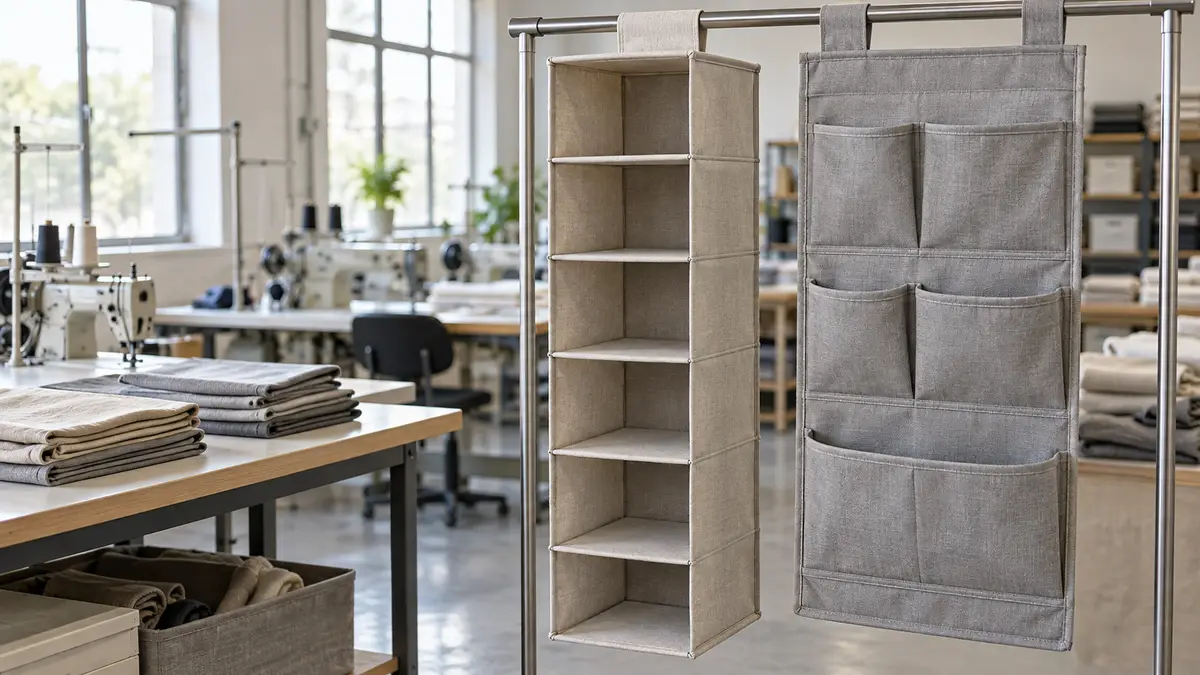
Define whether the organiser hangs from a wardrobe rail, door or wall fitting. Specify overall dimensions, pocket openings, shelf spacing, fabric construction, fibre blend, binding, reinforcement and removable inserts. Supply the actual rail or door profile for a fit trial. Record the intended contents and agree a load trial covering both individual compartments and the complete organiser.
Compare samples while loaded, after unloading and after the proposed cleaning method. Check whether shelves sag, inserts buckle or hanging straps slip. Importers and sellers are responsible for consumer product safety. Textile labels must show fibre content. Agree care information and installation guidance alongside the sample, and retain the approved construction for bulk comparison.
Worked duty example
Illustrative example, not a quote: Illustrative order: 800 woven hanging fabric storage organisers; illustrative FOB value and freight under 6307 90 98 99, invoiced at £9,000 free on board, with £800 of freight and insurance to the UK. The customs value is £9,800. Duty at 6% is £588. Import VAT at 20% is charged on the customs value plus duty, £10,388, so it is £2,077.60. Import taxes total £2,665.60; a VAT-registered importer can usually reclaim the VAT, so the lasting cost is the £588 of duty. The import duty and VAT guide explains each step.
Inspection checklist
Fit: hang samples on the intended rail or door, check door closure and confirm that hooks do not scrape the surface.
Load: use the agreed contents and load trial; inspect shelf sag, hook deformation, strap movement and attachment stitching.
Make-up: measure pockets and shelf spacing, inspect binding and seams, and compare fabric and insert stiffness with the approved sample.
Arrival: check for damp cartons, mould, colour transfer and missing inserts; compare fibre labels with the agreed specification. Include these points in your inspection brief.
Working out your own order? Send us the product on WhatsApp and we reply the same working day: WhatsApp us
What goes wrong
A hanging organiser can look square when empty but twist when pockets are unevenly filled. Thin shelf inserts buckle, stitching tears around suspension points, and smooth straps slide along the rail. Over-door hooks can prevent closure or mark paintwork. Approve the fitted, loaded sample rather than a catalogue photograph.
Bulk substitutions can change fabric stiffness, insert strength and hook fit without changing the appearance in a photograph. Record these components in the order and compare samples from different cartons. Keep damp or mouldy stock separate while you assess it, and repeat the agreed fit and load checks before releasing the delivery for sale.
Cambridge China Bridge sources these products for UK businesses, checking the factory and the documents before shipment. See factory verification. For own-brand ranges, see sourcing for brands.
Frequently asked questions
What is the UK import duty on hanging fabric organisers from China?
The selected heading 6307 lines carry 6% for felt, nonwoven and other articles, or 12% for knitted or crocheted articles. No anti-dumping or countervailing duty is recorded. Confirm the finished product's code.
Do hanging fabric organisers need fibre labels?
Textile labels must show fibre content. Agree the wording against the actual material specification and check it on the delivered stock.
How do I check an organiser's load capacity?
Agree a trial using the intended contents, both per compartment and across the complete organiser. Check shelf sag, straps, hooks and attachment seams while loaded and after unloading.
Will an over-door organiser fit any door?
Do not assume universal fit. Provide the door thickness and clearance, then test the actual hook with the door opening and closing. Check for scraping and movement under load.