Sourcing copper colanders from China
Copper colanders from China carry 0% UK duty across the relevant hand-made and other kitchenware lines, with no listed trade remedies. Confirm the applicable food-contact migration requirements with the relevant food safety authority. Specify the lining and check drainage-hole edges. Cambridge China Bridge sources copper colanders.
Buying from China for a business? How our UK China sourcing agent service works · China sourcing agent for small orders and first imports
Copper colander duty and classification
Heading 7418 covers copper table, kitchen and household articles, cooking apparatus and sanitary ware. Copper colanders fall within the other kitchenware lines: 7418 10 90 10 for hand-made articles and 7418 10 90 90 for other articles. The table shows lining variants under these same codes.
Read from the UK Trade Tariff on 4 October 2026, both relevant lines carry 0% duty for goods from China. The supplied tariff records list no anti-dumping or countervailing duty, suspensions or attached import controls for these lines.
Copper-plated steel or aluminium articles are classified by their base metal. Confirm the construction and manufacturing method using finding your commodity code. For the wider heading, see the copper roasting pans guide.
| Goods | Commodity code | Duty | Anti-dumping or countervailing duty on China |
|---|---|---|---|
| Hand-made copper colanders with tin lining | 7418 10 90 10 | 0% | None |
| Other copper colanders with tin lining | 7418 10 90 90 | 0% | None |
Specify the bowl, perforations and lining
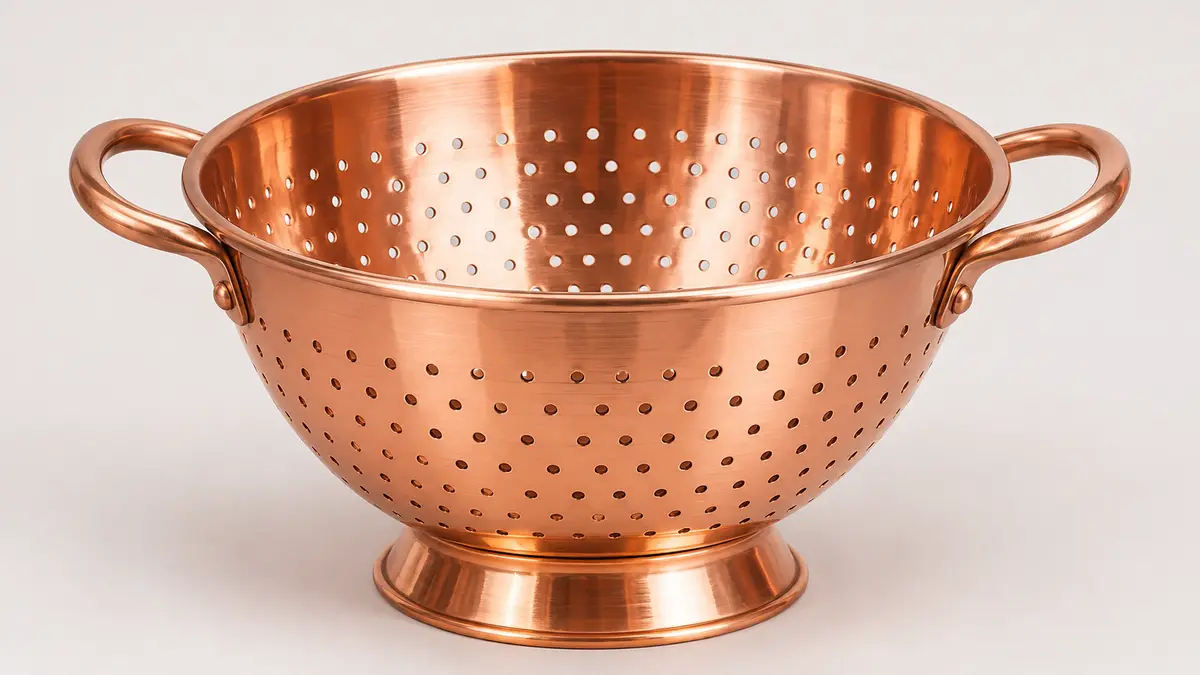
Specify solid copper or the actual layered construction, bowl diameter and depth, wall thickness, rim shape, drainage-hole size and pattern, handle attachment and the supporting foot or base. Agree whether the colander will drain hot pasta, wash produce or serve as decoration. Approve a sample that drains freely and sits steadily when loaded.
Unlined copper releases copper into acidic food, so agree a lining or a food-contact assessment for the intended use. Specify lead-free tin linings as a buying requirement. Request finished-product migration testing that represents the foods and contact conditions claimed, including exposed metal around perforations. See food-contact materials.
Food-contact traceability must be maintained throughout the supply chain, with systems identifying supplying and receiving businesses. Keep supplier, batch and business-customer records linked to the product and its test reports.
Worked duty example
Illustrative example, not a quote: Illustrative order: 2,000 tin-lined copper colanders under 7418 10 90 90, invoiced at £36,000 free on board, with £2,500 of freight and insurance to the UK. The customs value is £38,500. Duty at 0% is £0. Import VAT at 20% is charged on the customs value plus duty, £38,500, so it is £7,700. With no duty, the only import tax is the VAT, which a VAT-registered importer can usually reclaim. The import duty and VAT guide explains each step.
Inspection checklist
Construction: check the body material and wall thickness against the approved sample; inspect the rim and every accessible hole edge for burrs, cracks and snagging.
Lining: look for bare patches, peeling and gaps around perforations, seams and rivets; match the finished construction to the migration report and check tin lining for lead.
Drainage and handling: rinse and drain the intended food, check for trapped water, load-test handles to the agreed specification and check that the supporting base stays steady.
Arrival and packing: unpack samples for dents, tarnish and rubbing damage; check that nested pieces have separators and that handles have not distorted. Use the quality inspection guide to brief the inspector.
Working out your own order? Send us the product on WhatsApp and we reply the same working day: WhatsApp us
What goes wrong
A polished bowl can hide rough punched holes or incomplete lining. Food catches on burrs, water remains above poorly positioned perforations, and loose handles become apparent when the bowl is loaded. Check the finished perforated sample rather than approving an unperforated display piece.
Nested colanders can arrive with dented rims, scratched linings or bent handles. Agree separators and handle protection, then repeat drainage and stability checks on arrival. Decorative lacquer should not be treated as evidence of food suitability; decorative-only copper articles should be labelled accordingly.
Cambridge China Bridge sources these products for UK businesses, checking the factory and the documents before shipment. See factory verification. For repeat volumes, see container programmes.
Frequently asked questions
What is the UK import duty on copper colanders from China?
The relevant hand-made and other kitchenware lines carry 0% duty in the supplied tariff records, with no listed anti-dumping or countervailing duty.
Do copper colanders need a lining?
Agree a lining or a food-contact assessment for the intended use. Unlined copper releases copper into acidic food. Check exposed metal around drainage holes as well as the bowl.
Does a copper-coloured steel colander use the same code?
Copper-plated steel articles are classified by the base metal. Ask for the actual body construction before choosing the commodity code.
What should I check when copper colanders arrive?
Check drainage-hole burrs, lining gaps, loose handles, stability, trapped water and transit dents. Compare the delivered construction with the approved sample and test report.