Concrete Block & Brick Making Machines From China for Africa
Match the machine to your products, materials, electricity and destination requirements before paying. Compare complete packages, verify the supplier and agree payment milestones and acceptance tests. Use the Ghana example to distinguish CIF shipping costs from clearance and other destination costs.
Buying from China for a business? How our UK China sourcing agent service works · Verify a Chinese factory before you order
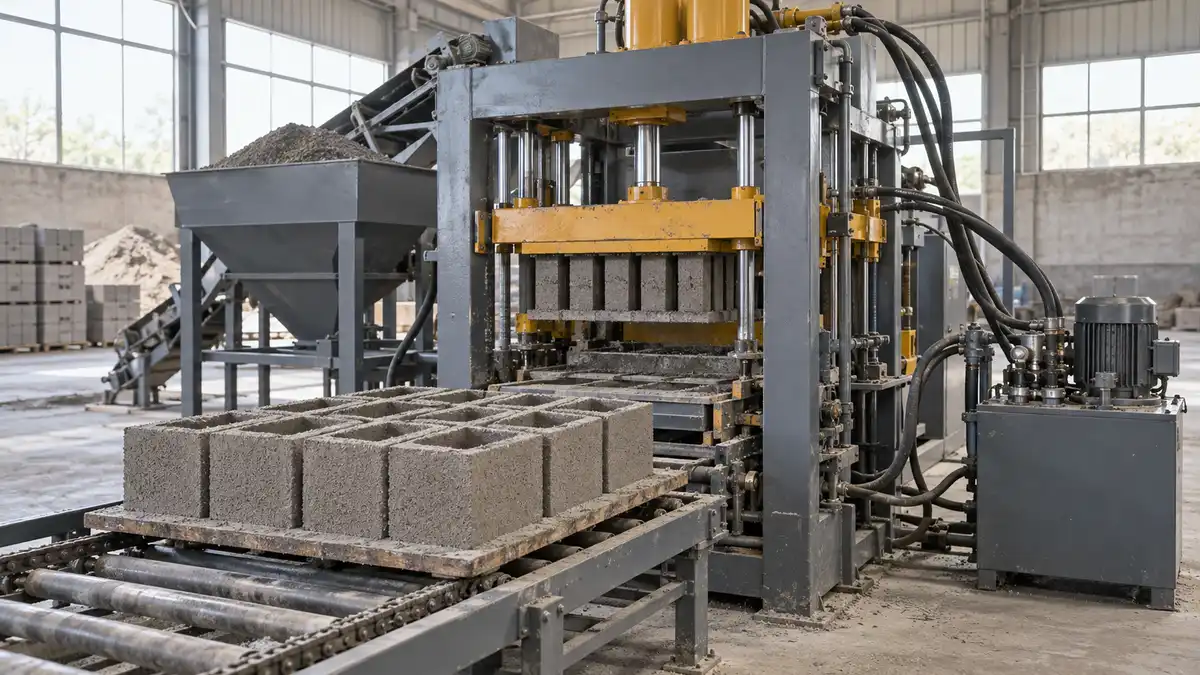
Start with the blocks you need to sell
Whether you are starting production, expanding capacity or ordering a complete line, begin with the finished product. Specify hollow blocks, solid concrete bricks or paving blocks, their drawings, intended use and required quality. Require separate confirmation of suitability if you also intend to produce fired clay bricks.
Give shortlisted suppliers the same brief: available aggregates and cement, water supply, site layout, electricity, labour, handling equipment and target saleable output. Ask what equipment and site work are needed beyond the forming machine, including mixing, feeding, pallets, curing space and finished-product handling.
Use Ghana as a destination example. For other destinations, confirm the applicable customs, machinery and construction-product requirements before choosing the machine.
Compare specifications before comparing prices
This guide provides no published price benchmark. Request itemised quotations against the same specification so a bare machine is not compared with an installed production line.
Compare output per cycle, mould sets, hydraulic pressing and vibration arrangements, automation level and included auxiliary equipment. Ask suppliers to identify the functions of each system and demonstrate the quoted configuration.
Treat advertised daily output as a claim to test. Request the block dimensions, cavities per mould, cycle assumptions, staffing, material mix and handling arrangements behind it. Include stoppages, rejects and curing arrangements in your production assessment.
| Item | Specify in writing | Evidence to request |
|---|---|---|
| Finished products and moulds | Product drawings, dimensions, tolerances, mould list and changeover requirements | Matching mould drawings and a trial using the quoted configuration |
| Output | Products per cycle and the operating conditions behind output claims | Recorded trial results, including rejects and interruptions |
| Compaction and automation | Hydraulic and vibration functions; manual and automatic tasks | Component schedule and demonstration of the production sequence |
| Complete package | Mixer, feeder, conveyors, pallets, handling equipment and exclusions | Itemised equipment and packing lists |
| Electrical specification | Voltage, frequency, phase, connected load, starting demand and control supply | Nameplates, electrical drawings and confirmation against the site supply |
| Support and spares | Installation scope, training, warranty, spare parts and control-system access | Written responsibilities, parts list and operating documentation |
Check the proforma invoice before accepting a 50% deposit
If a supplier requests a 50% deposit, assess the proposed advance payment and the evidence supporting it. Do not treat the percentage as proof that the arrangement is normal or safe.
Ask for the proforma invoice to identify the contracting seller, buyer, model, specification revision, moulds, accessories, currency, payment milestones, shipment terms and named destination. Reconcile the beneficiary with the seller and investigate any different receiving entity before transferring money.
Negotiate stages tied to evidence: approved specifications and supplier checks before the initial payment; documented manufacturing progress before an intermediate payment; successful acceptance testing and agreed shipping documents before the relevant balance becomes payable. Define defect correction, retesting and cancellation terms in the contract. Assess recovery arrangements separately from the payment percentages.
Use check a machine quote before paying a deposit and read a Chinese proforma invoice for the detailed checks. Agree the release conditions using paying the balance on a Chinese machine order.
Verify the Chinese company and visit the production site
Obtain the seller's Chinese legal name, business licence and unified social credit code. Check the company through the National Enterprise Credit Information Publicity System. SAMR describes searches using the enterprise name, unified social credit code or registration number. Compare the records with the contract and invoice; request explanations and supporting documents for discrepancies.
Verify manufacturing capability separately from company registration. Establish whether the seller is the manufacturer or a trading business, who owns the design and who will provide warranty support.
Arrange a factory visit covering the actual production address, relevant machinery under construction, machining and assembly capability, quality records and the proposed test facilities. Ask permission to identify the machine and moulds assigned to your order in the visit report.
Define the evidence and scope through factory verification. Arrange separate acceptance checks for your completed order.
Agree machinery safety and electrical requirements before manufacture
Ask a competent specialist to identify the destination's applicable machinery requirements and the standards appropriate to the complete configuration. ISO 12100:2010 sets out principles and a methodology for machinery risk assessment and risk reduction. Ask for evidence of how applicable requirements have been met, rather than accepting a reference to the standard alone.
Specify guarding, interlocks, emergency stops, isolation for maintenance, safe access and protection around moving moulds and handling equipment, as determined by the risk assessment. Request the risk assessment, relevant conformity documents, manuals and electrical drawings for the supplied model.
Have the site's electrician confirm voltage, frequency, phase, earthing, protection and starting demand, including generator compatibility where relevant. Require confirmation against the actual site supply before approving the electrical specification.
Arrange machine acceptance and block acceptance separately. Agree how finished blocks will be sampled, cured and tested against the destination's applicable product requirements. Require the agreed strength-test results separately from the demonstration of fresh blocks.
Witness a factory acceptance test and secure the spares
Write the factory acceptance test into the contract before production. Identify the machine, moulds, material recipe, test conditions, measurement methods, acceptance limits and the evidence the buyer will receive.
Run the quoted configuration with agreed materials. Record the production sequence, cycle performance, rejects, dimensions, mould changes, hydraulic leaks and safety-function checks. Record any limitations where the trial materials or site supply differ from those planned at the destination.
Link the report, photographs and video to the machine identification and specification revision. List defects, require corrective evidence and agree any retest before releasing the payment tied to acceptance. Plan separately for tests that require cured blocks.
Before packing, reconcile moulds, accessories and spares with the order. Specify relevant seals, sensors, switches, hydraulic components and wear parts by identifiable part number. Obtain electrical and hydraulic diagrams, maintenance instructions, warranty procedures and agreed access or backups for programmable controls.
Use pre-shipment inspection in China to define shipment checks. Agree separately who installs, commissions and trains operators, and how destination acceptance affects any retained payment.
CIF Tema, Ghana: separate the shipping quote from landed cost
For CIF Tema, state the named port and Incoterms edition. Under Incoterms 2020, the seller pays carriage and insurance to that port; risk transfers on board at shipment. Review the default limited insurance and any additional cover required.
Obtain the breakdown below without double counting. CIF assigns import clearance and taxes to the buyer; destination unloading costs depend on the carriage contract.
For handover before vessel loading, ask the forwarder about a suitable multimodal term. Before comparing LCL shipping from China, obtain packed dimensions, weights and handling requirements.
| Cost line | What the quotation should establish | Check with |
|---|---|---|
| Machine and production package | Equipment, moulds, spares, packing and exclusions | Seller |
| China inland and export handling | Collection, loading, export clearance and origin charges included in the price | Seller and forwarder |
| Ocean freight | Route, cargo details, surcharges and quotation validity | Seller or contracted carrier |
| Cargo insurance | Insured journey, cover, exclusions, deductible and claims procedure | Seller and insurer |
| Tema destination charges | Unloading, terminal, documentation and release charges; which are prepaid | Destination agent |
| Ghana clearance and compliance | Classification, valuation, applicable duties and taxes, agent fees and GSA requirements | Customs agent and relevant authorities |
| Delivery and commissioning | Inland haulage, unloading equipment, foundations, electrical work and installation | Local providers and supplier |
Working out your own order? Send us the product on WhatsApp and we reply the same working day: WhatsApp us
Ghana clearance: prepare customs and GSA documents
GRA lists a bill of lading or original waybill, attested invoice, packing list, Import Declaration Form, TIN or GhanaCard PIN, and applicable regulatory permits. Its procedure uses ICUMS for declarations. Confirm classification, valuation and documents with your agent before shipment.
GSA lists industrial machinery as high-risk goods. Its published procedure requires registration, purchase of applicable Ghana standards and a laboratory CoA or CoC referring to those standards. It states that missing certificates prevent clearance until samples pass the applicable tests.
Confirm machine-specific standards, accepted issuers, labelling and the submission route with GSA before ordering. Its page mentions GCNet; GRA describes ICUMS. Obtain current instructions.
UK example: customs value and import VAT
Under HMRC's transaction-value method, include transport, insurance, loading and handling to the UK border where not already included. For import VAT, add applicable import duties and other import charges except VAT, plus qualifying incidental expenses to the first UK destination. Include qualifying expenses arising from transport to a further UK destination known at importation. Avoid double counting.
For new machinery placed on the Great Britain market, official guidance recognises UKCA and CE routes with the applicable conformity assessment and declaration. HSE states that instructions must be in English. Confirm the requirements for the actual machine and supply arrangement; Northern Ireland has separate guidance.
Check requirements separately for Ghana or any other destination where the machine will be imported and used.
Prepare a brief for Cambridge China Bridge
Prepare a brief for Cambridge China Bridge with your destination, product drawings, materials, site electricity details, required production package and any quotation or proforma invoice already received. Include whether you need a standalone machine or a complete line, and who will install it.
Before commissioning work, request written confirmation of the scope for supplier checks, quote comparison, factory testing, inspection and shipping coordination.
Ask the quotation to state which factory checks and inspections are included, any exclusions and any third-party charges. Agree additional work and fees in writing before it proceeds.
Frequently asked questions
How much does a concrete block making machine from China cost?
This guide provides no published price range. Compare quotations with identical output assumptions, mould sets, hydraulic and vibration systems, automation, auxiliaries, spares and shipping scope.
Should I pay the supplier's 50% deposit?
Assess the amount at risk before agreeing. Complete supplier and invoice checks, settle the specification and negotiate payment milestones tied to verifiable evidence. Assess recovery arrangements separately from the deposit percentage.
Can the same machine make blocks, bricks and pavers?
Require written confirmation for each product, with matching moulds, materials and a trial. Require separate confirmation of suitability for fired clay bricks.
Does CIF Tema include everything I will pay in Ghana?
No. Obtain a destination-cost schedule for clearance, taxes, port charges, delivery and installation. Identify charges already included in the shipping quote.
What paperwork should I prepare for Ghana?
Confirm GRA documents and permits with your agent, and machine-specific registration, standards and conformity evidence with GSA before shipment.
Will the machine work with my electricity supply?
Have your electrician compare the machine's voltage, frequency, phase, load, starting demand and protection requirements with the actual site or generator supply before manufacture.
Can I accept a supplier's demonstration video?
Use it as supporting evidence. Require an agreed acceptance test identifying your machine, moulds, materials, results and defects, with independent attendance where commissioned.
Does a CE mark mean the machine is approved for Ghana?
Confirm Ghana's requirements separately with GSA, including the applicable standards and accepted conformity evidence for the machine.
What should I secure before paying the balance?
Obtain the agreed acceptance evidence, defect closure, equipment and spares reconciliation, manuals and payment-stage documents. Confirm commissioning and warranty responsibilities in writing.
Sources
- Ghana Revenue Authority: import procedures and clearance documents
- Ghana Standards Authority: high-risk goods and published import inspection procedure
- ICC: CIF rules, risk transfer, insurance and cost allocation
- China State Administration for Market Regulation: government service platform
- ISO: ISO 12100:2010 machinery risk assessment and risk reduction
- HMRC: valuing imported goods using transaction value
- HMRC: calculating import VAT value
- GOV.UK: machinery supply requirements in Great Britain
- HSE: buying new machinery and updated conformity guidance
- SAMR: enterprise information searches by name, unified social credit code or registration number