Sourcing coated knit rain trousers from China
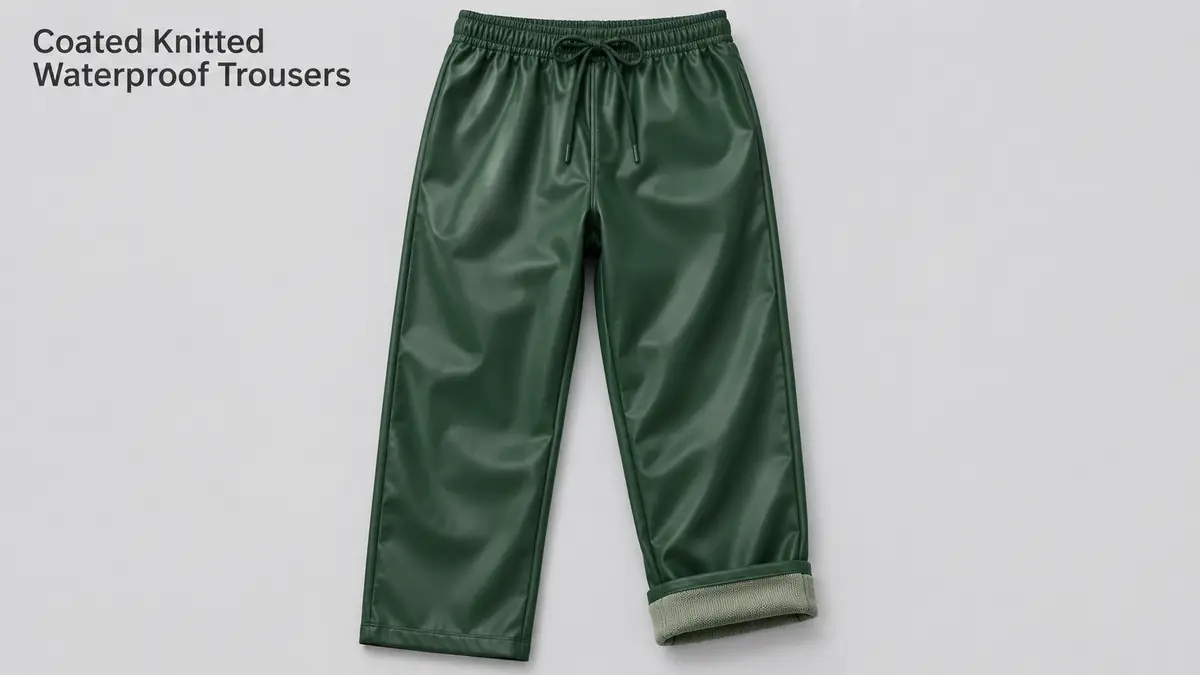
Coated knitted waterproof trousers from China carry UK duty of 8% to 12% under heading 6113, depending on the coating. Fibre content must be labelled, and waterproofness claims need test evidence. Specify the fabric and sealed seams before approving production. Cambridge China Bridge sources coated knitted waterproof trousers.
Buying from China for a business? How our UK China sourcing agent service works · China sourcing agent for small orders and first imports
UK duty by fabric and coating
Read from the UK Trade Tariff on 4 October 2026, heading 6113 covers garments made from knitted or crocheted fabrics of headings 5903, 5906 or 5907. For waterproof trousers, identify the knitted backing and coating material. Rubberised knitted fabric falls under 6113 00 10 00; other qualifying coated or laminated knitted fabric falls under 6113 00 90 00.
The supplied tariff records show 8% duty on the rubberised fabric line and 12% on the other line for goods from China. They record no anti-dumping or countervailing duty, suspensions or attached import controls. The table groups trouser constructions under the available codes.
Woven coated trousers belong to heading 6210; rainwear with a coating invisible to the naked eye is usually classified as ordinary knitted clothing. Confirm the commodity code using a fabric sample and construction details. See wetsuits and coated rainwear for the wider heading.
| Goods | Commodity code | Duty | Anti-dumping or countervailing duty on China |
|---|---|---|---|
| Waterproof trousers of polyurethane-coated knitted fabric | 6113 00 90 00 | 12% | None |
| Waterproof trousers of rubberised knitted fabric | 6113 00 10 00 | 8% | None |
Specify the coating, sealed seams and overtrouser fit
Specify the backing fibre composition, coating material, fabric weight, stretch and surface finish. Mark which seams must be taped or otherwise sealed, particularly the crotch, seat and inner legs. Agree tape material, overlap at seam intersections and compatibility with the coating. Approve the finished trousers rather than relying on a fabric swatch.
Define waist adjustment, rise, inseam, knee movement and ankle openings. If worn over clothing, approve fit over the intended underlayers and check whether boots pass through the openings. Agree waterproofness testing to ISO 811, washing to ISO 6330 and tape adhesion checks after washing. Request breathability evidence where it is claimed.
For sale in Great Britain, the label must show fibre content, including fur and other animal parts. Ask the relevant authority or a compliance adviser to confirm any UK REACH phthalate restrictions applicable to plasticised PVC coatings and any PAH restrictions applicable to rubber parts in direct and prolonged skin contact. Request material-specific laboratory reports. Products should only be sold once compliance with relevant product safety regulations has been demonstrated. Have a compliance adviser review intended occupational protective uses before ordering.
Worked duty example
Illustrative example, not a quote: Illustrative order: 500 pairs of polyurethane-coated knitted waterproof trousers; FOB value and freight are illustrative. under 6113 00 90 00, invoiced at £7,000 free on board, with £700 of freight and insurance to the UK. The customs value is £7,700. Duty at 12% is £924. Import VAT at 20% is charged on the customs value plus duty, £8,624, so it is £1,724.80. Import taxes total £2,648.80; a VAT-registered importer can usually reclaim the VAT, so the lasting cost is the £924 of duty. The import duty and VAT guide explains each step.
Inspection checklist
Fabric: compare production material with the sealed sample; check coating coverage, pinholes, tackiness, cracking and separation from the knitted backing.
Seams: inspect tape continuity at the crotch, seat, inner legs and pocket attachments; water-test finished garments and repeat checks after the agreed wash treatment.
Fit and closures: measure waist, rise, inseam and ankle openings; squat and bend in samples over clothing, then operate zips, adjusters and fasteners.
Labels and arrival condition: compare fibre wording with composition evidence; check sizes, packing quantities, dampness and coating transfer between folded garments. Plan sampling with the inspection guide.
Working out your own order? Send us the product on WhatsApp and we reply the same working day: WhatsApp us
What goes wrong
Waterproof fabric can become leaking trousers when stitching punctures the coating and seam tape misses intersections. Tape can lift at the crotch after stretching or washing. Narrow ankle openings make overtrousers difficult to put on over boots, while a short rise pulls the seat seam tight when the wearer bends.
Bulk coating can differ from the approval sample, becoming sticky in folded storage or peeling after washing. Keep sealed fabric and garment samples, record the agreed wash and water-test methods, and check production garments before shipment and on arrival. Resolve coating substitutions and failed seam seals before accepting the batch.
Cambridge China Bridge sources these products for UK businesses, checking the factory and the documents before shipment. See factory verification. For own-brand ranges, see sourcing for brands.
Frequently asked questions
What is the UK import duty on coated knitted waterproof trousers from China?
The supplied tariff records show 8% for rubberised knitted fabric trousers under 6113 00 10 00 and 12% for other qualifying coated knitted trousers under 6113 00 90 00, with no anti-dumping or countervailing duty recorded.
Do coated knitted waterproof trousers need fibre labels?
Approve the wording against the actual backing fabric composition before production.
How do I check that waterproof trousers will not leak?
Agree fabric waterproofness testing to ISO 811 and water-test finished trousers at the crotch, seat and inner-leg seams. Repeat checks after the agreed washing treatment and inspect tape adhesion.
What measurements matter for waterproof overtrousers?
Specify waist, rise, inseam, knee movement and ankle openings. Approve fit over the intended clothing and check putting them on over boots, squatting and bending.
Sources
What most often fails: Clothing, textiles and fashion
UK OPSS + EU / EEA Safety Gate (alerts counted separately in each system) · China-origin alerts over the 24 calendar month coverage window(2024-11 – 2026-10) · 150
Combined counts are alerts from both systems, not unique products across markets. Each source uses its own publication window; the same product may appear in both. · OPSS: 2024-11 – 2026-10 · Safety Gate: 2024-11 – 2026-10
- Chemical: 91
- Entrapment: 27
- Strangulation: 22
Most-cited regulations
- REACH Regulation: 77
- General Product Safety Regulation: 35
- EN 14682: 28
Checks to ask the factory for
- Ask for laboratory testing for restricted substances relevant to the materials and intended market.
- Match the report model, material colours and component list to the order.
- Ask how raw-material declarations and supplier changes are traced by batch.
Questions for due diligence, not a certification checklist or a guarantee of compliance. Select the applicable standards and tests with a competent laboratory.
The current calendar month is partial. These are published alerts, safety reports and recalls, not a measure of all products sold or a recall rate. Hong Kong is reported separately.
All recall dataContains public sector information licensed under the Open Government Licence v3.0 (OPSS, GOV.UK product safety alerts)
Source: European Commission, Safety Gate, English XML (en), extracted 2026-10-19. XML distribution: CC0. Cambridge China Bridge analysis.