Sourcing clam extract from China
Listed UK duty on clam extract from China is 0% to 12%, depending on pack size. Ask APHA and your customs broker to confirm whether China-origin clam extract for human consumption is eligible to enter Great Britain under the applicable country-approval rules. Cambridge China Bridge checks whether a product can be imported before any order is placed.
Buying from China for a business? How our UK China sourcing agent service works · China sourcing agent for small orders and first imports
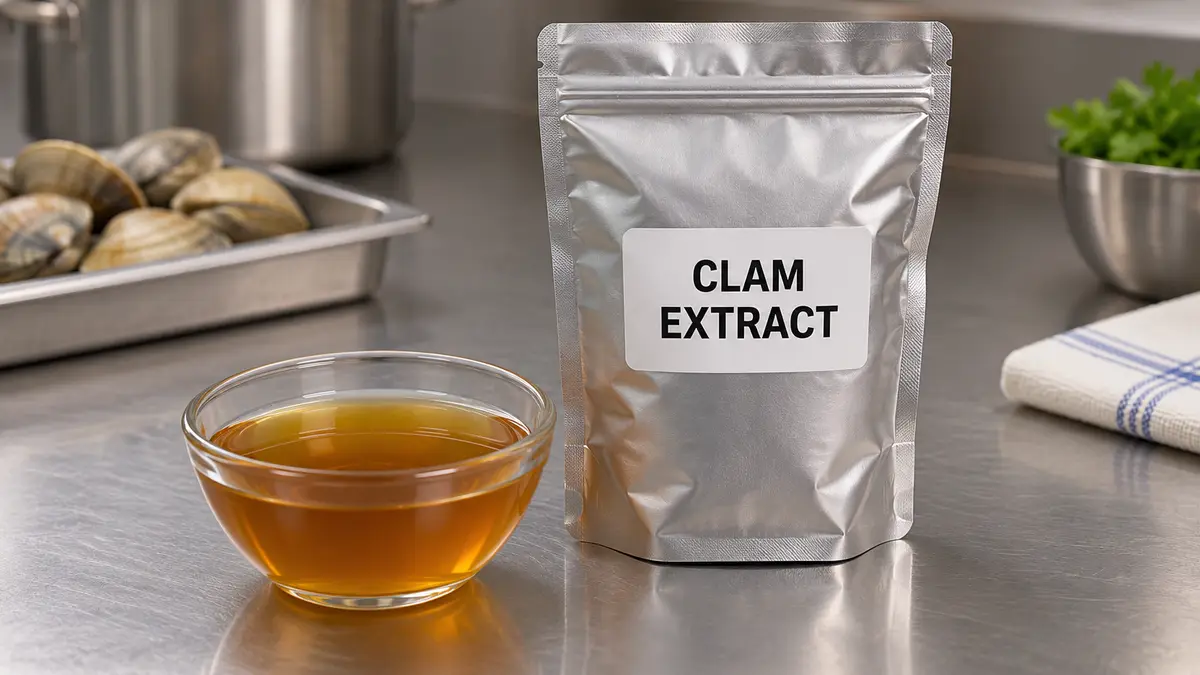
Clam extract duty and import eligibility
Read from the UK Trade Tariff on 29 September 2026, heading 1603 covers extracts and juices of meat, fish, crustaceans, molluscs and other aquatic invertebrates. The supplied Chinese-origin lines containing fishery products carry 12% in immediate packs with a net content of 1 kg or less and 0% in larger packs. No anti-dumping or countervailing duty or suspension is recorded.
Ask APHA and your customs broker to confirm whether China-origin clam extract for human consumption meets the applicable country-approval and entry rules for Great Britain. The tariff also attaches veterinary, organic and import and export CITES controls. These controls and the listed duty rates do not establish import permission. Ask your customs broker to confirm the veterinary entry document requirement for any revised, eligible sourcing proposal.
Confirm the commodity code using the full formulation, extraction process and immediate-pack net weight. The residual other-extract rows are included for comparison; they should not be selected simply to obtain a different treatment for clam extract. For the wider heading, see the oyster extract guide.
| Goods | Commodity code | Duty | Anti-dumping or countervailing duty on China |
|---|---|---|---|
| Clam extract containing fishery products, immediate packs not exceeding 1 kg | 1603 00 10 80 | 12% | None |
| Clam extract containing fishery products, larger immediate packs | 1603 00 80 10 | 0% | None |
| Other extracts, immediate packs not exceeding 1 kg: classification comparison | 1603 00 10 89 | 12% | None |
| Other extracts, larger immediate packs: classification comparison | 1603 00 80 90 | 0% | None |
Specify the clam source and extract concentration
This guide concerns clam extract supplied as a food ingredient. Establish import eligibility before commissioning production. Record the scientific species name, harvesting origin, whether the clams are farmed or wild, the extraction process and the processing establishment. General approval for fishery products should not be treated as approval for processed bivalves.
For an eligible sourcing proposal, specify liquid, paste or powder, clam-derived solids, salt, added sugar, carriers and preservatives. Agree concentration, colour, sediment, solubility and flavour against retained samples. Assess the extract in the intended soup, sauce or seasoning. Request processing records, batch analysis and evidence supporting storage instructions and shelf life.
CITES can cover derivatives: identify the clam species and ask your customs broker to confirm whether permits apply to the extract. For an organic proposal, confirm the inspection certificate and importer certification arrangements with your organic control body and broker. Neither arrangement establishes import eligibility; confirm the applicable country restrictions with APHA and your customs broker.
Worked duty example
Illustrative example, not a quote: Illustrative palletised order of clam extract in sealed 1 kg catering packs; calculation only, not an importable China shipment under 1603 00 10 80, invoiced at £30,000 free on board, with £4,000 of freight and insurance to the UK. The customs value is £34,000. Duty at 12% is £4,080. Import VAT at 20% is charged on the customs value plus duty, £38,080, so it is £7,616. Import taxes total £11,696; a VAT-registered importer can usually reclaim the VAT, so the lasting cost is the £4,080 of duty. The import duty and VAT guide explains each step. This assumes the goods are standard-rated for VAT. Most food for human consumption is zero-rated, and animal feed can be too, in which case no import VAT is due, so check the rate for your product in HMRC's VAT Notice 701/14.
Inspection checklist
Identity: for an eligible shipment, match the species, ingredient formula, processing establishment and batch references across the specification, documents and packaging.
Contents: compare concentration, saltiness, colour, sediment and dissolution with the approved sample; investigate unexpected dilution or excessive carrier material.
Packaging: inspect seals, leaks, swelling and contamination around closures; check powder for moisture damage and isolate suspect packs.
Labels: check the food name, ingredients with the mollusc allergen emphasised, net quantity, date mark, storage instructions and UK business address.
Working out your own order? Send us the product on WhatsApp and we reply the same working day: WhatsApp us
What goes wrong
A supplier presents a tariff code or general fishery approval as proof that Chinese clam extract can enter Great Britain. Ask APHA and your customs broker to confirm the applicable processed-bivalve country-approval rules for the exact product. Resolve eligibility before paying for production, approving printed packaging or booking transport.
Quality disputes arise when extra salt, water or carriers change the extract's strength, or when sediment and flavour differ from the approved sample. Missing batch records make the cause harder to establish. For an eligible supply route, agree measurable acceptance criteria and retain samples from the approved formulation and delivered batch.
Cambridge China Bridge sources these products for UK businesses, checking the factory and the documents before shipment. See factory verification. For repeat volumes, see container programmes.
Frequently asked questions
What is the UK import duty on clam extract from China?
The supplied fishery-product extract lines carry 12% in immediate packs of 1 kg or less and 0% in larger packs, with no recorded trade remedy or suspension. These rates do not override the import restriction.
Can I import Chinese clam extract into Great Britain?
Ask APHA and your customs broker to confirm whether China-origin clam extract for human consumption is eligible under the applicable processed-bivalve country-approval rules. Confirm any proposed alternative supply route before ordering.
Does clam extract need an allergen declaration?
Confirm the applicable mollusc-allergen declaration and emphasis requirements with the relevant food authority, including where clam extract is used in a sauce or seasoning. Check the ingredient list against that advice.
What should I put in a clam extract specification?
Specify species, harvesting origin, formulation, extraction process, concentration, salt, carriers, solubility, flavour, packaging and storage. Establish import eligibility before commissioning production.