Sourcing babies' woven garments from China
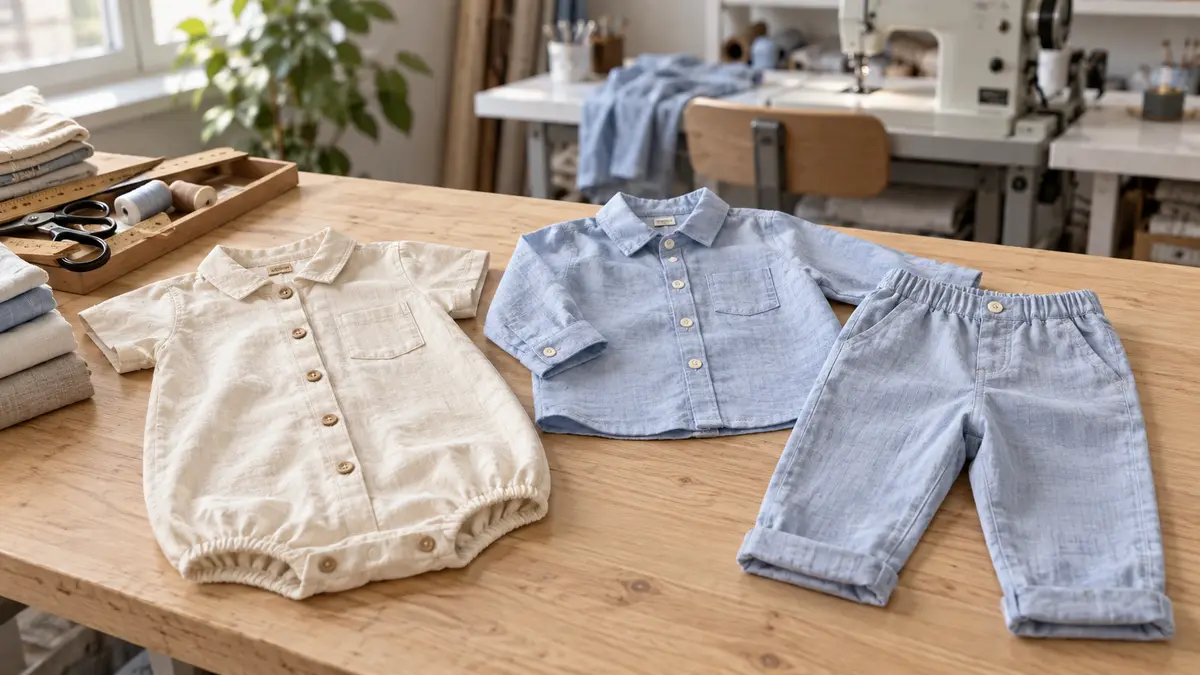
Babies' garments and clothing accessories of woven textiles from China, including muslin sets, dresses, rompers, socks and mittens, pay 10% UK duty, with no anti-dumping duty. Babies' clothes must be safe under general product safety law, with firmly attached small parts, no hazardous cords and nickel-safe snaps. Cambridge China Bridge sources babies' clothing.
Buying from China for a business? How our UK China sourcing agent service works · China sourcing agent for small orders and first imports
A flat 10%
Read from the UK Trade Tariff on 26 September 2026, babies' garments and clothing accessories of heading 6209, of cotton, synthetic fibres, wool or other textiles, including gloves, mittens and mitts and stockings and socks, carried 10% duty on goods from China, with no anti-dumping measure. The tariff treats garments for young children up to 86 cm body height as babies' garments.
Knitted babies' garments are in heading 6111, covered in the baby clothing guide; confirm the commodity code from the fabric construction. For gloves outside babywear, see our woven fabric gloves sourcing guide.
| Goods | Commodity code | Duty | Anti-dumping duty on China |
|---|---|---|---|
| Cotton gloves, mittens and mitts | 6209 20 00 10 | 10% | None |
| Cotton socks | 6209 20 00 20 | 10% | None |
| Other cotton garments | 6209 20 00 90 | 10% | None |
| Other synthetic fibre garments | 6209 30 00 90 | 10% | None |
| Other garments of other textiles | 6209 90 90 90 | 10% | None |
Safety for babies
Babies' clothes must be safe under the General Product Safety Regulations 2005 in Great Britain; Northern Ireland applies the EU General Product Safety Regulation instead. Buttons, snaps, bows and trims are choking hazards if they come off, so specify pull strength and test it; BS 7907 is the UK code of practice for the mechanical safety of children's clothing, and BS EN 14682 limits cords and drawstrings on children's clothing. Metal snaps in contact with skin fall under the UK REACH nickel release restriction in entry 27, and dyes under the azo restriction in entry 43.
Fibre composition must be labelled under the Textile Products (Labelling and Fibre Composition) Regulations 2012, and labels themselves should be soft and sewn where they cannot come loose.
What most often fails: Clothing, textiles and fashion
UK OPSS + EU / EEA Safety Gate (alerts counted separately in each system) · China-origin alerts over the 24 calendar month coverage window(2024-12 – 2026-11) · 152
Combined counts are alerts from both systems, not unique products across markets. Each source uses its own publication window; the same product may appear in both. · OPSS: 2024-12 – 2026-11 · Safety Gate: 2024-12 – 2026-11
- Chemical: 95
- Entrapment: 25
- Strangulation: 20
Most-cited regulations
- REACH Regulation: 79
- General Product Safety Regulation: 36
- EN 14682: 26
Checks to ask the factory for
- Ask for laboratory testing for restricted substances relevant to the materials and intended market.
- Match the report model, material colours and component list to the order.
- Ask how raw-material declarations and supplier changes are traced by batch.
Questions for due diligence, not a certification checklist or a guarantee of compliance. Select the applicable standards and tests with a competent laboratory.
The current calendar month is partial. These are published alerts, safety reports and recalls, not a measure of all products sold or a recall rate. Hong Kong is reported separately.
All recall dataContains public sector information licensed under the Open Government Licence v3.0 (OPSS, GOV.UK product safety alerts)
Source: European Commission, Safety Gate, English XML (en), extracted 2026-11-09. XML distribution: CC0. Cambridge China Bridge analysis.
Worked duty example
For a made-up shipment of 10,000 babies' cotton muslin sets under 6209 20 00 90, add the £2,000 of freight and insurance to the £30,000 free-on-board price and customs sees £32,000. At 10%, duty on these babies' woven garments is £3,200; babies' clothing is zero-rated for VAT under HMRC's VAT Notice 714, so no import VAT is due and the £3,200 of duty is the whole border cost. If the goods did not qualify, import VAT of £7,040 (20% of the value with duty added) would be due, which a VAT-registered importer usually gets back. The duty and VAT guide walks through the calculation.
Inspection checklist
Attachments: snaps, buttons, bows and appliqués tested with a calibrated force gauge before and after the care-label wash at the force set in the specification, snaps also opened and closed repeatedly to check they stay secure, metal snaps tested for nickel release by BS EN 1811, and every finished garment passed through a needle detector with a broken-needle log kept on the line.
Fabric: colour fastness to washing to ISO 105-C06 and to perspiration to ISO 105-E04, dimensional change to ISO 5077 after the care-label wash, formaldehyde to ISO 14184-1, pH of the aqueous extract to ISO 3071, and azo dyes to EN ISO 14362-1 against the UK REACH Annex XVII entry 43 restriction.
Sizing, cords and packs: garments measured against the UK size chart by age and body height, any cords, ties or ribbons measured against the limits in BS EN 14682, seams checked inside feet and mittens for loose threads, labels soft and fully sewn, polybags checked for a suffocation warning, and cartons sampled to ISO 2859-1.
Working out your own order? Send us the product on WhatsApp and we reply the same working day: WhatsApp us
What goes wrong
Babies' garments fail on small parts, shrinkage and sizing. Snaps set with the wrong die pull out of thin muslin, buttons sewn with too few stitches come off, and decorative bows are glued rather than sewn. Muslin and cotton shrink more than adult fabrics, sizes do not match UK age bands, and loose threads inside feet or mittens can wrap around fingers and toes.
Pull-test snaps and buttons on samples and after washing, test snaps for nickel release, check for loose threads inside mittens and feet, wash-test for shrinkage, measure against a UK size chart by age, and check that no cords exceed the lengths in BS EN 14682.
Cambridge China Bridge sources babies' woven sets, dresses, rompers, socks and mittens, with small parts testing, fabric tests and sizing agreed before the order. Find out how we source babywear. For the reverse trade, see exporting baby clothing to China.
Frequently asked questions
What is the UK import duty on babies' clothes from China?
Read from the UK Trade Tariff on 26 September 2026, babies' woven garments of heading 6209 carried 10% duty from China.
Where do knitted babies' clothes go?
Knitted babies' garments are in heading 6111, not 6209.
Which standards cover babies' clothing safety?
BS 7907 for mechanical safety of children's clothing and BS EN 14682 for cords and drawstrings.
Do baby snaps need a nickel test?
Yes. Metal snaps in skin contact fall under the UK REACH nickel restriction in entry 27.