Sourcing apple juice concentrate from China
Agree the reconstitution and testing basis before comparing prices. The GB patulin limit is 50 µg/kg for concentrated juice as reconstituted, so a certificate without its dilution basis is not enough. Under 2009791990 UK duty is 30% plus 20% import VAT. Also ask for an Alicyclobacillus test: it can spoil the taste without swelling the pack.
Buying from China for a business? How our UK China sourcing agent service works · China sourcing agent for small orders and first imports
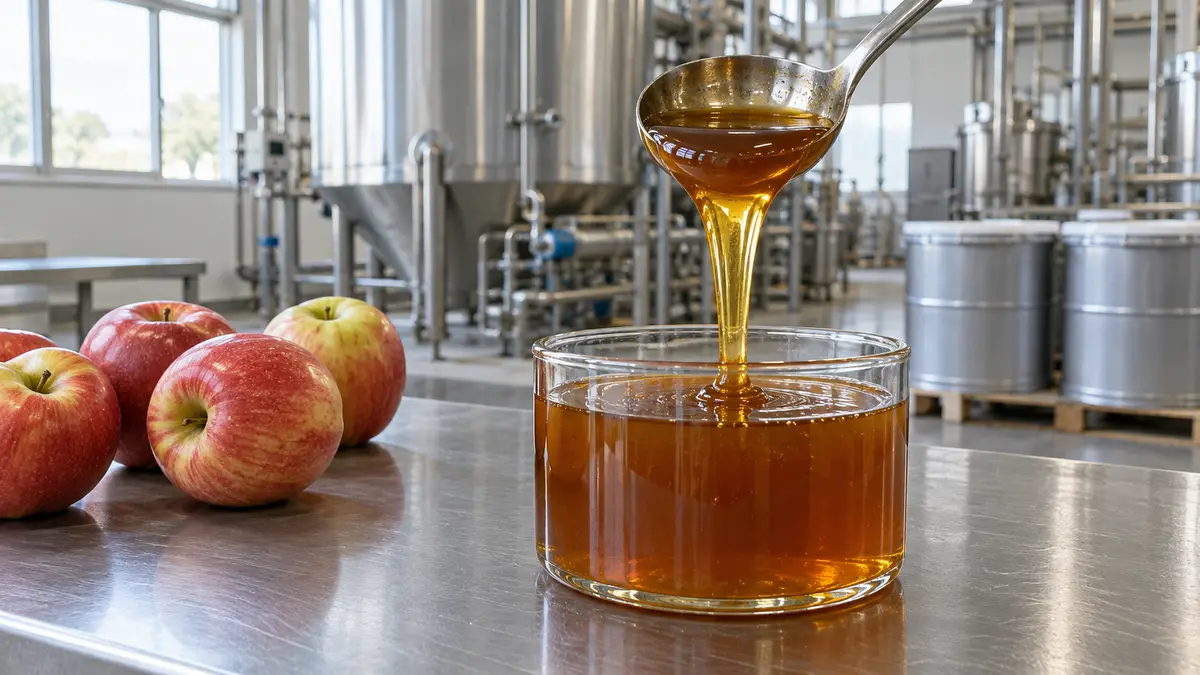
Where to look: processing sites in Shaanxi and Shandong
Use named processing sites to build your enquiry list. Andre’s Chinese factory pages identify apple concentrate production in Baishui County, Shaanxi, with an address in Dukang Town, Weinan; and in the food industrial park in Liquan County, Xianyang. Its Muping operation in Yantai identifies concentrated juice among its products. These are documented sourcing leads, not endorsements of any supplier or batch.
Ask which plant will manufacture your order, rather than accepting only the exporting company’s name. Request the plant address, concentrate type, batch identification and the laboratory responsible for the analysis certificate. Use the factory audit checklist to organise a visit around fruit acceptance, processing, storage and traceability.
Specify the juice and the test conditions together
Start the enquiry with clear or cloudy concentrate, intended beverage formulation, contracted Brix, titratable acidity expressed as malic acid, and whether any ingredients or acidifying agents are added. Ask suppliers to state the measurement method and sample preparation alongside each result.
China’s standards register lists GB/T 18963-2012, Apple juice concentrate, as a current recommended national standard. Use it as a reference when discussing the Chinese specification; retain a separate destination-law and buyer-acceptance specification.
Andre’s published clear-concentrate description assesses flavour after dilution to 11.5 Brix and requires a transparent appearance without sediment or suspended matter. Its cloudy-concentrate description uses 10 Brix for flavour assessment. These are supplier-specific test conditions, not universal purchasing limits. Ask for the current signed specification rather than copying limits from an old web page.
For clear juice, agree colour, clarity, turbidity, pectin and starch acceptance criteria with your laboratory. Assess the diluted sample in your intended recipe and retain an approved reference sample. Record all of this in the product specification, so two offers are compared on the same basis.
Two different risks: patulin and hidden spoilage
For GB contaminant compliance, the UK version of Regulation (EC) No 1881/2006 sets a patulin maximum of 50 µg/kg for fruit juices, concentrated fruit juices as reconstituted and fruit nectars. Require the report to identify the batch, units, analytical method and reconstitution basis. Do not treat an unexplained result for undiluted concentrate as directly comparable with that limit.
Alicyclobacillus is a separate spoilage concern. Pall’s technical paper describes juice developing medicinal, phenolic, disinfectant-like or smoky odours, while the organism does not produce the gas that would make a flexible package swell. An intact-looking drum therefore does not establish acceptable flavour or freedom from this spoilage.
Recommended release checks: arrange representative batch sampling; request a specific Alicyclobacillus assay alongside yeast and mould testing; assess the reconstituted juice against the approved sensory sample; and obtain patulin testing from a laboratory accredited for mycotoxin analysis. Agree methods and contractual acceptance limits before shipment.
Inspect drum condition, closures, bag integrity where accessible, batch labels and net weights without compromising the aseptic packaging. Match sampled lots to the analysis reports and loading records. Make laboratory release and physical inspection separate requirements in the quality inspection brief.
UK tariff: classify the actual concentrate
The table gives the ordinary duty for 2009791990, with the rate confirmed by the checker on 3 October 2026. It is not a classification for every product sold as apple concentrate. Establish Brix, value per 100 kg net weight and product form before using it; confirm the classification through the commodity code guide.
The entry shows ordinary third-country duty of 30% and no China anti-dumping measure. Budget using the ordinary rate unless your customs agent confirms an available and applicable relief.
| Goods | Commodity code | Duty | Anti-dumping duty on China |
|---|---|---|---|
| Apple juice concentrate example, subject to confirmation of classification | 2009791990 | 30% ordinary duty | None shown on the checked entry |
Worked duty and import VAT calculation
Hypothetical example, not a supplier quotation: 20 tonnes of non-powdered, 70 Brix apple concentrate for beverage manufacture cost £24,000, with £2,000 freight and insurance to the UK border. Assume classification under 2009791990 has been confirmed, £26,000 is the accepted customs value, no other customs-value adjustments, and no quota relief.
Duty: £26,000 × 30% = £7,800. Assume a further £600 of qualifying UK transport and handling to the first destination, not already included. The import VAT base is £26,000 + £7,800 + £600 = £34,400. Import VAT: £34,400 × 20% = £6,880. Duty plus import VAT totals £14,680; the illustrated cost including those taxes and the £600 expenses is £41,280.
HMRC VAT Notice 701/14 explicitly lists juice and juice concentrates at the standard rate when they are beverages or products for preparing beverages. The tariff entry shows that rate as 20%. HMRC also requires qualifying incidental expenses to the first UK destination to enter the VAT valuation. Apply the import duty and VAT method to your actual invoice and freight figures.
Working out your own order? Send us the product on WhatsApp and we reply the same working day: WhatsApp us
England’s juice rules and the shipment release pack
For an English buyer, the Fruit Juices and Fruit Nectars (England) Regulations 2013 set composition and naming rules. Schedule 13 gives apple juice from concentrate a minimum Brix of 11.2. That finished-juice benchmark is different from the concentrate’s contracted Brix and from a supplier’s chosen sensory-test dilution.
Regulation 13 specifically addresses concentrate not intended for the final consumer: the presence and quantity of added lemon juice, added lime juice or permitted acidifying agents must be indicated on the packaging, an attached label or an accompanying document. Ask the supplier for an explicit declaration covering these additions.
The cited contaminant regulation remains published as the UK version, and the English juice regulations are not marked revoked on legislation.gov.uk. This guide uses the GB tariff and contaminant framework and the English composition rules; confirm the destination’s requirements separately for a Northern Ireland shipment.
Before authorising loading, assemble the signed specification, approved sample reference, batch analysis reports, ingredient and acidifier declaration, inspection record and customs classification instructions. Agree what happens if a batch fails, including who authorises replacement or disposal. For help arranging the laboratory scope and supplier documents, see testing and certification support.
Related help: container programmes.
Frequently asked questions
Can I compare two offers just because both say 70 Brix?
Use 70 Brix only as the starting point. Require the same juice type, acidity basis, sample preparation, sensory assessment and batch-release tests. A concentrate-strength result and a diluted-juice result need their preparation details before they can be compared.
Does a drum without swelling rule out spoilage?
No. Alicyclobacillus spoilage can produce objectionable odours without gas production or package swelling. Request the specific test and assess a reconstituted sample.
Can I budget below the ordinary duty rate?
The worked example uses the ordinary 30% duty for 2009791990. Use a lower rate only after your customs agent confirms an available and applicable relief for your declaration. Recheck the live entry for your declaration date.
Sources
- Andre — Baishui processing site
- Andre — Liquan processing site
- Andre — Muping processing operation
- SAMR — GB/T 18963-2012
- Andre — clear and cloudy concentrate descriptions
- Pall — Alicyclobacillus control in the fruit juice industry
- UK legislation — contaminant limits, Annex
- FSA — mycotoxin law and accredited laboratory advice
- UK Trade Tariff — 2009791990
- HMRC — VAT Notice 701/14
- HMRC — import VAT valuation
- UK legislation — contaminant regulation status
- English fruit juice regulations — current contents
- English fruit juice regulations — concentrate declarations
- English fruit juice regulations — minimum Brix