Product testing in China or the UK: cost and time
Neither country is always cheaper or faster. Price the whole route for your order: sample collection and carriage, the tests, a retest after a failure, and a report your customer will accept. A laboratory in China suits development and pre-shipment work near the factory; a UK laboratory suits buyers whose customer names it or who need to test goods already landed.
Buying from China for a business? How our UK China sourcing agent service works · Verify a Chinese factory before you order
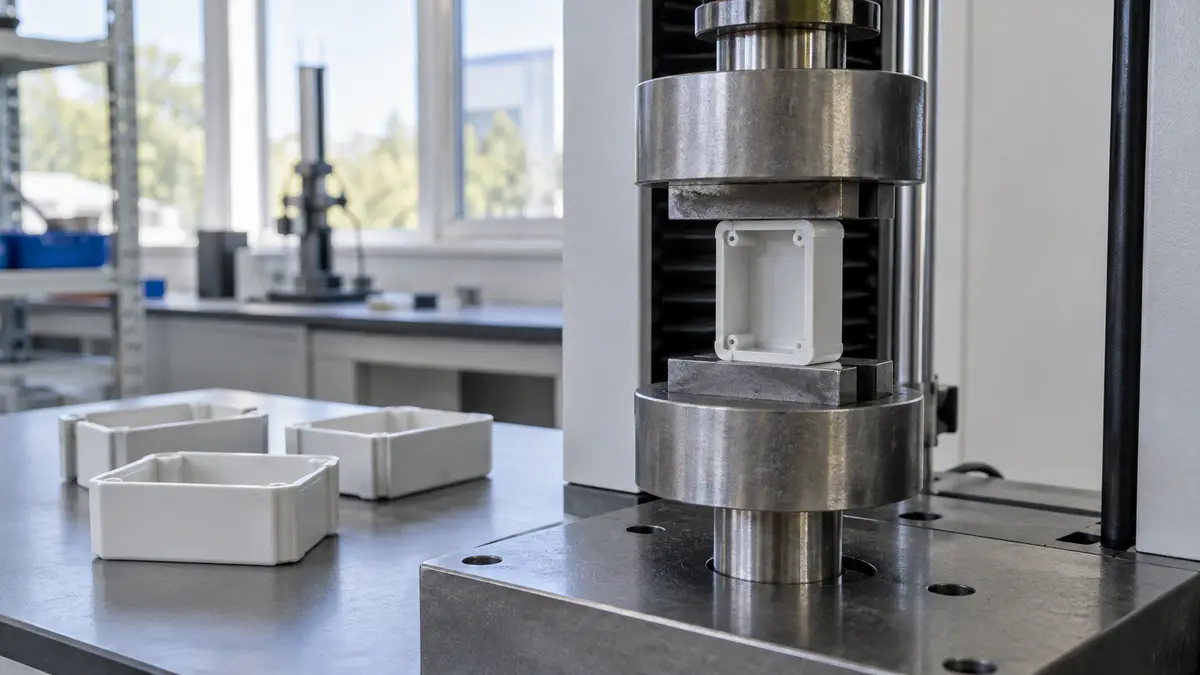
The deciding factors side by side
Start with the one factor that can overrule the rest: who has to accept the report. Ask your customer, retailer or marketplace to confirm in writing whether it requires a named laboratory, a laboratory in a particular country, or any laboratory accredited for the tests. Then weigh the practical factors in the table below.
If you plan development testing in China and final testing in the UK, write down what each stage must prove so you do not pay twice for the same result.
| Factor | Points to a laboratory in China | Points to a UK laboratory |
|---|---|---|
| Who must accept the report | Customer accepts the named laboratory or its accreditation | Customer names a UK laboratory or wants to meet it |
| Correcting a failure | Factory can send a corrected sample soon after a fix | Corrections are rare or the design is already stable |
| Sample transport | Samples are bulky, heavy or awkward to send by courier | Samples are small and carrier acceptance is simple |
| Witnessing and discussion | Your factory or agent will attend | You or your customer want to attend in person |
| Goods already in the UK | Goods are still in production | Stock has arrived and you need to test what landed |
Build a like-for-like cost comparison
Send both laboratories the same written brief: the product, each variant, the tests and methods, the report format and the number of samples. Then compare line by line: test fees per variant, sample quantity and who supplies them, collection and carriage, any customs formalities for samples sent to the UK (see customs relief for goods imported for testing), conditioning, a retest after failure, and a revised report. For toys already on sale, see our post-market toy sample testing guide. For food batches, see our guide to agreeing contaminant testing.
A quote for one variant against another laboratory's quote for the whole range is not a comparison. Nor is a quote without retest terms, because a failed first test is where the cost difference between the two routes usually opens up. Laboratory tests are third-party work: inspection and factory checks are normally included in our quote; anything complex enough to need a third party is charged separately, agreed in advance.
Time to a usable report, not laboratory turnaround
A laboratory's quoted turnaround usually starts when it accepts the sample, not when the factory finishes it. Ask each laboratory when it can take the sample, what starts its clock, and how long review and report issue take. Add collection, carriage and, for the UK, carrier acceptance and clearance. For the supplier's quote during this wait, see our guide to keeping a trial-order quote valid. For factory timing, see when production lead time starts.
Then add the failure path: how quickly the factory can make a corrected sample and get it to the laboratory, and whether the laboratory will retest only the failed items. For the dispatch steps, see sending inspection samples to a UK laboratory.
Accreditation at the actual testing site
Accreditation is the government's recommended way for a laboratory to demonstrate competence. In either country, ask for the current accreditation schedule and match each test, method and edition to it, and confirm the site that will do the work and whether any test will be subcontracted. A group name or logo on a quotation is not the testing site.
For a UK laboratory, follow checking laboratory accreditation. For either, check that the report will cover the variants you are ordering using checking report coverage. For upholstered furniture, see our guide to fire-test coverage of material combinations.
Working out your own order? Send us the product on WhatsApp and we reply the same working day: WhatsApp us
Common mistakes
Booking before the customer has accepted the laboratory; letting the factory commission the tests and losing access to the original report; testing a pre-production sample and treating the result as evidence for bulk; comparing quotes for different scopes; and leaving retest terms out of both quotes.
Agree before booking who commissions the work, who is named on the report and who receives the laboratory-issued original, and keep your own copy. Send Cambridge China Bridge your testing brief and your customer's acceptance conditions, and its staff in China can collect production samples and coordinate factory corrections; see testing and certification.
Frequently asked questions
Is product testing cheaper in China than in the UK?
Not as a rule. Compare quotes for the same brief, then add sample carriage, customs for samples, retest terms and report revisions. The retest after a failure is often where the difference appears.
Will my UK customer accept a Chinese laboratory report?
Ask the customer to approve the proposed laboratory, scope, methods and report format in writing before booking. Do not assume acceptance from the laboratory's name or location.
Should I repeat a Chinese test in the UK?
Only for a reason: customer acceptance, a changed product, missing coverage or a disputed result. Ask the proposed laboratory what existing evidence it can use first.
Can I get the original report if the factory books the testing?
Agree access before booking. Ask the laboratory what permission it needs to send you the complete report and verify it directly, and keep your own copy.