Buying a UV steriliser or ozone cleaner from China
Before buying, check how the device prevents UV or ozone exposure, whether independent tests support its exact disinfection claims, and what happens if a safety control fails. Match reports to the supplied model and home-use instructions. Cambridge China Bridge can coordinate factory checks with its own staff in China.
Define what the device is supposed to do
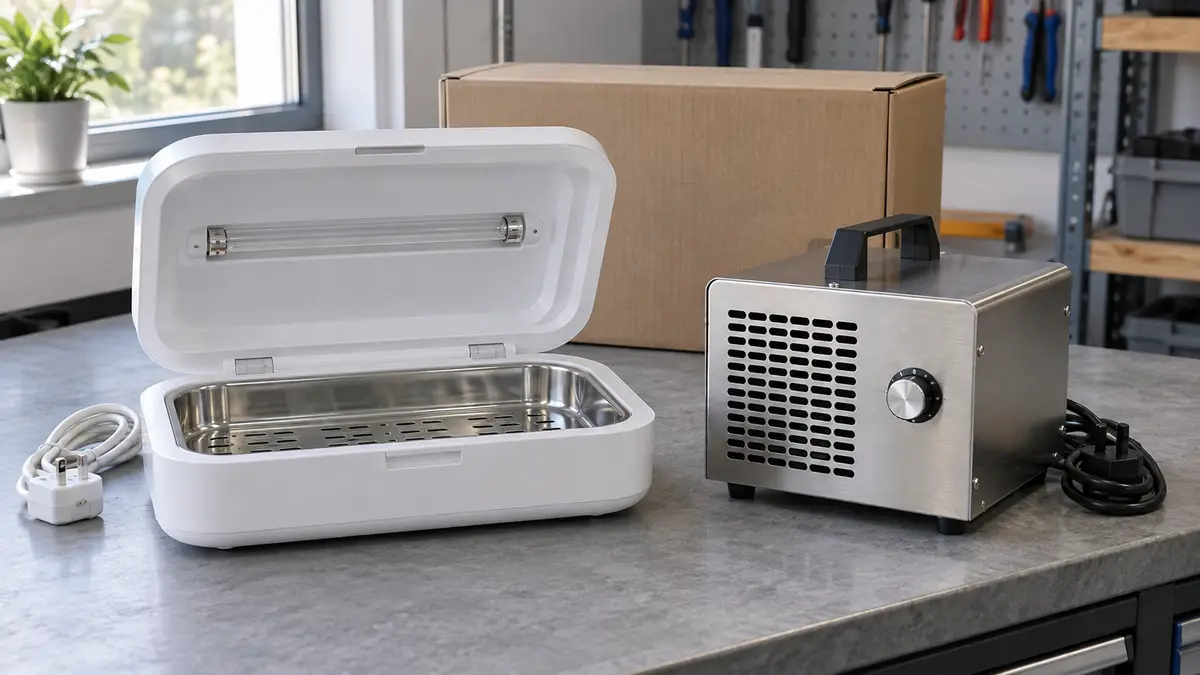
Ask whether the device treats surfaces, enclosed objects, air or water, and whether it deliberately generates ozone or could produce it during operation. Request the intended household setting, operating instructions and exclusions before ordering a sample. Do not use a room-treatment claim as evidence for treating drinking water, food or medical equipment.
Ask the supplier to define ‘cleaning’, ‘disinfection’ and ‘sterilisation’ in its claim. Request evidence for the actual outcome advertised. Removing an odour, lighting a lamp or completing a cycle does not establish microbial performance. For ozone generated for disinfection, ask a UK biocides specialist to review the intended use with HSE separately from the electrical paperwork.
Check exposure hazards before testing a sample
HSE identifies skin burns and painful eye injury among UV hazards. Do not shine a disinfection lamp onto people or pets, look into it or test its output on your skin. Ask for an independent optical safety assessment covering accessible radiation during normal use, foreseeable misuse and faults. Include children looking upwards beneath a handheld device.
HSE ozone guidance describes irritation and damage to the small airways of the lung. Ask for measured ozone emissions during treatment, leakage and residual ozone after the cycle. Do not judge safe re-entry by smell or accept a timer alone as proof. For a home, prefer a design that avoids deliberate ozone release into occupied rooms; reject unsupported claims that people or pets can remain present.
Demand efficacy evidence that matches home use
The OPSS home-use UV research report says virus inactivation depends critically on line-of-sight exposure. Ask how the proposed loading arrangement treats undersides, folds, overlapping objects and shaded surfaces. Request measured wavelength, irradiance at the treated surface and exposure duration. A lamp component report does not establish the performance of the finished appliance.
Request an independent laboratory report naming the exact model, tested organisms, test method, untreated controls, results and limitations. Match distance, loading, surface condition and operating cycle to the manual. For ozone, also ask about concentration, humidity, room conditions and clearance after treatment. Verify the report with the laboratory using our test report guide. Do not extend a result for a named organism to every pathogen or call it sterilisation without supporting evidence.
Specify protective features and fault behaviour
For an enclosed UV appliance, specify shielding and a lid or door interlock that stops hazardous emission when opened. Ask a competent tester to check leakage through seams and viewing panels, operation with a partly closed lid, sensor failure and behaviour after power returns. For handheld or open-room devices, ask how exposure is prevented when someone enters the beam. A warning label or supplied goggles should not be your only protection.
For ozone equipment, ask for evidence supporting containment, ozone removal, ventilation instructions and a measured clearance procedure before access. Request sensor calibration and replacement arrangements where sensors form part of the protection. Have a specialist assess failures of fans, sensors and ozone-removal components. Reject a design if its safe operation depends on household members reliably keeping an accessible room empty without effective controls.
Working out your own order? Send us the product on WhatsApp and we reply the same working day: WhatsApp us
Make the order conditional on the evidence
Use our electrical imports guide for the wider UK compliance checks. Request the exact model’s declaration, supporting reports and English instructions. CE or UKCA marking does not establish the advertised disinfection result. Keep optical exposure, ozone exposure and microbial efficacy as separate questions, with evidence for each.
Put the approved lamp, enclosure, safety controls, operating cycle and manual into the purchase specification. Require review before substitutions, then arrange production inspection against that specification. Factory inspection can check identity and operation, but laboratory work is needed to establish exposure and efficacy. Cambridge China Bridge’s staff in China can coordinate factory checks and arrange specialist testing through our testing and certification service.
Frequently asked questions
Is a CE-marked UV steriliser safe for home use?
Do not rely on the mark alone. Check the exact model’s supporting reports, accessible UV exposure, protective controls and instructions. Disinfection efficacy needs separate evidence.
Can I stay in a room while an ozone cleaner runs?
Do not stay based on a seller’s reassurance. Require independent evidence for the intended occupied use. For room treatment requiring evacuation, follow a validated clearance procedure before returning.
What test report should a UV steriliser supplier provide?
Ask for independent safety and microbial efficacy reports for the finished model. Results should identify organisms, loading, distance, exposure duration, controls and limitations matching the manual.
Does a UV box sterilise everything inside it?
Do not assume so. Ask for evidence covering the actual loading arrangement, including shaded and hidden surfaces. A result on an exposed test surface does not prove every item or surface is treated.