Buying Powered Gates from China: Installer Checks
Ask a competent UK gate installer to assess the actual driveway before ordering, specify protection for every trapping zone, and agree recorded safety tests, handover documents and maintenance. A factory demonstration cannot prove the installed gate is safe. Coordinate the China-side specification with Cambridge China Bridge.
Agree who takes responsibility before ordering
Give your installer the proposed gate drawings, actuator details, controller manual and safety-device wiring diagrams before paying a deposit. Ask whether the proposal is a complete gate system or components needing a site-specific design. For a gate powered on site, HSE identifies whoever coordinates or undertakes that work as the manufacturer. Agree who will assess the completed system and provide its conformity documents.
Get written confirmation that the installer can work with the proposed equipment, obtain replacement parts and carry out gate safety testing. Include any additional guarding, sensors and wiring in the purchase specification. Use our installation and commissioning guide to agree the wider installation and support arrangements.
Map hazards at the actual driveway
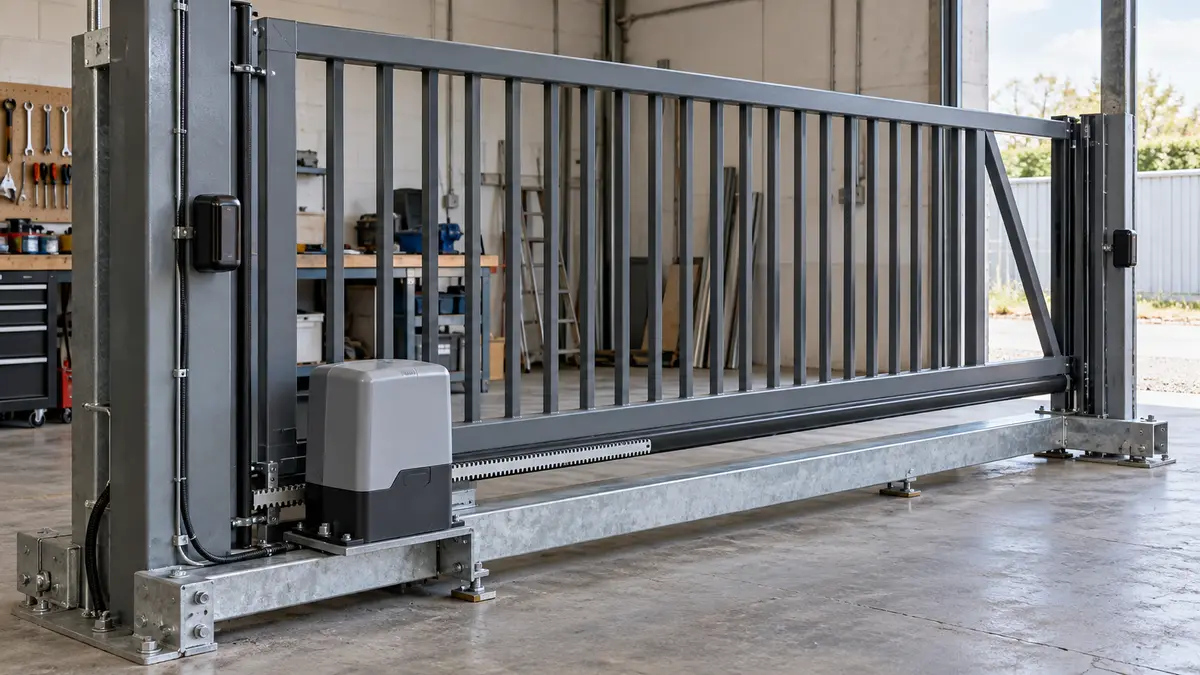
Ask the installer to mark hazards on a site drawing throughout opening and closing. Include closing edges, hinges, gaps against posts and walls, the swept area behind swing gates, sliding gates passing fences, exposed drives and places where fingers or heads could become trapped. Consider children, visitors and pedestrians approaching from either side, including when nobody is watching.
Check the existing gate structure, hinges, foundations, tracks, stops and protection against falling or derailment. Assess slopes, wind exposure, drainage and pedestrian routes. Record any alterations needed before choosing the motor and safety package. A factory video cannot show these conditions; our pre-payment guide covers the separate checks on the goods before shipment.
Specify protection for each hazard
Ask for a protection schedule linking each hazard to its control: removing the dangerous gap, guarding access, fitting pressure-sensitive edges or providing suitable presence detection. Do not accept motor force limitation or a vehicle photocell as the whole safety plan. Ask the installer to explain sensor coverage, blind spots and protection during opening as well as closing.
Have the installer confirm that edges, sensors and controller work together, including how faults are detected and what movement is allowed after a fault. Check cable protection and resistance to water ingress. Gates must have an emergency release mechanism for entrapment. Ask for a demonstration of isolation and release, with accessible keys and instructions, without using a person as a test obstruction.
Make commissioning evidence a handover condition
HSE says the installed gate needs safety checks during commissioning before handover, with a benchmark for later inspections. Ask for a dated report identifying the gate, site, assessor, controller settings and results. Include opening and closing checks, protective-device activation, safe fault responses, emergency release and any unresolved defects. Where force limitation is the safety strategy, HSE says details of specific force tests should be provided.
Ask for measured force-test results tied to test locations, the method and acceptance criteria used, and the measuring equipment. Do not accept a hand-push demonstration as your force-test evidence. Request the final risk assessment, relevant conformity declaration, English instructions, wiring diagrams and maintenance schedule. Our certification guide explains the separate role of product documents. Agree that unresolved safety defects prevent operational handover.
Working out your own order? Send us the product on WhatsApp and we reply the same working day: WhatsApp us
Plan maintenance before the gate enters service
Ask the installer to set a maintenance and safety-check schedule for the actual usage and environment, following the equipment instructions. Specify checks on hinges, tracks, fixings, guards, edges, sensors, cables, release arrangements and force limitation where used. Name who arranges servicing, keeps records and deals with faults. Keep commissioning results as the baseline for subsequent checks.
Arrange reassessment after changes to the gate, controller, settings, fencing or pedestrian route. Ask the installer to define when a fault means stopping use and isolating power, and how access will be managed safely meanwhile. Cambridge China Bridge can coordinate factory drawings, component details and shipment checks with your UK installer; the site assessment and commissioning evidence come from the completed installation.
Frequently asked questions
Can I fit a Chinese automation kit to my existing gates?
Ask a competent gate installer to assess the existing structure, movement and trapping points before buying. Agree the safety design and who takes responsibility for the completed powered gate.
Are photocells enough to make driveway gates safe?
Do not assume they are. Ask the installer to explain what each sensor detects, its blind spots and how hinges, opening edges and gaps against fixed structures are protected.
What evidence should I get when powered gates are commissioned?
Request a dated safety report, risk assessment, recorded settings, protective-device results, force-test evidence where force limitation is used, conformity documents, instructions and a maintenance schedule.
How often should automatic gates be serviced?
Ask the installer to set the schedule from the equipment instructions, usage and site conditions. Keep service and safety-test records, and arrange review after faults or changes.