Sourcing vacuum flasks and insulated tumblers
Vacuum flasks, insulated bottles and vacuum tumblers from China pay 0% UK duty, with no anti-dumping duty. They are food contact articles, so the factory must show the steel, lid plastics and seals are suitable for food, and the heat retention claim on the box must be tested. Cambridge China Bridge sources own-brand and promotional flasks.
Buying from China for a business? How our UK China sourcing agent service works · China sourcing agent for small orders and first imports
Zero duty
Read from the UK Trade Tariff on 25 September 2026, vacuum flasks and other vacuum vessels, complete, and their parts other than glass inners carried 0% duty on goods from China, with no anti-dumping measure.
A single-walled bottle or cup is not a vacuum vessel and classifies under its material, so confirm the commodity code; the reusable cup guide covers cups.
| Goods | Commodity code | Duty | Anti-dumping duty on China |
|---|---|---|---|
| Vacuum flasks and other vacuum vessels, complete, and parts other than glass inners | 9617 00 00 00 | 0% | None |
Food contact
Anything that holds a drink is a food contact material and must not transfer its constituents to the drink in quantities that could endanger health. Ask for the stainless steel grade for the inner wall, the plastics and silicone used in the lid and seals, and migration test reports for the finished product; the food contact materials guide sets out the documents.
Ask too how the vacuum is sealed at the base, and whether any solder or getter material is used, so the construction is part of the food contact evidence.
Heat retention and leak claims
Hours hot and hours cold are the claims customers test. Ask the factory for the test method, starting temperature and ambient conditions behind each figure, and repeat the test on production samples. Leak-proof lids need a leak test in several positions. For airpots, see our guide to sourcing vacuum beverage airpots.
Check coatings for chipping and printed or laser-engraved logos for adhesion and position at inspection.
Worked duty example
For a made-up shipment of 10,000 500 ml stainless steel vacuum flasks under 9617 00 00 00, add the £2,500 of freight and insurance to the £32,000 free-on-board price and customs sees £34,500. Duty on vacuum flasks is zero, leaving import VAT of £6,900, 20% of the customs value. For a VAT-registered buyer that is a cash-flow cost rather than a lasting one. The duty and VAT guide walks through the calculation.
Inspection checklist
Heat retention and construction: flasks tested by the method of BS EN 12546-1 for vacuum ware and insulated flasks, filled with near-boiling water and measured after the hours printed on the box, the outer wall checked by hand and thermometer for hot spots that mean a lost vacuum, and a sample of each batch cut open to check wall thickness and weld quality.
Food contact: the inner steel grade confirmed as the one ordered, such as 1.4301 or 1.4404 under BS EN 10088, by certificate and a handheld XRF check, overall and specific migration tested on lids and seals under retained Regulation (EU) No 10/2011, and the base checked so any solder or getter used to seal the vacuum is covered and not exposed.
Lids and finish: lids leak-tested full, upside down and on their side, threads checked for cross-threading, coated flasks put through dishwasher cycles by the method of BS EN 12875-1 where dishwasher-safe is claimed, and coating adhesion, laser marks and printed logos checked against the approved sample.
Working out your own order? Send us the product on WhatsApp and we reply the same working day: WhatsApp us
What goes wrong
Flasks fail on the vacuum, the lid and the coating. Poor welds or a failed seal let the vacuum go, so the outer wall gets hot and the heat retention claim collapses, and some flasks are sealed with a solder dot on the base that can contain lead, which must never be exposed. Lids leak when tilted, silicone seals taint drinks, powder coating chips and flakes, and dishwasher-safe claims are made for coatings that fade after a few washes.
Fill samples with boiling water and measure temperature after the claimed hours against the factory method, check the outer wall stays cool, leak-test lids upside down and on their side, ask what seals the vacuum and confirm no lead-containing material is exposed, get migration test reports for the steel, lid plastics and seals, and run dishwasher cycles on coated samples.
Branding and minimums
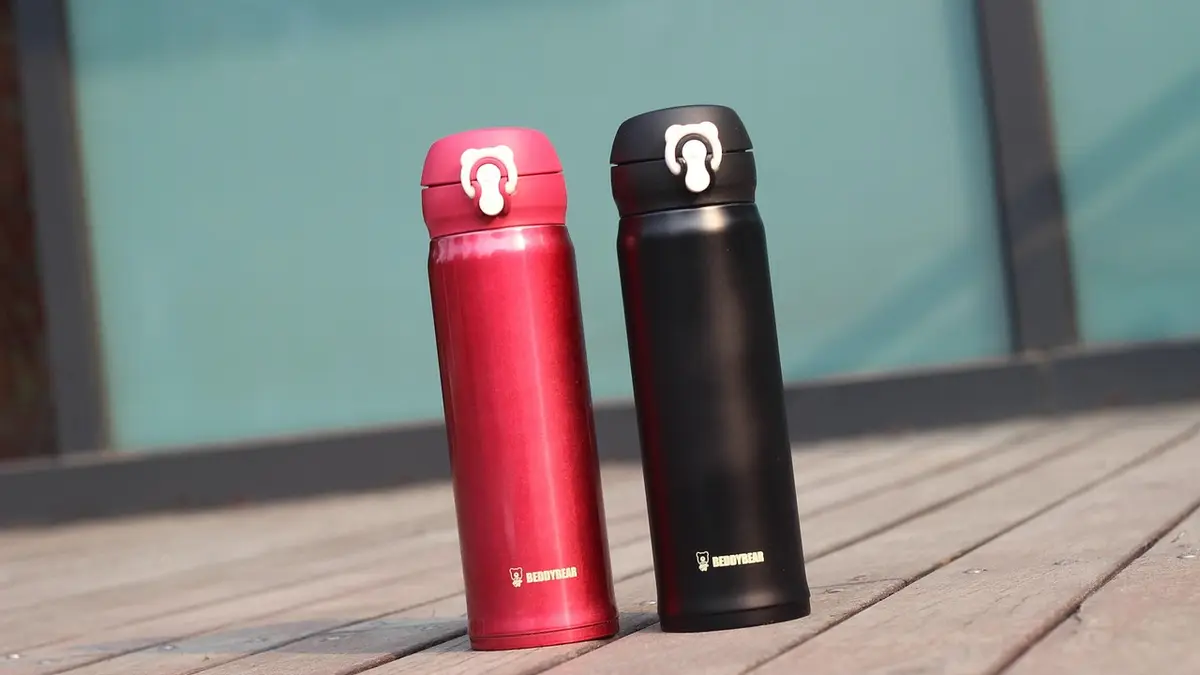
Flasks are popular branded gifts: powder coating in Pantone colours, laser engraving, and printed packaging. Minimums are set per colour and decoration; stock bodies decorated to order go lower. For other branded gifts, see our pens and markers sourcing guide.
Cambridge China Bridge sources own-brand and promotional flasks and tumblers, with food contact evidence, heat retention tests and decoration approved before production. See how our sourcing service works. For the reverse trade, see exporting UK vacuum flasks to China.
Frequently asked questions
What is the UK import duty on vacuum flasks from China?
Read from the UK Trade Tariff on 25 September 2026, vacuum flasks and vacuum vessels carried 0% duty from China, with no anti-dumping duty.
What food contact evidence should a flask factory give?
The stainless steel grade, the lid and seal materials, and migration test reports on the finished product.
How do I check heat retention claims?
Ask for the test method, starting temperature and ambient conditions behind each figure, and repeat the test on production samples.
Can flasks be branded in small quantities?
Stock bodies decorated to order allow lower minimums; custom colours and shapes raise them.