Sourcing USB charging cables from China
Relevant USB charging cable classifications carry 0% or 2% UK duty from China; the telecommunications rate depends on the actual cable. Confirm applicable hazardous-substance and product safety requirements with the relevant authority, including for low-voltage designs. Cambridge China Bridge sources USB charging cables.
Buying from China for a business? How our UK China sourcing agent service works · China sourcing agent for small orders and first imports
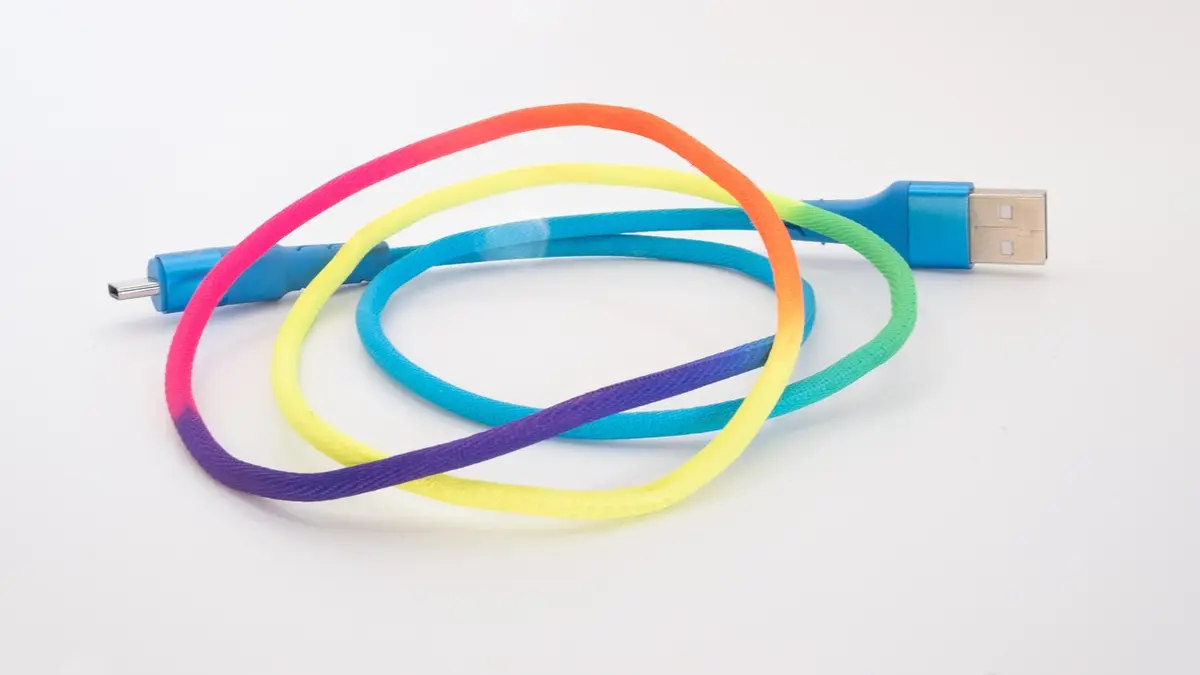
USB cable duty depends on function and construction
Read from the UK Trade Tariff on 4 December 2026, heading 8544 covers insulated electrical conductors, including cables fitted with connectors. Check 8544 42 90 90 for charge-only leads and whether 8544 42 10 00 applies to a telecommunications cable. A USB connector alone does not settle classification. The table includes loose cable for assembly; those rows describe inputs rather than finished charging leads.
The selected lines carry 0% or 2% duty for goods from China, with no anti-dumping or countervailing duty or attached import controls recorded. The suspensions on 8544 42 90 90 concern a specifically described cable and offshore wind cable manufacture under authorised use. Do not assume ordinary USB charging cables qualify. The other selected lines have no suspension.
Confirm the commodity code with your broker using the connector drawing, rated voltage, wiring diagram and evidence of charging and data functions. For the wider heading, see the HDMI cable guide. The import duty and VAT guide explains import tax calculations.
| Goods | Commodity code | Duty | Anti-dumping or countervailing duty on China |
|---|---|---|---|
| Other cables with connectors: candidate for charge-only USB leads | 8544 42 90 90 | 2% | None |
| Telecommunications cables with connectors: check charging-and-data leads | 8544 42 10 00 | 0% | None |
| Other cable without connectors, up to 80 V: cable assembly input | 8544 49 93 90 | 2% | None |
| Telecommunications cable without connectors, up to 80 V: assembly input | 8544 49 20 00 | 0% | None |
Specify charging behaviour, connectors and conductors
Specify the connector combination, usable length and tolerance, conductor material and cross-section, sheath compound, strain relief and connector-shell construction. State whether the cable is charge-only or also carries data. For USB-C cables, define the supported charging behaviour, current and power claims, and any electronic identification needed by the agreed design. Keep an approved sample and a wiring diagram.
Agree tests using the intended charger and device combinations. Record delivered charging performance, voltage drop and connector heating under the agreed load. Test data transfer separately when advertised. A cable that charges a phone during a brief demonstration has not demonstrated every charging or data claim.
Confirm with the relevant authority which hazardous-substance and product safety rules apply to the cable, including low-voltage designs. Where the hazardous-substance rules apply, obtain the required declaration of conformity and request material evidence matching the actual sheath, solder and connector plating. Use testing and certification support to review the exact design and documents.
The Environment Agency treats accessories that function with different products as electrical equipment, so assess separately sold charging cables on that basis. Confirm the reporting category with your regulator or compliance scheme. Where your business is a producer, annual producer registration is required.
Worked duty example
Illustrative example, not a quote: 5,000 USB charging cables; illustrative order only under 8544 42 90 90, invoiced at £16,000 free on board, with £1,100 of freight and insurance to the UK. The customs value is £17,100. Duty at 2% is £342. Import VAT at 20% is charged on the customs value plus duty, £17,442, so it is £3,488.40. Import taxes total £3,830.40; a VAT-registered importer can usually reclaim the VAT, so the lasting cost is the £342 of duty. The import duty and VAT guide explains each step.
Inspection checklist
Construction: compare length, conductor material, strand construction and sheath against the approved sample. Open samples to inspect soldering, insulation and strain relief.
Connectors: check fit in the intended devices, contact alignment, shell security and cable retention. Flex the cable near each connector while monitoring continuity.
Performance: check wiring, continuity and short circuits, then measure voltage drop and heating under the agreed charging load. Verify advertised data transfer and electronic identification where specified.
Arrival: check crushed connectors, split mouldings, corrosion, mixed connector combinations, labels and batch identification. Repeat the agreed functional sampling checks on receipt; the inspection guide explains the inspection stages.
Working out your own order? Send us the product on WhatsApp and we reply the same working day: WhatsApp us
What goes wrong
A thick braided cover can conceal undersized conductors. Weak solder joints, poor contact pressure and ineffective strain relief can cause intermittent charging or local heating. A cable may charge successfully while failing its advertised data function or charging performance.
Do not accept changes to conductor material, connector construction or internal electronics without reviewing the sample and test evidence again. Keep the approved construction, packaging claims and supporting documents together so repeat orders can be checked against the same specification.
Cambridge China Bridge sources these products for UK businesses, checking the factory and the documents before shipment. See factory verification. For components and parts, see sourcing for manufacturers.
Frequently asked questions
What is the UK import duty on USB charging cables from China?
The relevant candidate lines carry 0% or 2%. Check the telecommunications classification against the other connector-fitted cable line. No anti-dumping or countervailing duty is recorded for the selected lines.
Does a low-voltage USB cable avoid product safety rules?
Do not assume low-voltage operation settles compliance. Confirm applicable product safety and hazardous-substance requirements with the relevant authority. Where the substance rules apply, obtain the required declaration of conformity.
How do I check a USB cable's fast-charging claim?
Agree the intended charger and device combinations, supported charging behaviour and acceptance criteria. Test charging performance, voltage drop and connector heating under load, including electronic identification where specified.
Is a continuity test enough for USB charging cables?
No. Continuity does not establish charging performance, resistance to heating, joint durability or data capability. Check construction and test the complete cable against its agreed charging and data claims.