Sourcing puncture-resistant midsoles from China
Puncture-resistant footwear midsoles from China carry 0% UK duty across the selected footwear-part lines. Separately sold components may need individual conformity assessment and marking, so confirm the product's regulatory scope before sale. Cambridge China Bridge sources puncture-resistant footwear midsoles.
Buying from China for a business? How our UK China sourcing agent service works · China sourcing agent for small orders and first imports
Midsole duty and material controls
Heading 6406 covers footwear parts and removable insoles. Read from the UK Trade Tariff on 1 October 2026, all selected lines carried 0% duty for goods from China, with no listed anti-dumping or countervailing duty and no listed suspensions. The table gives candidate lines for fixed midsoles and removable protective inserts; it does not determine the classification of a particular construction.
The selected lines attach CITES import and export controls, cat-and-dog-fur import and export controls, and seal-product import controls. For goods from China containing listed animal materials, confirm the relevant CITES permits with your broker. Cat and dog fur and products containing it cannot be imported. Seal products brought into Great Britain for trade must have a seal catch certificate; confirm with the relevant authority or your customs broker which exemptions and sale conditions apply. Check applicability against the actual materials.
Send your broker the material breakdown, drawings, photographs, manufacturing method and whether the insert is fixed or removable to confirm the commodity code. Describe any attached footwear components. For the wider heading, see shoe soles, uppers and insoles. The import duty and VAT guide explains the calculation.
| Goods | Commodity code | Duty | Anti-dumping or countervailing duty on China |
|---|---|---|---|
| Other footwear parts, hand-made; candidate line for fixed midsoles | 6406 90 90 20 | 0% | None |
| Other footwear parts; candidate line for fixed midsoles | 6406 90 90 90 | 0% | None |
| Hand-made removable insoles and accessories; candidate line for removable inserts | 6406 90 50 10 | 0% | None |
| Other removable insoles and accessories; candidate line for removable inserts | 6406 90 50 90 | 0% | None |
Specify the barrier and its footwear assembly
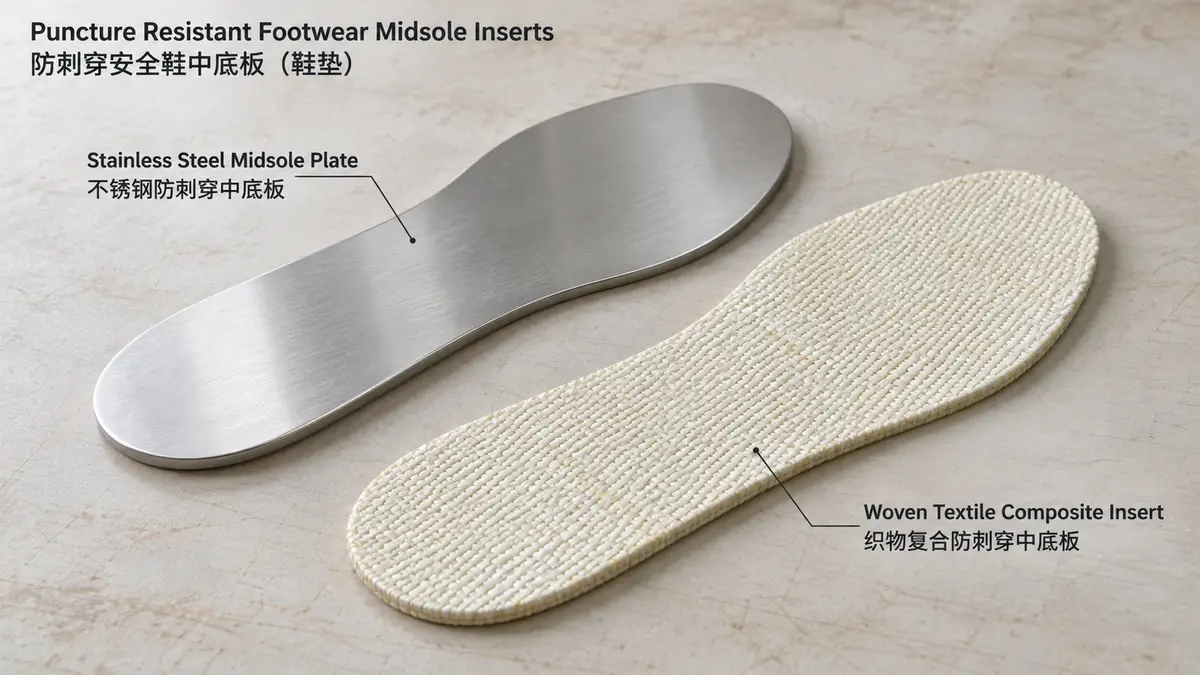
State whether the barrier is steel or textile composite, its thickness, outline, flexibility, edge finish and intended position within the shoe. For textile constructions, record the fabric, layer arrangement, resin and permitted cutting method. Approve drawings across the size run, including toe and heel coverage, and identify the shoe construction in which performance will be checked.
Agree the puncture-test method, test probe, conditioning and acceptance criteria with the laboratory. Ask for reports identifying the actual material and construction, then test representative production samples and the intended footwear assembly. Arrange this through testing and certification. A report for a different barrier material or shoe construction should not be accepted as evidence for your order.
Ask a compliance adviser to distinguish components supplied for shoe manufacture from protective inserts sold separately. Separately supplied components may need individual conformity assessment and marking. Confirm the applicable route before selling them in Great Britain, and agree who supplies the supporting documents.
Worked duty example
Illustrative example, not a quote: Illustrative mixed-size trial order of fixed puncture-resistant midsoles; values are illustrative, not a quotation under 6406 90 90 90, invoiced at £3,000 free on board, with £135 of freight and insurance to the UK. The customs value is £3,135. Duty at 0% is £0. Import VAT at 20% is charged on the customs value plus duty, £3,135, so it is £627. With no duty, the only import tax is the VAT, which a VAT-registered importer can usually reclaim. The import duty and VAT guide explains each step.
Inspection checklist
Dimensions: compare length, width, outline and thickness with approved drawings across the size run; check left and right parts and the intended protective coverage.
Barrier: inspect steel for burrs, corrosion and permanent distortion; inspect textile composites for frayed edges, wrinkles, separated layers and exposed reinforcement.
Assembly: trial the parts with the intended last, sole, primer and adhesive; check positioning, bonding and movement after flexing.
Batch evidence: match material identification and production batches to the agreed test reports; check size allocation, dry packaging and damage on arrival.
Working out your own order? Send us the product on WhatsApp and we reply the same working day: WhatsApp us
What goes wrong
A midsole can fit the shoe while leaving an unintended gap around the protective barrier. Poor grading, reversed parts or trimming during assembly can change coverage. Steel burrs can damage adjacent materials, while textile layers can separate or wrinkle. Approve the cutting pattern and assembly process together.
Material substitution can leave a report describing a different construction from the delivered batch. An insert can also shift or bond poorly in the intended shoe. Hold affected stock while you compare it with approved samples and arrange the agreed checks. Use the quality inspection guide to record defects and batch details.
Cambridge China Bridge sources these products for UK businesses, checking the factory and the documents before shipment. See factory verification. For own-brand ranges, see sourcing for brands.
Frequently asked questions
What is the UK import duty on puncture-resistant midsoles from China?
The selected heading 6406 lines carried 0% duty on 1 October 2026, with no listed anti-dumping or countervailing duty or suspensions. Confirm the code for the actual construction.
Are fixed midsoles and removable protective inserts classified alike?
Do not assume they share a code. The tariff separates removable insoles and accessories from other footwear parts. Give your broker drawings, materials and the intended method of fitting.
Do puncture-resistant inserts need conformity assessment?
Ask a compliance adviser to confirm the scope and route for the actual insert and intended sale.
How do I check a supplier's puncture-resistance report?
Match the report to the barrier material, layer construction, sample identity and test method. Agree production testing and checks in the intended footwear assembly before accepting the batch.