Sourcing prosthetic socket liners from China
Buy the liner and suspension interface as one specification: a matching size label does not prove fit or lock compatibility. Require model-specific sizing, finished-material biological evaluation and sample approval by the receiving prosthetist. For a UK reseller, budget 20% import VAT even where the confirmed prosthesis-parts tariff attracts 0% duty.
Buying from China for a business? How our UK China sourcing agent service works · China sourcing agent for small orders and first imports
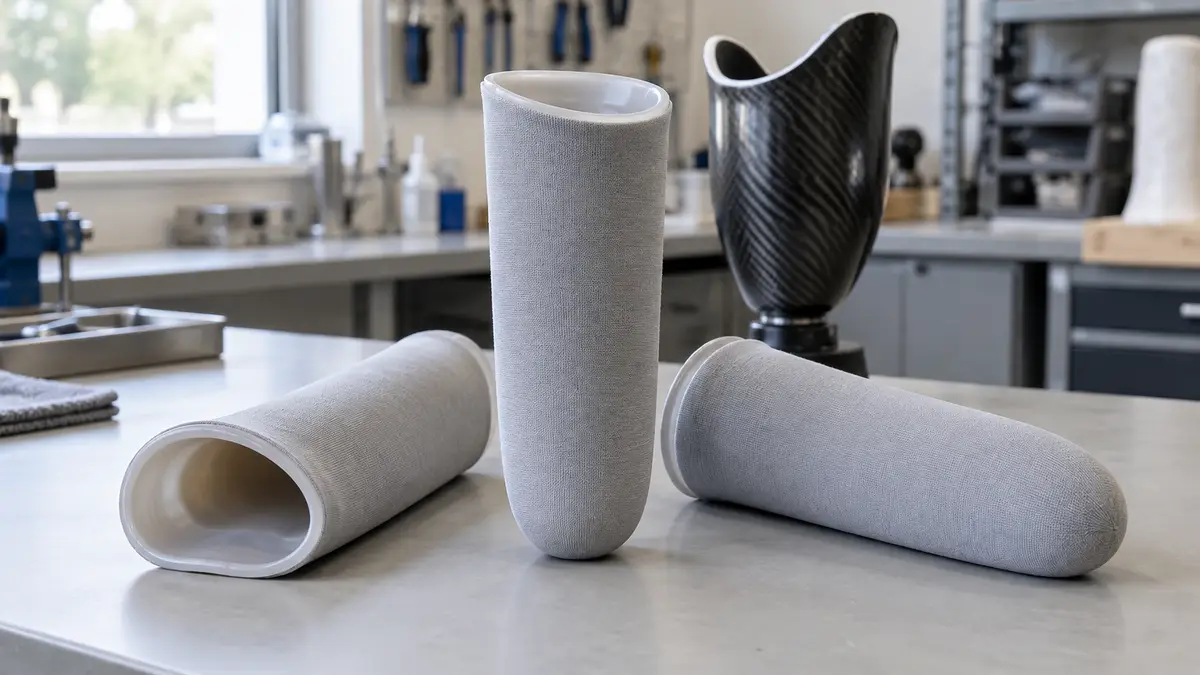
Where to find relevant Chinese suppliers
Shijiazhuang is a documented starting point for supplier research. Shijiazhuang Wonderfu Rehabilitation Device Technology describes its business as prosthetic and orthotic production and sales. The Chinese online exhibition directory of Care & Rehabilitation Expo China lists 石家庄万德福康复器具科技有限公司 and its 凝胶套, categorised as prosthetic accessories. These are sourcing leads, rather than evidence that a particular factory or liner is approved for your order.
The relevant specialist fair is 中国国际福祉博览会暨中国国际康复博览会, known in English as Care & Rehabilitation Expo China. Its official site names Beijing’s China National Convention Center as the venue. Use the exhibitor directory to arrange meetings about liner moulding, textile covering, distal attachments and material traceability; confirm the current event arrangements before travelling.
Ask each candidate which processes it performs itself and which are subcontracted. Request a production walkthrough for the proposed liner, rather than accepting photographs of unrelated prosthetic components. When buying a complete assembly, use the prosthetic limbs guide alongside this liner specification.
A size label is not a purchasing specification
State whether you need a cushion liner, a pin-lock liner or a sealing liner. ALPS’ instructions distinguish cushion and locking versions, describe the distal pin connection, and require an expulsion valve for its UltraSeal sealing liner. Treat these as examples of distinct interfaces: obtain compatibility confirmation for the actual liner, lock, valve and socket you intend to supply.
Specify the measurement position as well as the circumference. For example, ALPS’ LSL/LSC size chart measures circumference 60 millimetres above the residual-limb end. That is a rule for those models, not a universal measurement method for every Chinese liner. Ask the supplier to supply its own illustrated sizing instructions and explain how its size labels relate to measured circumference.
Record material formulation, textile construction, liner length, wall-thickness profile, distal shape and attachment details in the product specification. The fair’s Wonderfu gel-liner listing offers 3- and 6-millimetre thicknesses; specify where thickness is measured rather than ordering simply by a nominal thickness.
Keep an approved reference sample for every ordered construction. Ask the receiving prosthetist to assess the sample with the intended system before authorising production. Agree acceptance criteria with that professional and the manufacturer; do not invent a universal pull-force limit or fit tolerance.
Inspect the failures that matter for a liner
Material integrity: inspect the skin-contact surface and trim edge for folds, holes, tears and inclusions. ALPS’ instructions identify creases, holes and damage as reasons to stop using the liner and consult a prosthetist. Photograph defects with the model, size and batch identification.
Pin suspension: check pin alignment, the distal connection and engagement with the agreed lock. ALPS warns about the pin unscrewing from the distal end. Require the supplied manufacturer’s assembly instructions and retention method; do not transfer another brand’s adhesive instructions to an untested design.
Sealing suspension: have the technical assessor check the seal and valve with the intended socket. A liner-only examination cannot establish that the assembled system seals correctly. Record the agreed system test and its result.
Stretch and covering: compare longitudinal and circumferential stretch with the approved sample, then inspect textile bonding after the agreed cleaning procedure. The Wonderfu listing specifically distinguishes limited longitudinal elasticity from transverse elasticity, so a generic claim of ‘stretchy gel’ is insufficient.
Cleaning and packaging: obtain model-specific care instructions and check that packaging protects the liner from permanent creases. ALPS warns that soap residue can cause rash or irritation and that prolonged flat storage can produce creases. These are reasons to examine instructions and packaging, rather than promise that ‘medical-grade silicone’ prevents skin reactions.
Put these checks into the quality inspection brief. Separate visible-defect inspection from functional testing and clinical fit approval.
Request standards evidence for the actual construction
ISO 22523:2006 covers requirements and test methods for external limb prostheses and orthoses, including strength, materials, risk and information for use. Ask the manufacturer to explain which requirements apply to the liner and its interfaces, and provide the corresponding evidence.
ISO 10993-1:2025 addresses biological safety evaluation within a risk-management process. For this skin-contact product, request an evaluation identifying the finished liner’s formulation, manufacturing process, contact conditions and intended exposure duration. Ask a competent evaluator to justify the supporting tests and any reliance on existing material data.
A report for raw silicone alone should prompt questions about the finished product, including colourants, processing residues and any skin-contact coating. Require a documented assessment before approving changes to formulation, fabric, bonding or production process. These standards are evidence frameworks; listing their numbers does not itself establish UK market compliance.
Use Cambridge China Bridge’s testing and certification service to define the evidence required for the proposed construction before commissioning tests.
Settle the Great Britain medical-device route
For Great Britain, the governing instrument is the Medical Devices Regulations 2002, SI 2002/618, as amended. Its current revised contents remain available on the UK legislation website; it is not shown as wholly revoked. MHRA guidance requires the applicable product marking and conformity assessment, registration before market placement, and a UK responsible person for a manufacturer based outside the UK.
Before ordering, obtain a model-specific declaration of conformity, the manufacturer’s classification rationale, the applicable UKCA or accepted CE route, UK responsible person details and registration evidence. Establish who handles technical-document requests and complaints.
Ask which legal route supports any CE marking; do not accept a logo or generic certificate as the answer. MHRA distinguishes the Great Britain and Northern Ireland regimes, so confirm the destination before treating a Great Britain compliance review as sufficient.
Working out your own order? Send us the product on WhatsApp and we reply the same working day: WhatsApp us
Duty and VAT: a reseller import is not automatically relieved
The tariff line below is a candidate for a finished liner classified as a dedicated artificial-limb component. It is not a liner-specific ruling. Give your broker the intended purpose, composition, construction and suspension details and confirm the commodity code before shipment.
The UK Trade Tariff page for 9021399000, checked on 10 October 2026 with China selected, shows 0% third-country duty and no applicable anti-dumping measure. Its description sits under ‘Other artificial parts of the body’. Recheck the measures for the declaration date.
HMRC’s VAT Notice 701/7 distinguishes eligible disability-related supplies from imports by a supplier. Artificial limbs and qualifying dedicated parts can fall within the relief, but section 8.1 states that importing goods as a supplier does not qualify for relief in that way. For an ordinary commercial reseller import without another applicable relief, use the tariff’s 20% standard VAT rate.
Hypothetical example, not a quotation: assume classification under 9021399000 is confirmed. Goods cost £10,000, with £900 freight and insurance to the UK border, giving a customs value of £10,900. Duty is £10,900 × 0% = £0. Assume a further £200 of delivery and incidental costs to the documented UK destination, with no other valuation additions. The import VAT value is £10,900 + £0 + £200 = £11,100; VAT at 20% is £2,220. Total duty plus import VAT is £2,220.
The £200 matters because HMRC requires relevant destination costs to be included in the VAT value. The UK import duty and VAT guide explains the wider calculation; assess any relief separately from tariff classification.
Related help: how we verify factories and inspect orders and support for manufacturers.
| Goods | Commodity code | Duty | Anti-dumping duty on China |
|---|---|---|---|
| Dedicated artificial-limb liner, if confirmed under other artificial body parts | 9021399000 | 0% | None shown |
Frequently asked questions
Can I reorder using the same size number from another brand?
Do not approve substitution by label alone. Compare each manufacturer’s measurement position, size chart, thickness profile and suspension interface, then have the proposed sample assessed with the intended system.
Does ‘medical-grade silicone’ replace biological evaluation?
Request evidence addressing the finished liner and its intended skin contact. Ask the evaluator how material data, processing and any additives support the biological safety assessment.
Does disability VAT relief make a reseller’s import VAT-free?
HMRC’s VAT Notice 701/7 says a supplier’s import does not qualify for relief in that way. The worked commercial reseller example therefore uses 20% import VAT; any separate relief needs its own assessment.
Is the listed Shijiazhuang supplier a recommendation?
It is a documented product and manufacturing lead. Obtain evidence for the actual production site, liner model and material construction before approving it for your order.
Sources
- UK Trade Tariff: 9021399000, China selected
- Care & Rehabilitation Expo China: Wonderfu gel-liner listing
- Wonderfu: manufacturer’s description and location
- ALPS: silicone liner construction and sizing chart
- ALPS: silicone liner instructions
- ISO 22523:2006: external limb prostheses and orthoses
- ISO 10993-1:2025: biological safety evaluation
- Medical Devices Regulations 2002: revised contents
- MHRA: regulating medical devices in the UK
- HMRC VAT Notice 701/7: disability relief and supplier imports
- HMRC: calculating the import VAT value